

Key Takeaways
- Open shelving suits those who maintain consistent tidiness and enjoy displaying curated items.
- Closed storage hides clutter, reduces dust accumulation, and works better for high-traffic or busy households.
- Most spaces benefit from a hybrid approach — open for display, closed for everyday essentials.
- Your household habits matter more than aesthetics when choosing a storage style.
- Room function, dust levels, and available wall space should all inform your decision.
Our Verdict
Neither open shelving nor closed storage is universally superior — the right choice depends on how a room is used, who lives in the home, and how consistently items get put back in place. Open shelving rewards discipline and adds visual depth; closed storage offers flexibility and forgiveness for everyday mess.
| Best for | Recommended |
|---|---|
| Households that maintain consistent organization habits | Open Shelving |
| Busy families or high-traffic rooms prone to clutter | Closed Storage |
| Most real-world kitchens, living rooms, and home offices | Hybrid Approach |
| Small rooms where visual weight and flexibility are priorities | Closed Storage with selective open display |
Why This Decision Is More Practical Than Aesthetic
Open shelving has dominated interior design inspiration for years — airy, accessible, and photogenic. But the gap between a styled shelf in a magazine and the same shelf six weeks into daily life can be significant. Choosing between open and closed storage is ultimately a question about how you actually live, not just how you want your home to look.
Both approaches have genuine strengths. Closed cabinets and covered storage conceal the inevitable accumulation of everyday items, require less frequent cleaning, and offer flexibility — you can store mismatched or utilitarian objects without them affecting the room's appearance. Open shelving creates visual lightness, keeps frequently used items visible and easy to grab, and can showcase objects you genuinely want to display.
The challenge is that most people choose based on aesthetics and then struggle to maintain the result. Understanding the practical tradeoffs first makes the decision easier and the outcome more sustainable. For related guidance on how storage choices interact with room appearance, see how paint finishes affect light and space.
| Open Shelving | Closed Storage | |
|---|---|---|
| Dust and maintenance | Requires frequent wiping | Protects contents, less frequent cleaning |
| Visual impact | Airy, decorative, displays items | Cleaner look, hides clutter |
| Accessibility | Items visible and immediately reachable | Requires opening doors or drawers |
| Forgiveness for mess | Low — disorder is visible | High — imperfect organization is hidden |
| Best content types | Curated, uniform, decorative items | Functional, mismatched, or bulky items |
| Maintenance habit required | High — consistent tidiness needed | Moderate — internal systems help most |
The Case for Open Shelving
Open shelving works well when the items being stored are worth seeing. Uniform dishware, a curated book collection, or a row of labeled pantry jars can all add warmth and personality to a room. The items themselves become part of the décor.
Accessibility is another genuine advantage. When items are visible at a glance, there's no need to open doors or dig through stacked containers. This matters in a kitchen where a cook reaches for the same bowls and pans repeatedly, or in a home office where reference materials need to stay within easy reach.
Curate Before You Display
Before committing to open shelving in any room, edit down the items you plan to store there by at least half. Open shelves look intentional when they hold fewer, well-chosen objects with some breathing room between them. Crowded open shelves tend to read as clutter regardless of how organized the individual items are.
The limitation is exposure. Dust settles on open shelves continuously, meaning items need regular wiping down — not just occasional cleaning. In kitchens especially, grease and cooking particles accumulate on dishes and surfaces over time. For open shelving to remain functional and attractive, everything on it needs to earn its place and be used or cleaned regularly. Adding more storage doesn't always solve disorganization — and open shelves can become visual clutter if filled without restraint.
The Case for Closed Storage
Closed storage — cabinets, drawers, wardrobes, lidded bins — is fundamentally forgiving. It accommodates the reality that most households accumulate a mix of attractive and purely functional items, and it protects contents from dust, light, and visual noise. A cabinet door closed on a jumble of Tupperware lids is still a clean surface from across the room.
This matters particularly in shared households. When multiple people use the same space with different tidiness standards, closed storage creates a built-in buffer. Everyone can put things away adequately without needing to maintain a display-ready appearance. For more on navigating differing standards in shared spaces, see organizing a home when tidiness means different things to different people.
The tradeoff is that closed storage can become a black hole for disorganization. Without internal systems — dividers, labels, consistent categories — things go in but don't come out efficiently. Paired with smart internal organization, like the drawer-sorting methods covered in managing kitchen drawer chaos, closed storage performs at its best.
Closed Storage Can Hide Disorganization
Closed cabinets and drawers make a room look tidy, but they don't create organization on their own. Without internal dividers, labels, or consistent categories, items become difficult to locate and the space fills up faster than expected. Plan the interior of closed storage before installing it, not after.
Making a Hybrid Approach Work
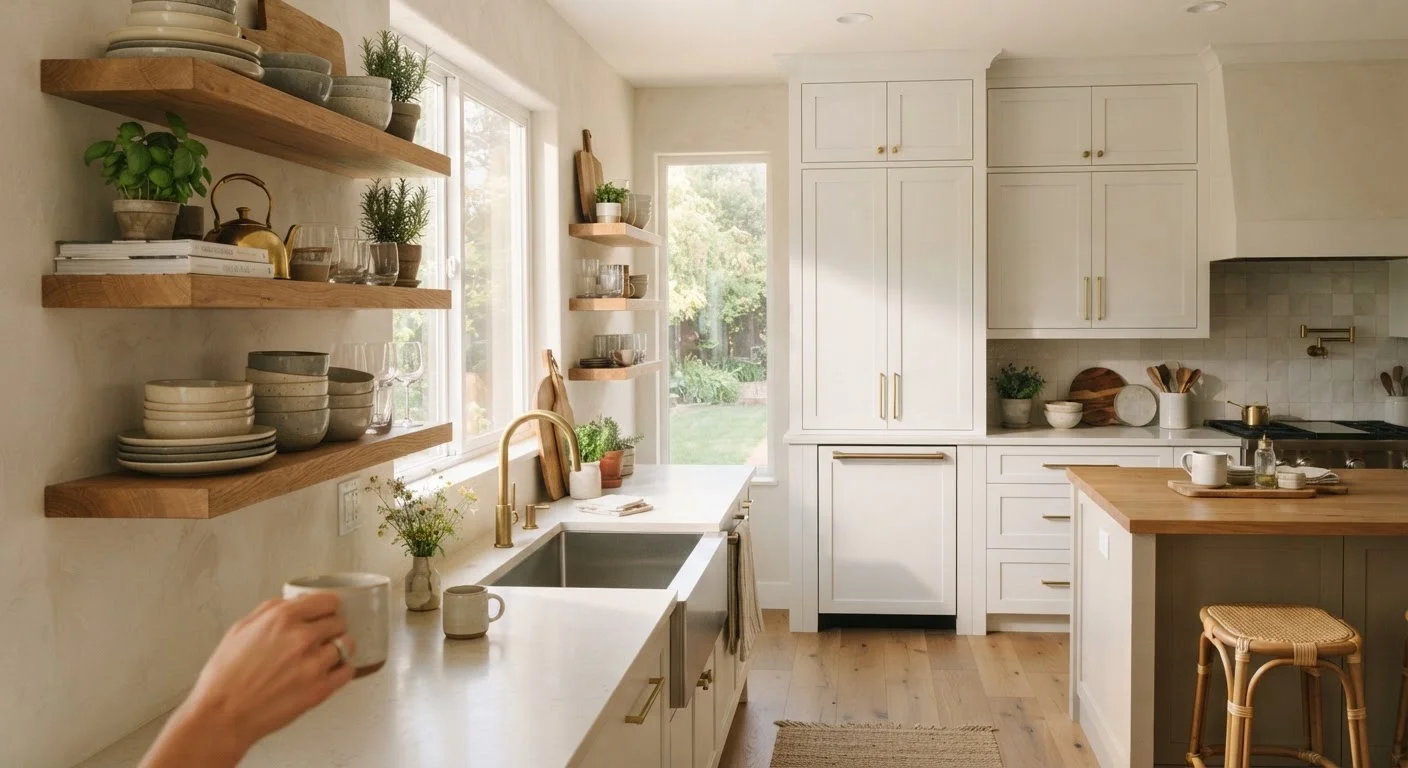
Most well-functioning homes use both. The key is intentional assignment: closed storage for everyday functional items, open shelving for things that are genuinely decorative or regularly rotated. In a kitchen, this might mean closed lower cabinets for pots, food staples, and cleaning supplies, with open upper shelves reserved for uniform glassware or a small selection of frequently used items.
In a living room, a media console with doors handles cables and equipment while a few open shelves above hold books, plants, and objects that change seasonally. This kind of seasonal rotation keeps open displays fresh without requiring constant rearranging. Meanwhile, vertical storage strategies can help maximize wall space regardless of which storage style you choose.
Before committing to either approach in a new space, spend a few weeks noticing which items you actually reach for daily, which tend to pile up, and how much time you realistically spend tidying. The honest answer to those questions will point toward the right balance more reliably than any design trend.