

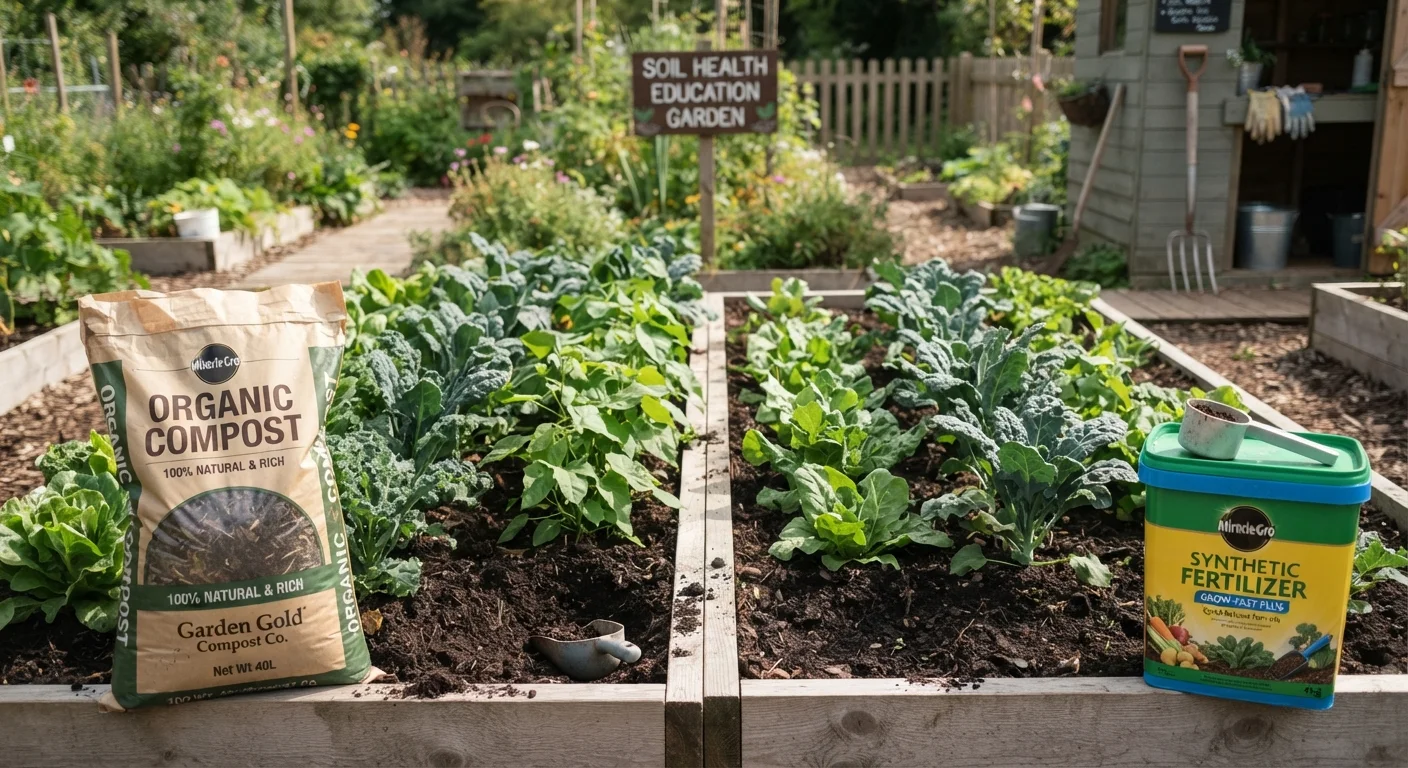
Key Takeaways
- Organic fertilizers feed soil biology slowly; synthetic fertilizers deliver nutrients to plants quickly.
- Synthetic options risk nutrient runoff and salt buildup with overuse; organics rarely cause these problems.
- Cost per application is typically lower for synthetics, but organics improve soil structure over time.
- Most home gardeners benefit from using both types strategically rather than choosing one exclusively.
- Soil pH significantly affects how well either fertilizer type performs — test before you apply.
Our Verdict
Neither organic nor synthetic fertilizers win outright — both serve different purposes at different moments in the growing season. Synthetic fertilizers offer reliable, fast results for nutrient-deficient plants; organic fertilizers invest in long-term soil health. Understanding that distinction helps you get the most from either approach.
| Best for | Recommended |
|---|---|
| Gardeners focused on long-term soil health and ecology | Organic fertilizers |
| Gardeners needing fast correction of a specific nutrient deficiency | Synthetic fertilizers |
| Those growing vegetables or edibles with sustainability goals | Organic fertilizers |
| New lawn establishment or high-demand annuals needing quick green-up | Synthetic fertilizers |
How Each Type Works in the Soil
Understanding the mechanism behind each fertilizer type helps explain nearly every trade-off you'll encounter as a gardener.
Organic fertilizers — including compost, blood meal, bone meal, fish emulsion, and worm castings — supply nutrients in complex, carbon-based forms. Soil microbes must break these materials down before plant roots can absorb the nutrients. This biological process takes time, ranging from a few weeks to an entire growing season, depending on soil temperature and moisture. As a side effect, this microbial activity builds organic matter, improves soil structure, and enhances moisture retention.
Synthetic fertilizers are manufactured to supply nutrients — most commonly nitrogen (N), phosphorus (P), and potassium (K) — in immediately water-soluble mineral form. Roots absorb them directly with no microbial middleman. That speed is genuinely useful when plants show visible deficiency symptoms mid-season. However, because nutrients aren't bound to organic matter, they can leach out of the soil rapidly, especially in sandy soils or during heavy rainfall.
Soil pH plays a major role in how available nutrients are to plant roots — a factor that affects both fertilizer types equally. Testing your soil before applying anything is always worth the small effort.
| Organic Fertilizers | Synthetic Fertilizers | |
|---|---|---|
| Nutrient release speed | Slow (weeks to months) | Fast (days) |
| Soil biology impact | Feeds and supports microbes | Neutral to mildly disruptive at high rates |
| Risk of burn or runoff | Low | Higher with overuse |
| Cost per application | Generally higher | Generally lower |
| Long-term soil improvement | Yes — builds organic matter | Minimal |
| Best application timing | Pre-season incorporation | During active growth |
| Ease of precise dosing | Harder to measure exactly | Easy — labeled N-P-K ratios |
Practical Trade-Offs: Cost, Risk, and Application
Per-pound cost at the garden center often favors synthetic fertilizers, which are highly concentrated. A small bag of synthetic granules covers a large area compared to the same weight of compost or pelleted organics. However, this comparison gets more nuanced over multiple growing seasons: organic amendments improve soil tilth and water-holding capacity, potentially reducing other inputs over time.
The main practical risks differ sharply between the two types:
- Synthetic over-application can cause fertilizer burn (salt injury to roots), nutrient imbalances, and runoff into waterways — a significant environmental concern, particularly near streams or storm drains.
- Organic over-application is far less common, though excessive nitrogen-rich organics like fresh manure or blood meal can still harm seedlings and contribute to soil nitrogen loading.
Application timing also differs. Synthetic fertilizers work during the growing season when plants are actively taking up nutrients. Many organic fertilizers benefit from being incorporated into beds weeks before planting to allow breakdown. Raised bed gardens lose nutrients faster through drainage, making both timing and choice of fertilizer especially important in those setups.
Test Your Soil Before Fertilizing
A basic soil test — available through most university cooperative extension programs for a modest fee — tells you exactly which nutrients are deficient and what your soil pH is. Applying fertilizer without this information can mean wasting money on nutrients you already have in abundance or inadvertently creating imbalances. Many state extension services offer soil testing kits by mail.
When to Use Each — or Both Together
Experienced gardeners rarely treat this as a strict binary. A common practical strategy is to use organic amendments as a baseline — worked into beds each fall or spring — and reserve synthetic fertilizers for targeted, in-season correction of specific deficiencies.
For example, if your tomato plants show yellowing lower leaves mid-July (a common sign of nitrogen shortage), a diluted liquid synthetic fertilizer can correct this within days. Organic options applied at the same stage would work too slowly to save the current crop.
Conversely, if you're establishing a new perennial bed or a long-season vegetable garden, building soil health through compost and organic matter creates a more forgiving and productive growing environment season after season. This matters especially when growing annuals versus perennials, since perennial plantings benefit most from the cumulative soil improvements that organic inputs provide.
Gardeners committed to avoiding synthetic inputs entirely — whether for ecological, certification, or personal reasons — can achieve excellent results with organics alone, but should expect a longer timeline to build soil fertility and plan applications accordingly. Those using synthetics should follow label rates precisely and consider pairing applications with organic matter to buffer salt effects and support soil biology.
For a broader low-intervention growing philosophy, ecology-based pest management pairs naturally with an organic fertility approach.
~5%
Organic matter in healthy garden soil
Most US garden soils contain 1–3% organic matter; horticultural guidelines generally target around 5% for optimal fertility and moisture retention.
50%+
Nitrogen lost to leaching in sandy soils
Research from university extension programs indicates that in coarse, sandy soils, more than half of applied synthetic nitrogen can leach below the root zone before uptake.