

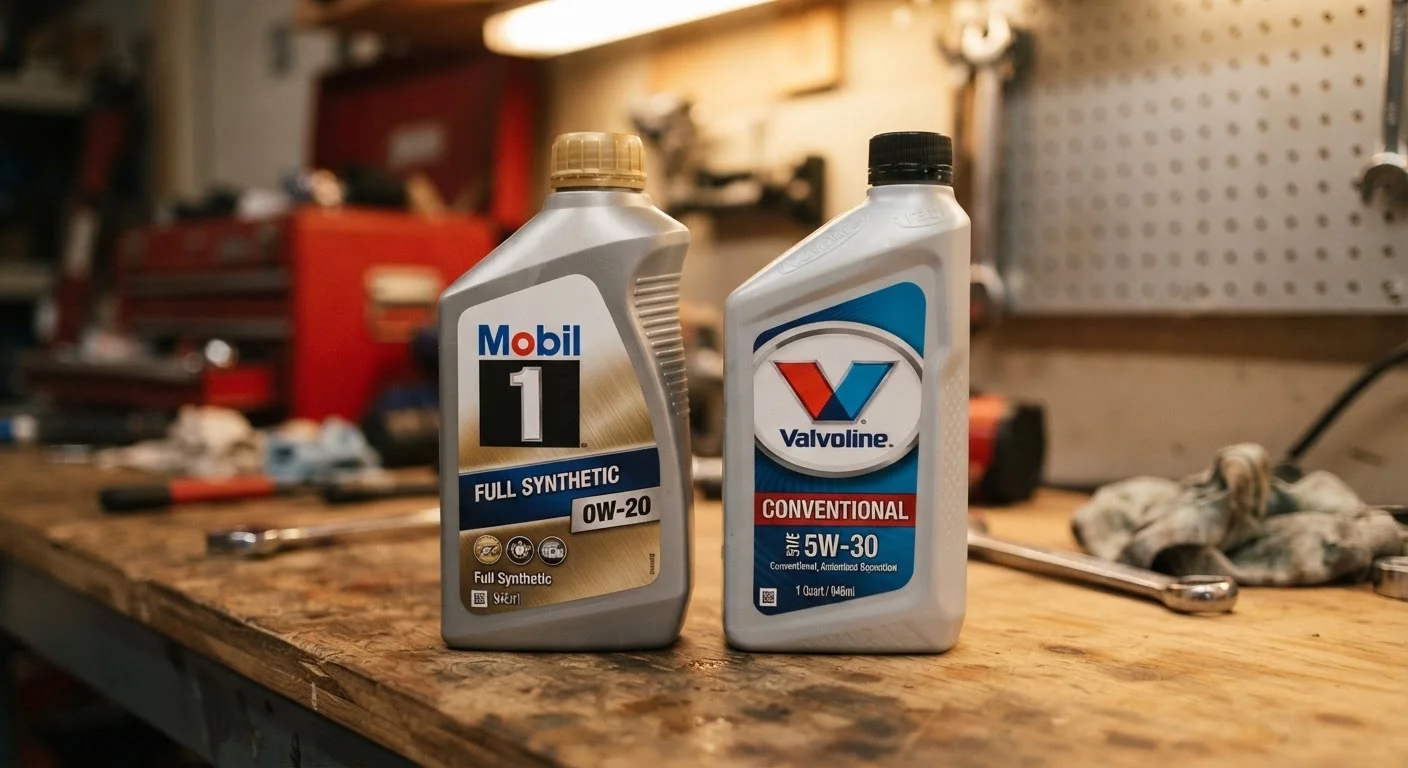
Key Takeaways
- Synthetic oil offers better performance in extreme heat and cold compared to conventional oil.
- Conventional oil typically costs less per quart, but may require more frequent changes.
- Your owner's manual is the most reliable source for which oil type your engine requires.
- High-mileage or turbocharged engines often benefit most from full synthetic formulations.
- Switching from conventional to synthetic is generally safe for most modern engines.
Option A
Synthetic Engine Oil
The engineered, high-performance formulation.
Best for: Drivers who log high mileage, operate in extreme temperatures, or want longer intervals between oil changes.
Option B
Conventional Engine Oil
The time-tested, petroleum-based standard.
Best for: Owners of older or low-mileage vehicles who follow regular short-interval maintenance schedules.
If you drive a newer vehicle with a turbocharged or high-performance engine
Synthetic Engine Oil
Turbocharged engines run hotter and demand oil that resists breakdown under stress. Synthetic formulations are specifically designed to handle that thermal load.
If you own an older vehicle with high mileage and a simpler engine
Conventional Engine Oil
Many older engines were designed around conventional oil tolerances, and your mechanic or owner's manual may actually specify it.
If you drive in extreme climates — very cold winters or very hot summers
Synthetic Engine Oil
Synthetic oil maintains stable viscosity across a wider temperature range, offering better cold-start protection and heat resistance.
If you drive primarily short distances at moderate speeds and want to minimise cost
Conventional Engine Oil
For light-duty, consistent driving in mild conditions, conventional oil can do the job at a lower upfront cost per change.
What Sets Them Apart at the Molecular Level
Both synthetic and conventional motor oils serve the same fundamental purpose — lubricating engine components to reduce friction and heat. The key difference lies in how each is made.
Conventional oil is refined directly from crude petroleum. That refining process removes many impurities, but natural molecular irregularities remain. Synthetic oil, by contrast, is chemically engineered — its molecules are uniform in size and structure, which translates to more predictable, consistent performance under varying conditions.
This molecular uniformity is what allows full synthetic oil to flow more reliably at low temperatures and resist breakdown at high temperatures. For a deeper look at how viscosity ratings like 5W-30 relate to these differences, see our guide to engine oil grades.
| Criterion | Synthetic Oil | Conventional Oil |
|---|---|---|
| Base material | Chemically engineered molecules | Refined crude petroleum |
| Cold-weather performance | Flows readily at low temperatures | Can thicken in extreme cold |
| Heat resistance | Resists breakdown under high heat | Degrades faster at high temperatures |
| Typical change interval | 7,500–10,000+ miles (varies by vehicle) | 3,000–5,000 miles |
| Cost per quart | Higher upfront cost | Lower upfront cost |
| Best engine fit | Turbo, modern, high-performance engines | Older, simpler, low-stress engines |
Cost, Change Intervals, and Real-World Economics
Synthetic oil typically costs more per quart than conventional — sometimes two to four times as much. However, that comparison alone doesn't tell the whole story.
Conventional oil is generally recommended for changes every 3,000 to 5,000 miles, while many full synthetic formulations are rated for 7,500 to 10,000 miles or more, depending on the vehicle and oil type. When you factor in fewer trips to the shop and less oil used over time, the cost gap narrows considerably for many drivers.
~7,500–10,000 mi
Typical synthetic oil change interval
Many full synthetic oils carry manufacturer-rated intervals well above conventional oil's standard range, though actual intervals depend on driving conditions and vehicle specifications.
~3,000–5,000 mi
Typical conventional oil change interval
Traditional guidance recommends this range for conventional oil, though some modern engines and driving patterns may allow longer intervals — always verify with your owner's manual.
That said, change intervals vary significantly by vehicle, driving conditions, and manufacturer specification. Always defer to your owner's manual rather than a blanket rule. For a fuller breakdown of when oil genuinely needs changing, our article on engine oil viscosity and change timing walks through the key indicators.
Which Oil Does Your Engine Actually Need?
The single most reliable answer is in your vehicle's owner's manual. Automakers specify the oil type and viscosity grade required for their engines — following that guidance protects your warranty and your engine alike.
Generally speaking, turbocharged engines, high-performance engines, and vehicles designed after roughly 2010 are more likely to call for full synthetic. Older, simpler engines with lower operating temperatures may run perfectly well on conventional oil — and some may actually develop minor seal issues if switched to synthetic without a mechanic's input.
If you're unsure whether switching makes sense for your vehicle, it's worth a conversation with a qualified mechanic. Our comparison of DIY vs professional servicing can help you decide when a shop visit is genuinely the smarter call.
What About Synthetic Blend Oils?
A third option exists between full synthetic and conventional: synthetic blend oil, which mixes conventional base oil with a portion of synthetic. Blends offer improved performance over straight conventional oil — particularly in temperature extremes — at a lower price than full synthetic. They can be a practical middle ground for drivers whose vehicles don't require full synthetic but who want some added protection. Check your owner's manual to confirm compatibility.
For a more detailed head-to-head on how each oil type performs across specific driving conditions, our article on what the synthetic vs conventional difference means for your engine goes deeper on long-term engine impact.
This article is for general informational purposes only. Always consult your vehicle's owner's manual and a qualified mechanic before making changes to your maintenance routine.