

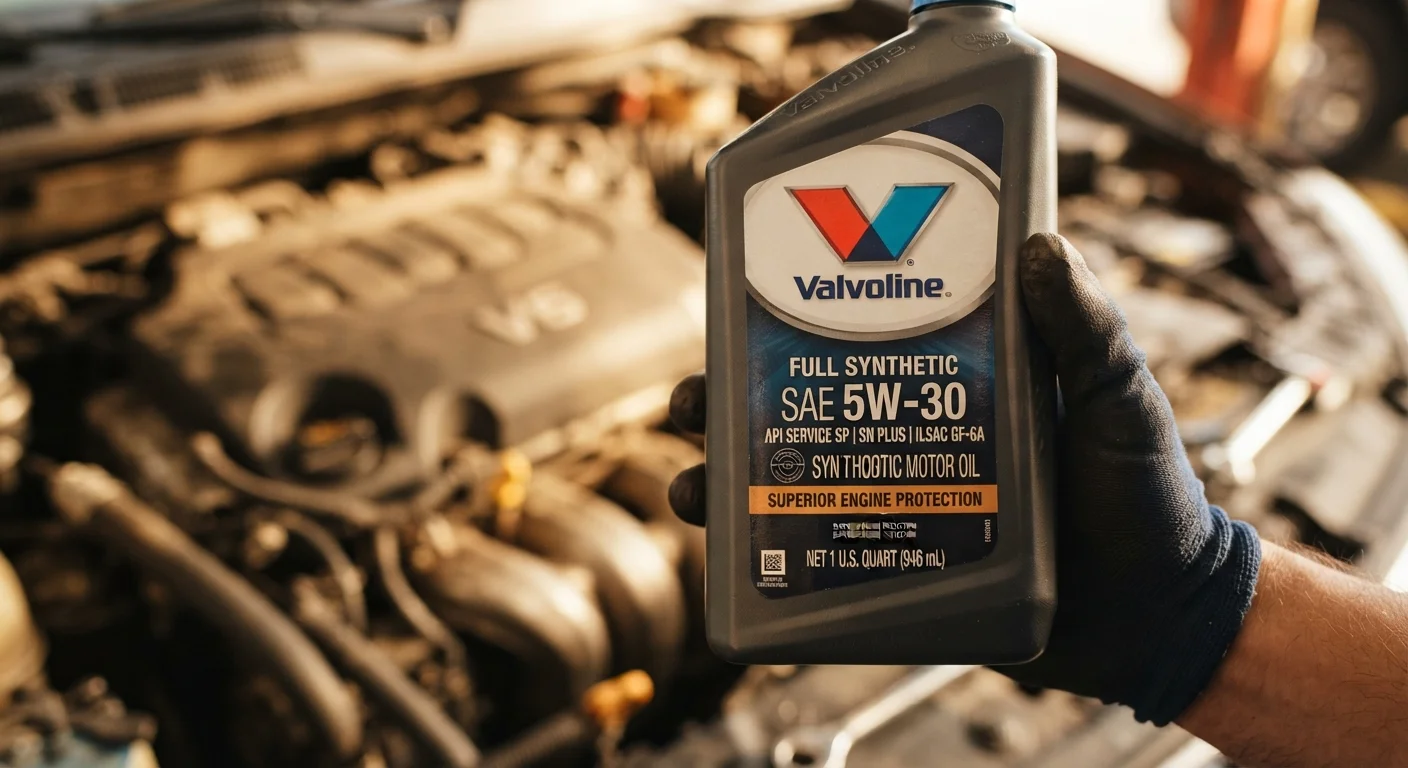
Key Takeaways
- The number before the 'W' indicates how the oil performs in cold temperatures — lower means better cold-weather flow.
- The number after the 'W' describes the oil's viscosity when the engine is fully warmed up.
- Your owner's manual specifies the correct oil grade — always start there.
- Climate and driving conditions can influence whether you need a narrower or broader viscosity range.
- Using the wrong grade doesn't guarantee immediate damage, but sustained misuse can accelerate engine wear.
Engine Oil Viscosity Grade
An engine oil viscosity grade is a standardized code — like 5W-30 or 10W-40 — that describes how thick or thin an oil is at different temperatures. The grade tells you how well the oil will flow when your engine is cold at startup and how much it thickens or resists breakdown when your engine is hot and running. Choosing the correct grade for your vehicle helps protect engine components from wear.
Grades are set by the Society of Automotive Engineers (SAE). The "W" stands for Winter, and the number before it reflects cold-temperature pumpability; the number after indicates high-temperature viscosity under load.
Breaking Down the Code: What Each Number Means
At first glance, a label like 5W-30 looks like an engineering puzzle. But the logic behind it is straightforward once you know what each part represents.
The number before the W describes how the oil flows at low temperatures — specifically, how quickly it can be pumped through the engine during a cold start. A 5W oil flows more readily in cold conditions than a 10W oil. This matters because the most damaging wear on an engine often occurs in those first seconds before oil reaches all moving parts.
The number after the W describes the oil's viscosity at normal operating temperature — typically around 212°F (100°C). A 30 rating means the oil is relatively thin at heat; a 40 or 50 is thicker and resists shearing under heavy load. Thicker hot-side ratings can benefit high-mileage or high-performance engines, while thinner ratings often support better fuel efficiency in newer, tightly-toleranced engines.
Common grades you'll encounter include 0W-20, 5W-20, 5W-30, and 10W-40. These are all multi-grade oils, meaning they perform well across a range of temperatures — unlike older single-grade oils that required seasonal switching.
~40%
Engine wear that occurs at cold startup
Industry estimates commonly attribute a significant share of total engine wear to the brief period after a cold start before oil fully circulates — underscoring why cold-temperature viscosity ratings matter.
SAE J300
Standard that defines oil viscosity grades
The Society of Automotive Engineers' J300 specification is the globally recognized standard classifying engine oil grades by cold- and hot-temperature performance benchmarks.
Why the Right Grade Actually Matters
Engine tolerances — the tiny gaps between moving metal parts — are engineered to work with oil of a specific thickness. If oil is too thin, it may not provide a sufficient protective film. If it's too thick, it can struggle to circulate quickly enough, particularly at startup.
Your vehicle's manufacturer specifies a grade based on years of testing with your engine's design. That specification lives in your owner's manual, and it's the most reliable guide you have. For a broader look at how oil changes fit into your overall maintenance plan, see our guide to your car's service schedule.
Start With Your Owner's Manual
Before shopping for oil, look up the exact grade specification in your owner's manual — it's the most reliable source for your vehicle. Some manufacturers approve multiple grades depending on climate, so you may have options. When in doubt, a dealership or trusted mechanic can confirm which grades are safe for your engine.
Climate plays a supporting role. If you regularly drive in sub-zero winters, an oil with a lower cold-rating (like 0W) may circulate more effectively at startup. In consistently hot, high-load conditions — towing, mountain driving — some drivers opt for a slightly higher hot-side rating, though always within manufacturer-approved options.
Synthetic vs. Conventional: Does Grade Change?
One common source of confusion is the relationship between oil type (synthetic or conventional) and oil grade. These are separate characteristics. Both synthetic and conventional motor oils are sold in identical SAE grade designations — a bottle of 5W-30 synthetic and a bottle of 5W-30 conventional share the same viscosity profile.
What differs is the quality and consistency of the base oil. Synthetic oils are engineered at a molecular level, which generally means better performance at temperature extremes and longer service intervals. For a deeper dive into that distinction, our comparison of synthetic vs. conventional oil lays out when each makes sense for everyday drivers.
If your manual calls for 5W-30, switching to a synthetic 5W-30 is a grade-compatible choice — but always verify with your manual or a qualified mechanic before making changes, especially for newer vehicles under warranty.
Reading Your Owner's Manual — and When to Ask a Pro
The single most important step any driver can take is checking the oil specification in their owner's manual before every oil change. Manufacturers sometimes approve a range of grades (e.g., 5W-20 or 5W-30), often with climate guidance. Following that guidance is both the safest and most cost-effective approach.
If your manual is lost, the information is typically available on the manufacturer's website or from a dealership service department. Some vehicles also display the recommended grade on a sticker inside the engine bay or on the oil filler cap.
For a fuller picture of what oil grades mean and when your oil actually needs changing, our engine oil explainer covers the complete picture. And if you're unsure whether your current grade is appropriate for your driving conditions, a licensed mechanic can give advice tailored to your specific vehicle — no guesswork required.
This article is for general informational purposes. Always consult your vehicle's owner's manual and a qualified mechanic before making changes to your maintenance routine.