

Key Takeaways
- Compound interest earns returns on your previous returns, not just your original deposit.
- Time is the single most powerful driver of compounding — starting earlier matters more than starting with more.
- Compounding works against you when it applies to debt, such as credit card balances.
- The frequency of compounding (daily, monthly, annually) affects how quickly a balance grows.
- Even modest, consistent contributions can grow significantly over decades through compounding.
Compound Interest
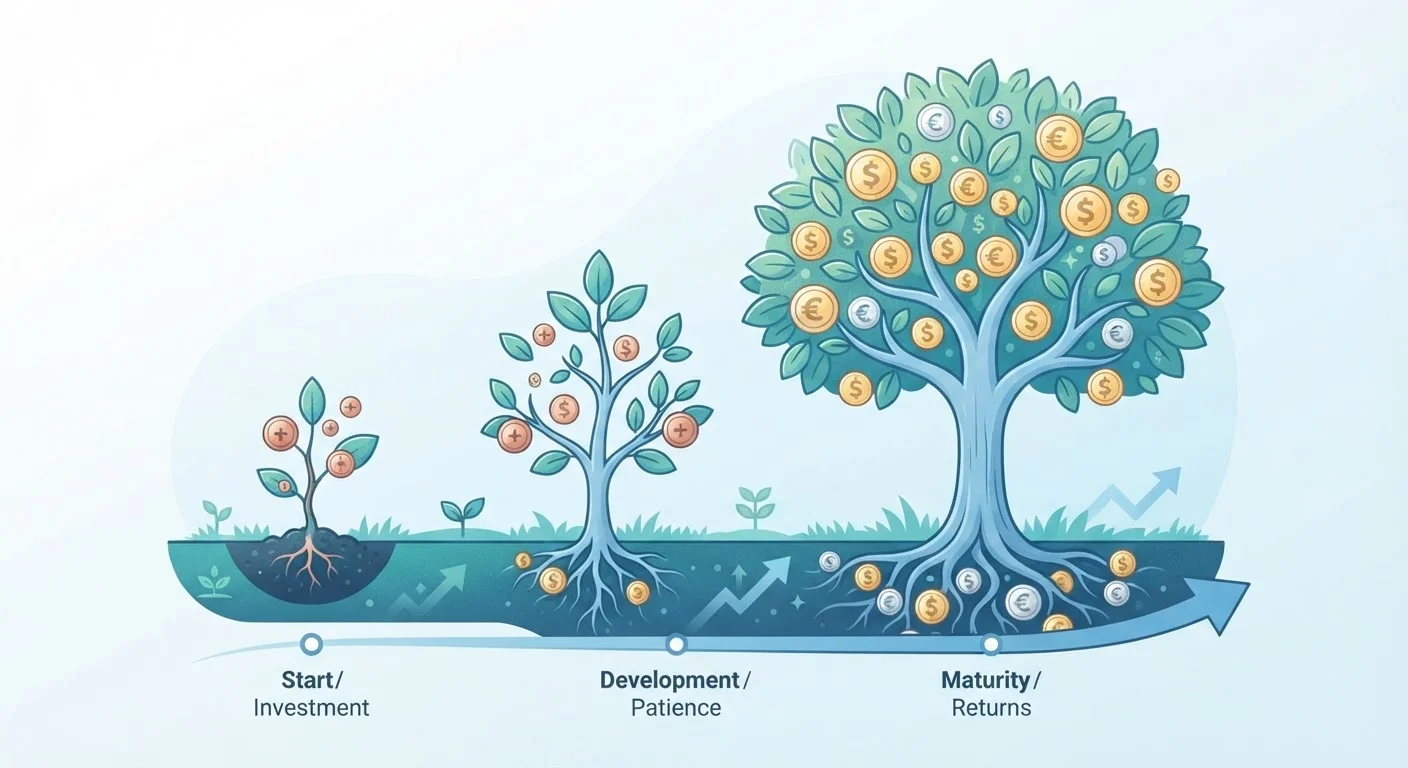
Compound interest is the process of earning returns not just on your original sum of money, but also on the returns you've already accumulated. Each time interest is added, your balance grows — and future interest is calculated on that larger balance. Over long periods, this cycle of reinvesting earnings produces growth that accelerates over time.
The standard formula is A = P(1 + r/n)^(nt), where P is the principal, r is the annual interest rate, n is the number of compounding periods per year, and t is time in years.
What Compounding Actually Does to Your Money
The word "compounding" carries a reputation for seeming almost miraculous — personal finance content often frames it as a secret or a cheat code. It is neither. It is straightforward arithmetic that, given enough time, produces results that feel surprising only because humans are not naturally wired to think in exponential terms.
Here is the core idea: when you earn interest or investment returns and those earnings are reinvested rather than withdrawn, your next round of returns is calculated on a larger balance. A $1,000 deposit earning 5% annually becomes $1,050 after year one. In year two, you earn 5% on $1,050 — not $1,000. After 30 years at that rate, with no additional contributions, the balance reaches roughly $4,322. You contributed $1,000; compounding did the rest.
This is not magic. It is repetition. Each compounding period, no matter how small the gain, slightly expands the base on which future returns are calculated. See how this plays out across different time horizons for a closer look at the numbers.
~$4,322
Value of $1,000 at 5% after 30 years
Illustrates compounding with no additional contributions, calculated using the standard compound interest formula at annual compounding.
72 ÷ rate
Years to double money (Rule of 72)
At a 6% annual return, this shortcut estimates your money doubles roughly every 12 years — a useful mental benchmark, not a financial guarantee.
~20×
Approximate growth of $1 invested at birth by age 65
At a hypothetical 5% annual return compounded over 65 years, illustrating how dramatically time extends the effect of compounding.
Why Time Is the Real Variable
Most people assume the amount of money they invest matters most. In the long run, time matters more. A person who begins investing at 25 and stops at 35 — contributing for just ten years — can end up with more money at retirement than someone who starts at 35 and contributes for 30 consecutive years, assuming identical annual returns. The early starter's returns have more time to compound on themselves.
This asymmetry surprises most people, and it is entirely a product of how exponential growth works: the curve is flat for a long time, then steep. Early years feel unremarkable because the absolute gains are small. Later years feel dramatic because a large base is compounding. Both phases are necessary.
Starting Small Still Counts
You do not need a large lump sum to benefit from compounding. Even modest regular contributions — if maintained consistently — give compounding the two things it needs most: a base to work with and time to work. The key is to begin rather than wait for ideal conditions.
To understand the full picture of how money grows once it is put to work, it helps to first grasp what actually happens when you invest. Compounding is the engine; understanding the fuel it runs on matters just as much.
When Compounding Works Against You
The same mechanism that quietly builds wealth in a savings account can quietly erode financial stability in debt. On revolving credit — credit cards being the most common example — unpaid balances attract interest that is added to the principal. Next month, interest is charged on that inflated balance. The cycle mirrors investment compounding exactly, but in the wrong direction.
A $3,000 credit card balance at an 20% APR, left unpaid and untouched, roughly doubles in under four years. Understanding this symmetry is useful: the behaviours that accelerate wealth-building (reinvesting returns, not withdrawing early) are the mirror image of the behaviours that accelerate debt growth (not paying down principal, carrying balances long-term).
For context on how fees interact with compounding in investment accounts, see how even small fees erode returns over time — a closely related concept that many investors overlook.
Putting Compounding Into Practical Context
Compounding does not require large sums to be meaningful. Regular, smaller contributions that compound over time can outperform a single large contribution made later. This is the logic behind consistent saving habits, and it is explored in depth when comparing lump-sum investing with regular contributions.
What compounding cannot do is make poor financial decisions harmless, eliminate investment risk, or guarantee any specific outcome. It is a mathematical process — neutral, reliable within its inputs, and entirely dependent on the rate of return and time actually provided. Overstating what it does sets unrealistic expectations; understanding it clearly lets you make better-informed decisions about savings, debt payoff, and long-term goals.
For a broader grounding in financial vocabulary, a plain-language guide to common personal finance terms covers compound interest alongside APR, amortisation, and other concepts worth knowing.
This article is for general informational and educational purposes only and does not constitute personalised financial, investment, or tax advice. Consult a qualified financial adviser before making decisions about your own finances.