

Key Takeaways
- Compound interest earns returns on both your principal and previously earned interest.
- Time in a savings account is the single most influential factor in compounding growth.
- More frequent compounding periods (daily vs. annually) accelerate balance growth.
- Starting earlier — even with smaller amounts — generally outperforms starting later with larger deposits.
- High-yield accounts amplify the compounding effect compared to standard savings accounts.
- Compound interest works against you on debt, so understanding it cuts both ways.
Compound Interest
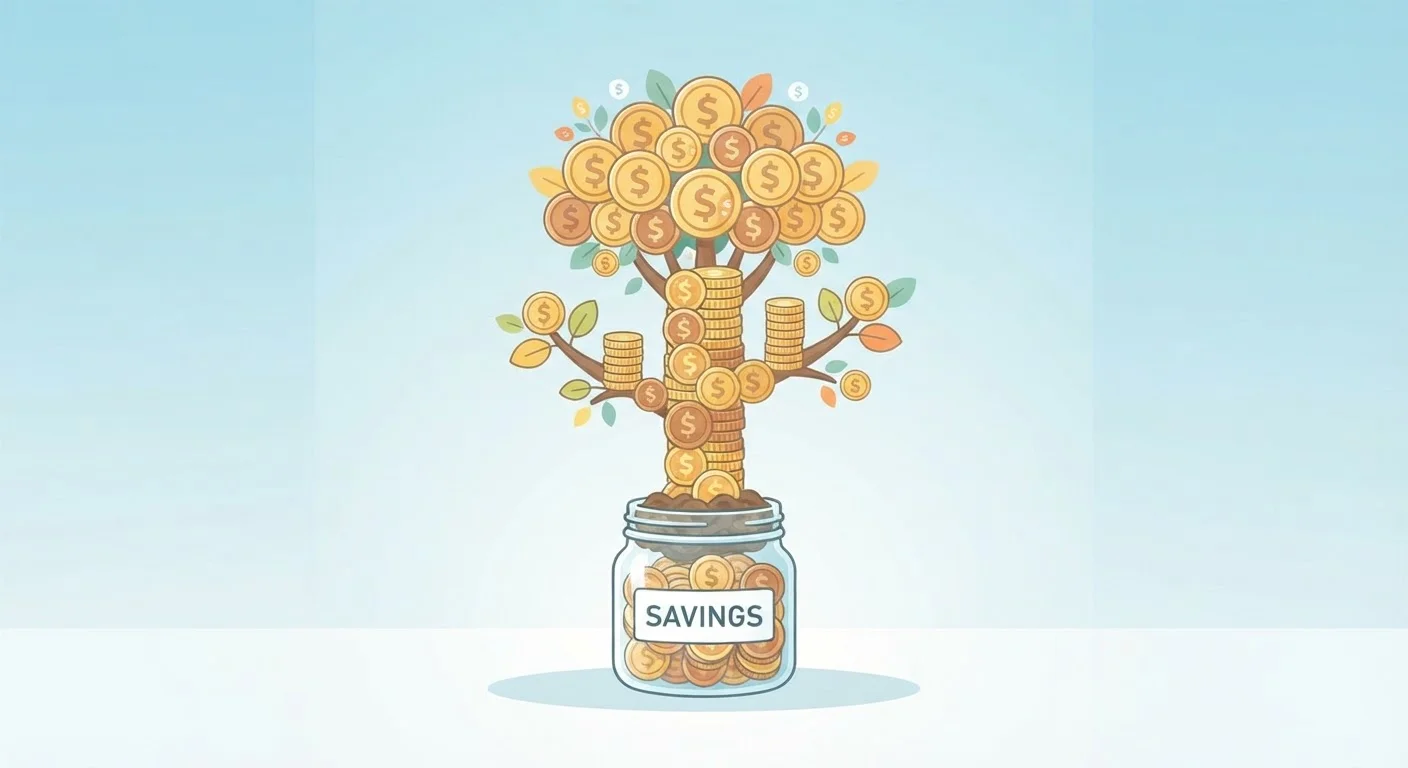
Compound interest is the process by which interest is earned not only on your original deposit but also on the interest that has already accumulated. Each compounding period, your balance grows — and that larger balance then earns even more interest. Over time, this creates an accelerating growth curve rather than a straight line.
The standard formula is A = P(1 + r/n)^(nt), where P is principal, r is the annual interest rate, n is the number of compounding periods per year, and t is time in years.
How Compounding Actually Works
At its core, compound interest means your money earns a return — and then that return starts earning a return of its own. Unlike simple interest, which is calculated only on the original principal, compounding builds on itself each period.
Here's a plain illustration: suppose you deposit $1,000 at a 5% annual rate. After year one, you have $1,050. In year two, you earn 5% on $1,050 — not the original $1,000 — giving you $1,102.50. By year ten, that single deposit has grown to roughly $1,629 without any additional contributions. The growth isn't dramatic in year one, but it accelerates meaningfully over longer periods.
The frequency of compounding also matters. Interest that compounds daily produces slightly more than the same rate compounding annually, because each day's interest is added to the base before the next day's calculation runs. This is why the APY (Annual Percentage Yield) — not just the stated rate — is the correct figure for comparing savings accounts. For a plain-language breakdown of these terms, see our guide to personal finance terms.
Rule of 72
Estimate years to double your money
Divide 72 by your annual interest rate to estimate how many years it takes for a deposit to double; at 4%, that's approximately 18 years.
Daily
Most common compounding frequency in savings accounts
Many online and high-yield savings accounts compound interest daily, which produces a slightly higher effective yield than monthly or annual compounding at the same stated rate.
10+ years
Threshold where compounding acceleration becomes most visible
Financial education materials broadly note that the compounding curve steepens noticeably after a decade, as accumulated interest itself becomes a meaningful portion of the growing balance.
Why Time Is the Decisive Variable
The most counterintuitive insight about compound interest is that time outweighs contribution size over long horizons. This is because compounding is exponential, not linear — small differences in the starting point compound into very large differences at the end.
Consider two savers. The first deposits $5,000 at age 25 and never adds another dollar. The second waits until age 40 and deposits $10,000. Assuming a consistent hypothetical rate, the first saver may still end up with a larger balance by retirement age, despite contributing less — simply because of the additional 15 years of compounding. This is a general illustration, not a guarantee; actual results depend on the interest rate, account type, and whether rates remain constant.
This dynamic is why financial educators consistently emphasise starting early, even if contributions are modest. The common belief that small amounts don't add up is directly contradicted by how compounding behaves over decades.
“Compound interest is the eighth wonder of the world. He who understands it, earns it; he who doesn't, pays it.”
— Widely attributed to Albert Einstein, This quote is commonly cited in financial education contexts; its precise origin is debated by historians, but its sentiment accurately reflects the core principle of compounding.
Compounding in Debt: The Same Maths, Opposite Effect
Compound interest is not exclusively a savings tool — the same mechanism applies to most forms of debt, particularly credit cards and some personal loans. When a credit card balance goes unpaid, interest is added to the outstanding amount. The following month, interest is calculated on that higher balance. Left unaddressed, debt can grow at a rate that surprises many borrowers.
This symmetry is important: if you hold high-interest debt alongside savings earning a lower rate, the compounding working against you on that debt may outpace the compounding working for you in your account. Understanding this is a practical reason to consider debt reduction as part of an overall savings strategy — though the right balance depends on individual circumstances a qualified financial adviser can help assess.
Match Your Account to Your Goal
Because compounding rewards time and rate, placing long-term savings in an account with a higher APY amplifies the effect. Comparing account types by APY — rather than the stated rate — gives a more accurate picture of how your balance will grow. Our comparison of high-yield and traditional savings accounts walks through the structural differences in plain terms.
For a broader look at how compounding connects to investing over time, the maths behind reinvested earnings is worth exploring when you're ready to move beyond savings accounts.
This article is for general informational and educational purposes only and does not constitute personalised financial or investment advice. Consult a licensed financial professional for guidance suited to your individual situation.