

Key Takeaways
- When you invest, your money is typically used by companies or governments to fund real economic activity.
- Returns come from two main sources: price appreciation and income such as dividends or interest.
- Compounding allows returns to build on themselves, amplifying growth the longer money stays invested.
- All investments carry risk, including the possibility of losing some or all of the amount invested.
- Fees, taxes, and inflation all affect what investors actually keep — not just the headline return.
Investing
Investing means committing money to an asset — such as a share of a company, a government bond, or a fund — with the expectation that it will grow in value or generate income over time. Unlike saving, where cash sits in a bank account, investing puts money into the broader economy. Returns are never guaranteed, and the value of an investment can fall as well as rise.
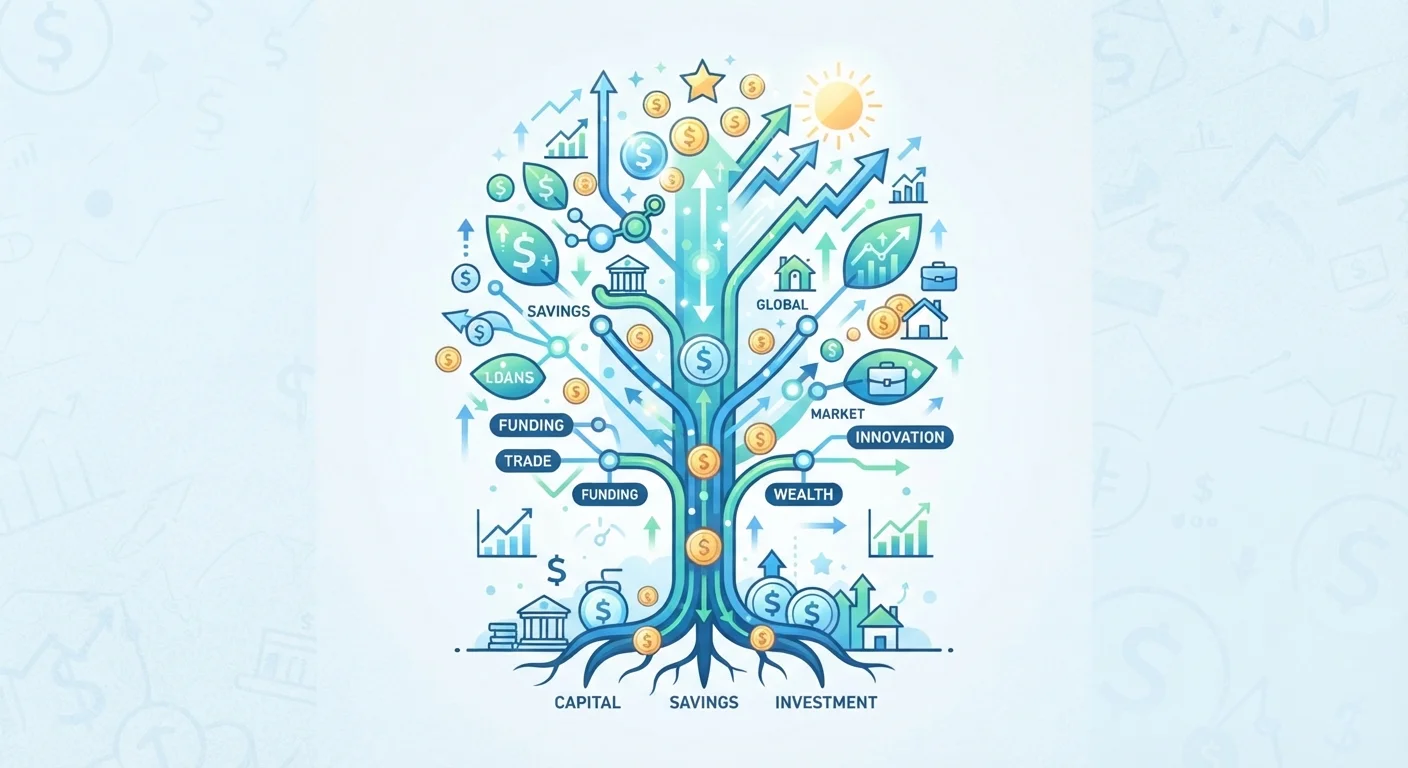
Economically, investing channels capital toward productive activities — businesses, infrastructure, and innovation — creating a system where investors share in the value that activity generates.
Where Your Money Goes
When most people picture investing, they imagine a trading floor or a screen full of numbers. The mechanics underneath are actually more straightforward — and more grounded in real-world economics — than that image suggests.
When you purchase a stock (also called a share or equity), you're buying a fractional ownership stake in a company. On a public exchange, that transaction usually happens between you and another investor who is selling. In either case, the company's share price reflects what participants collectively believe the business is worth. When a company grows its revenue and profits, its shares typically rise in value — and as an owner, you benefit.
When you purchase a bond, you're acting as a lender. A government or corporation borrows your money for a fixed period and agrees to pay you interest. At the end of the term, the principal is returned. Bond investing is generally considered lower-risk than stocks, though returns tend to be more modest.
Funds — including index funds and mutual funds — pool money from many investors and spread it across dozens or hundreds of assets simultaneously. This is how most ordinary investors participate in markets without needing to pick individual stocks or bonds. See our overview of stocks, bonds, and funds for a deeper look at how each asset class works.
How Returns Are Generated
Investment returns come from two primary sources, and understanding both is essential.
- Price appreciation: If an asset becomes worth more than you paid for it, you have an unrealised gain. That gain becomes real when you sell. A company that expands its operations, increases earnings, or captures more market share typically sees its stock price rise over time.
- Income: Many investments generate regular cash payments. Stocks may pay dividends — a share of company profits distributed to shareholders. Bonds pay interest (often called a coupon). This income can be spent or reinvested to buy more shares.
Reinvesting income is where compounding becomes powerful. When dividends buy additional shares, those shares generate their own dividends, which buy yet more shares. Over years and decades, this snowball effect can dramatically amplify growth — even without adding new money. This is why time in the market matters as much as the amount invested.
~10%
Average annual return of US stocks historically
The broad US stock market has returned approximately 10% per year on average before inflation over the long run, according to widely cited historical analyses — though individual years vary dramatically and past performance does not guarantee future results.
Rule of 72
Years to double an investment
Dividing 72 by an annual return rate estimates how many years it takes for an investment to double — for example, at 6% annual growth, an investment would roughly double in about 12 years, illustrating the power of compounding.
1%
Annual fee difference that matters enormously
Research consistently shows that a 1 percentage point difference in annual fees can reduce an investor's ending portfolio value by 20% or more over a 30-year horizon, underscoring why low-cost investing matters.
This article is for general informational purposes only and does not constitute personalised financial or investment advice. Consult a qualified financial adviser before making investment decisions.
Risk, Fees, and What You Actually Keep
Returns on paper and returns in your pocket are two different things. Several factors reduce what an investor ultimately keeps.
Risk is inherent to all investing. Markets fluctuate; companies fail; economic cycles create periods of loss. A broadly diversified portfolio — spread across asset types, industries, and geographies — reduces the impact of any single failure, but it cannot eliminate market-wide downturns. Higher potential returns are almost always paired with higher potential for loss.
Fees are a quieter but persistent drag. Fund management fees, account fees, and transaction costs reduce your net return every year, compounding in reverse. Even a difference of 1% annually may seem trivial but can represent tens of thousands of dollars over a long investment horizon. Our article on how investment fees erode returns over time explains this in detail.
Inflation matters too. If your investment earns 4% annually and inflation runs at 3%, your real purchasing-power gain is roughly 1%. Investing is often described as one tool for preserving and building wealth against inflation — but the math only works in your favour if returns outpace it.
Start With Understanding, Then Act
Before selecting any investment, take time to understand what you're buying, how it generates returns, and what the realistic risks are. New investors who understand the mechanics — even at a basic level — are far less likely to panic during market downturns and sell at a loss. Knowledge is itself a risk-management tool.
If you're ready to move from understanding to action, the first-timer's roadmap to investing covers the practical steps for opening an account and building an initial portfolio.