

Key Takeaways
- Envelope budgeting assigns a fixed cash amount to each spending category before the month begins.
- Digital envelope apps replicate the same logic without requiring physical cash.
- The method works best for categories where overspending is a recurring problem.
- It requires consistent upkeep and may feel restrictive for irregular earners.
- Consulting a financial adviser can help tailor any budgeting method to your situation.
Makes overspending immediately visible
An empty envelope delivers an unmistakable signal that a category limit has been reached — no end-of-month credit card statement surprise needed.
Reduces impulse spending through friction
Research on payment psychology consistently finds that spending feels more real when a physical or visual limit is involved, making thoughtless purchases less automatic.
Simple enough to start without tools
Unlike spreadsheet-based systems, envelope budgeting requires no software, formulas, or financial literacy beyond basic arithmetic, making it accessible to true beginners.
Works well alongside a zero-based budget
Because every dollar is assigned to an envelope at the start of the month, the method naturally produces a zero-based budget where income minus allocations equals zero.
Digital versions support irregular expense planning
App-based envelopes allow sinking funds for predictable but infrequent costs — car maintenance, annual memberships — that are difficult to manage with cash alone.
Carrying cash creates security and convenience risks
Physical envelopes mean carrying meaningful amounts of currency, which can be lost, stolen, or inconvenient in an increasingly card-first payment environment.
Requires consistent, ongoing manual effort
Envelopes must be restocked each pay period and spending must be logged or monitored regularly; neglecting the system for even a week can undermine its effectiveness.
Poorly suited to irregular income
Freelancers, gig workers, and commission earners may find it difficult to pre-assign fixed amounts when monthly income fluctuates significantly from period to period.
Rigid category limits can cause unnecessary stress
A strict envelope system with no room for reallocation can feel punishing during months with unexpected but legitimate expenses, potentially discouraging continued use.
Our Verdict
Envelope budgeting is one of the most effective spending-control systems available to beginners because it makes budget limits concrete and immediate. The core logic translates well to digital tools, removing the friction of carrying cash while preserving the psychological guardrails. However, it demands regular attention and works best when income is predictable.
Ideal for anyone who consistently overspends in specific categories and wants a simple, visual system to rebuild spending discipline — whether using physical cash or a digital equivalent.
What Is Envelope Budgeting?
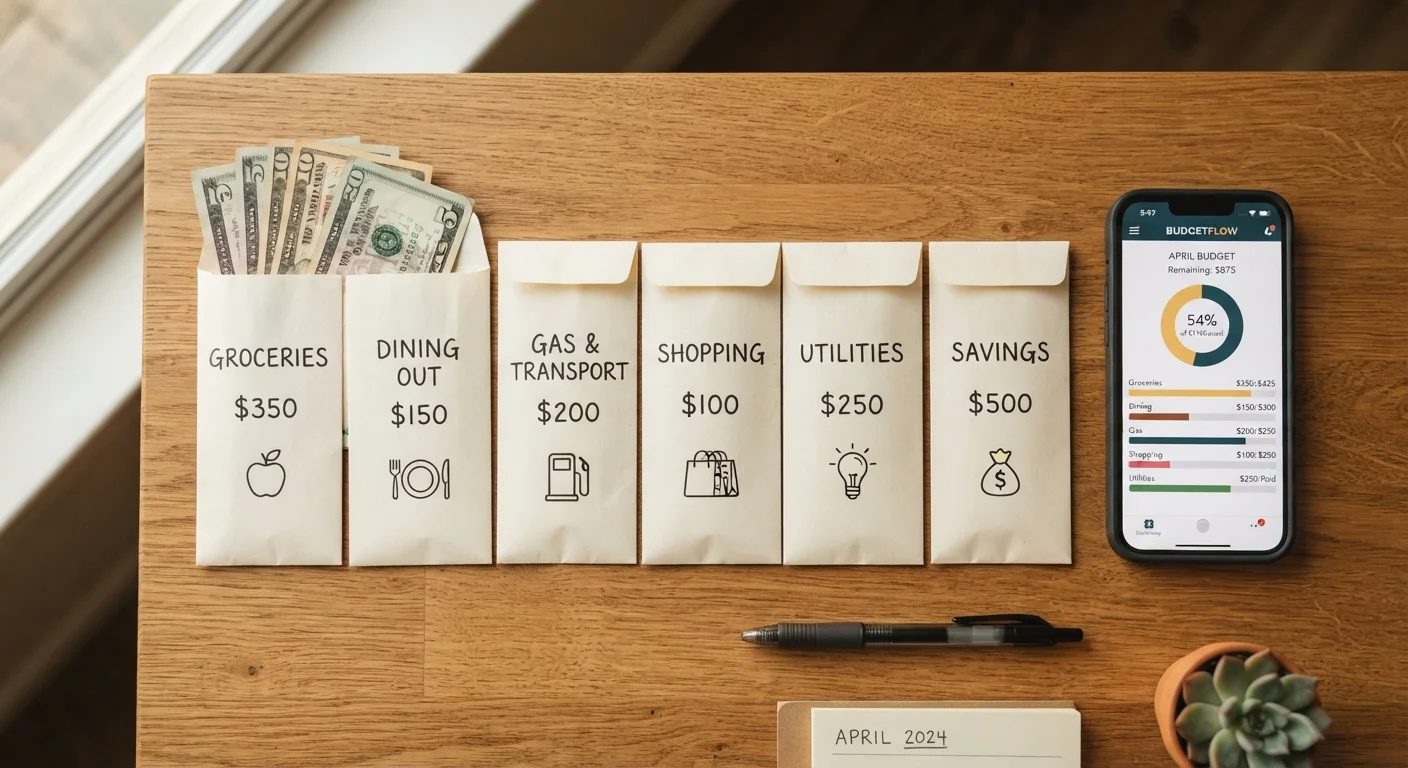
Envelope budgeting is a cash-allocation method where you divide your monthly take-home pay into labeled envelopes — one for groceries, one for dining out, one for transportation, and so on. Once an envelope is empty, spending in that category stops for the month. There is no borrowing from next month and no silent overage on a card statement; the limit is physical and immediate.
The method has roots in mid-20th century household money management, but its logic predates formal personal finance as a discipline. It works because it converts abstract budget numbers into a tangible constraint. For a plain-language overview of core budgeting concepts, see the personal budgeting glossary.
If you have never built a budget before, envelope budgeting is one of several frameworks covered in Your First Budget in Seven Steps, which walks through the full setup process in plain language.
How Digital Envelopes Work
Several budgeting apps replicate the envelope framework without cash. You create virtual categories, assign a dollar amount to each at the start of the period, and the app deducts spending in real time as you log or sync transactions. The constraint is identical to the physical version; only the medium changes.
Digital Envelopes and Sinking Funds
Digital envelope apps can handle irregular expenses — a car registration, an annual subscription, a holiday gift fund — by letting you contribute a small amount each month until the lump sum is reached. This is called a sinking fund and is one area where digital tools clearly outperform physical cash envelopes. Most envelope-style apps allow you to create and name as many sinking fund categories as you need alongside your regular monthly envelopes.
Digital envelopes can also handle irregular expenses — a car registration, an annual subscription, a holiday gift fund — by letting you contribute a small amount each month until the lump sum is reached. This is sometimes called a sinking fund and is harder to manage with physical cash alone.
For a broader comparison of budgeting tools, Paper, Spreadsheet, or App examines the trade-offs of each format in detail.
Pros and Cons of Envelope Budgeting
Like any budgeting system, envelope budgeting has genuine strengths and real limitations. Understanding both helps you decide whether it fits your financial habits and lifestyle.
Makes overspending immediately visible
An empty envelope delivers an unmistakable signal that a category limit has been reached — no end-of-month credit card statement surprise needed.
Reduces impulse spending through friction
Research on payment psychology consistently finds that spending feels more real when a physical or visual limit is involved, making thoughtless purchases less automatic.
Simple enough to start without tools
Unlike spreadsheet-based systems, envelope budgeting requires no software, formulas, or financial literacy beyond basic arithmetic, making it accessible to true beginners.
Works well alongside a zero-based budget
Because every dollar is assigned to an envelope at the start of the month, the method naturally produces a zero-based budget where income minus allocations equals zero.
Digital versions support irregular expense planning
App-based envelopes allow sinking funds for predictable but infrequent costs — car maintenance, annual memberships — that are difficult to manage with cash alone.
Carrying cash creates security and convenience risks
Physical envelopes mean carrying meaningful amounts of currency, which can be lost, stolen, or inconvenient in an increasingly card-first payment environment.
Requires consistent, ongoing manual effort
Envelopes must be restocked each pay period and spending must be logged or monitored regularly; neglecting the system for even a week can undermine its effectiveness.
Poorly suited to irregular income
Freelancers, gig workers, and commission earners may find it difficult to pre-assign fixed amounts when monthly income fluctuates significantly from period to period.
Rigid category limits can cause unnecessary stress
A strict envelope system with no room for reallocation can feel punishing during months with unexpected but legitimate expenses, potentially discouraging continued use.
For context on how envelope budgeting compares structurally to other frameworks, see Zero-Based Budgeting vs. the 50/30/20 Method. Envelope budgeting shares DNA with zero-based budgeting — both assign every dollar a job — but differs in its category-by-category hard stop.
~33%
Adults without a monthly budget
Federal Reserve survey data has consistently found that roughly one-third of U.S. adults report not tracking their spending against a formal budget.
~$1,000
Median emergency savings shortfall
Bankrate's annual Emergency Savings Report has repeatedly found that a significant share of Americans could not cover a $1,000 unexpected expense without borrowing.
This article is for general informational and educational purposes only and does not constitute personalised financial advice. Consult a qualified financial adviser before making decisions about your own budget or financial plan.