

Key Takeaways
- Zero-based budgeting assigns every dollar of income a specific purpose, leaving a balance of zero at month's end.
- The 50/30/20 rule divides after-tax income into needs (50%), wants (30%), and savings or debt (20%).
- Zero-based budgeting requires more time but delivers granular control over spending categories.
- The 50/30/20 method is faster to set up but may be too broad for those with complex financial situations.
- Neither method guarantees financial outcomes — consistency and honest tracking matter most.
- Beginners can start with 50/30/20 and graduate to zero-based budgeting as their financial habits mature.
Option A
Zero-Based Budgeting
The meticulous, dollar-by-dollar approach.
Best for: People who want total visibility into every spending decision and are willing to invest time each month building a detailed plan.
Option B
50/30/20 Method
The simple, percentage-driven framework.
Best for: Beginners or busy earners who want a low-maintenance structure without tracking every individual expense.
If you're budgeting for the first time
50/30/20 Method
Its three-category simplicity removes barriers to starting. You can get a working budget in under an hour without tracking every line item.
If you want to eliminate debt aggressively
Zero-Based Budgeting
Assigning every dollar intentionally makes it harder to let money drift toward low-priority spending when debt payoff is the goal.
If your income is irregular or varies month to month
Zero-Based Budgeting
Rebuilding the budget from scratch each month lets you adjust to what you actually earned rather than relying on fixed percentages that may not fit.
If you have a stable income and straightforward expenses
50/30/20 Method
Predictable income makes percentage targets reliable enough to guide spending without requiring detailed monthly recalculation.
If you find detailed tracking stressful or time-consuming
50/30/20 Method
A simpler system you'll actually maintain beats a sophisticated one you'll abandon after two months.
How Each Method Works
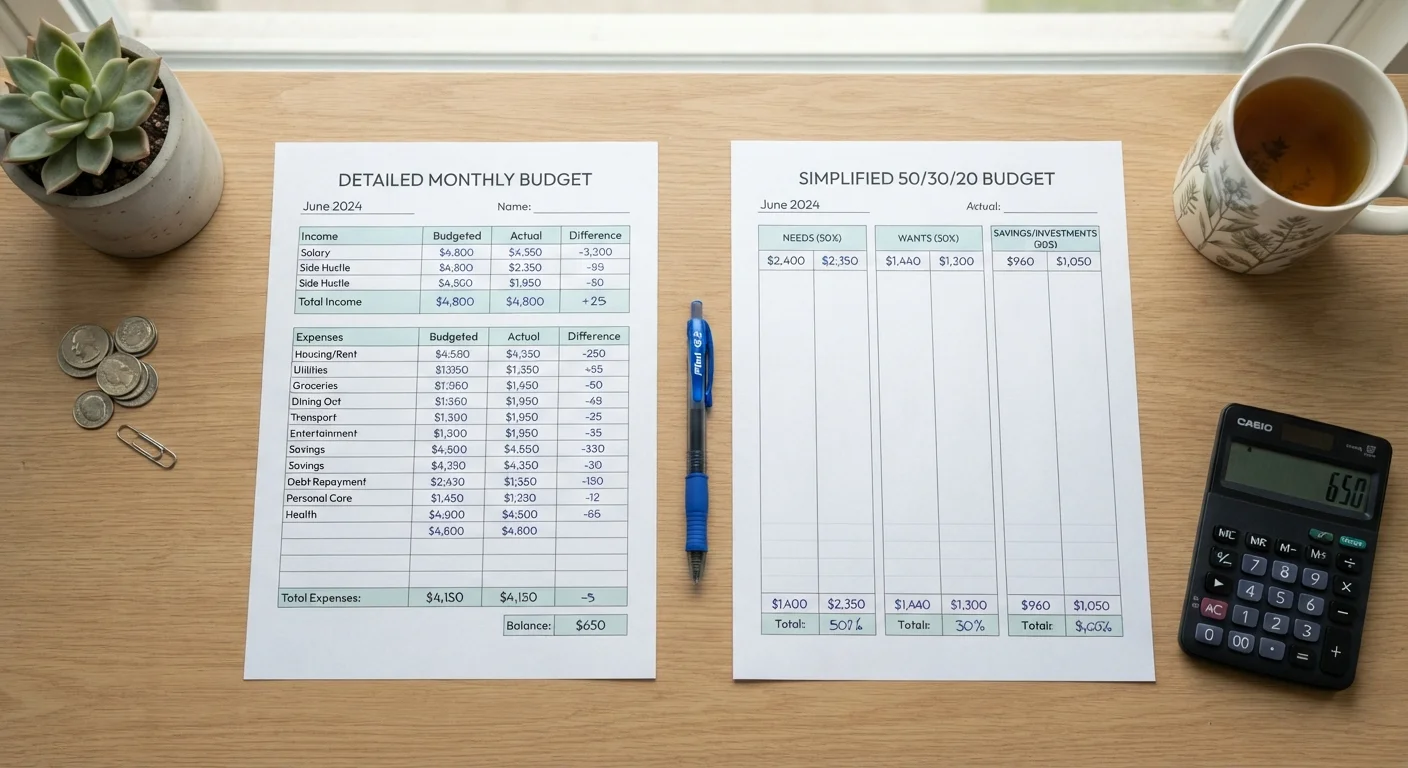
Zero-based budgeting (ZBB) starts from scratch every budget period. You list your total expected income, then allocate every dollar to a specific category — housing, groceries, transportation, savings, entertainment — until the remaining balance is exactly zero. Nothing is left unassigned. The logic is that unplanned dollars tend to disappear without trace.
The 50/30/20 rule, popularized in part by discussions around personal finance frameworks, takes a broader view. After-tax income is divided into three buckets: 50% toward needs (rent, utilities, food, insurance), 30% toward wants (dining out, streaming, hobbies), and 20% toward savings and debt repayment. For a deeper look at how those proportions work in practice, see The 50/30/20 Rule Explained.
Both methods are income-first frameworks — meaning you plan based on what you earn, not what you hope to spend — but their levels of precision differ dramatically.
| Criterion | Zero-Based Budgeting | 50/30/20 Method |
|---|---|---|
| Setup time | High — detailed monthly build | Low — minutes to configure |
| Granularity | Every dollar assigned | Three broad categories |
| Flexibility | Fully customizable each month | Fixed percentage targets |
| Best income type | Variable or irregular income | Stable, predictable income |
| Learning curve | Moderate to steep | Minimal |
| Visibility into spending | Very high | Moderate |
| Ongoing maintenance | Regular monthly effort required | Minimal after initial setup |
Where They Diverge: Effort, Flexibility, and Insight
The most significant practical difference is time investment. Zero-based budgeting typically requires building a new detailed plan each month, reviewing prior spending, and reassigning every dollar deliberately. For households with multiple spending categories or variable expenses, this can take an hour or more per month, plus periodic check-ins.
The 50/30/20 method, by contrast, can be set up in minutes. If your take-home pay is $4,000 a month, your targets are immediately clear: $2,000 for needs, $1,200 for wants, $800 toward savings or debt. The simplicity is a genuine advantage for anyone overcoming common budgeting myths and building early financial habits.
Zero-based budgeting, however, provides granular insight that broad percentages cannot. When every dollar is named, it becomes immediately visible when a category like dining out is consuming funds originally intended for an emergency fund. That specificity can accelerate progress toward concrete financial goals.
The 20% Savings Target Is a Starting Point
The 50/30/20 rule's 20% savings-and-debt guideline was designed as a general benchmark, not a universal prescription. High-interest debt, low emergency fund balances, or specific savings goals may justify adjusting this proportion significantly. Use the framework as a directional guide and consult a licensed financial adviser if your situation is more complex.
Choosing the Right Framework for Your Situation
The right budgeting method is ultimately the one you'll use consistently. Research in behavioral finance consistently suggests that even an imperfect budget, maintained regularly, outperforms a theoretically optimal plan that gets abandoned.
If you're building your first budget, the 50/30/20 framework offers a low-friction entry point. Our seven-step guide to your first budget walks through setting it up without any spreadsheet expertise required. Once comfortable tracking at a category level, transitioning to zero-based budgeting becomes much less daunting.
For those further along — managing debt payoff, saving for a down payment, or dealing with fluctuating freelance income — zero-based budgeting's precision tends to be worth the additional effort. It pairs naturally with tools explored in Paper, Spreadsheet, or App, depending on your preferred tracking style. And whichever framework you choose, building consistent saving habits creates a foundation for the next step: understanding investing fundamentals.
~74%
Americans living paycheck to paycheck
A 2023 LendingClub report found roughly three in four U.S. consumers reported living paycheck to paycheck, underscoring the importance of structured budgeting regardless of which method is chosen.
1 in 3
Adults with no written budget
According to a National Financial Educators Council survey, approximately one-third of U.S. adults do not track their spending with any formal budgeting system.
This article is for general informational and educational purposes only and does not constitute personalized financial or investment advice. Consult a qualified financial professional before making decisions based on your individual circumstances.