

Key Takeaways
- A budget works by matching your spending plan to your actual take-home income, not your gross pay.
- Tracking every expense — even small ones — reveals patterns you can act on.
- The 50/30/20 framework is a useful starting point, but any plan you'll stick to beats a perfect one you abandon.
- Monthly reviews keep your budget accurate as income and expenses naturally shift.
- Hidden irregular costs like car repairs and annual subscriptions sink many first budgets — plan for them early.
Start here
Why a Budget Matters Before You Start
Next
Steps 1–3: Know Your Numbers
Then
Steps 4–5: Build Your Spending Plan
Finally
Steps 6–7: Track, Review, and Adjust
Why a Budget Matters Before You Start
A budget is not a restriction — it is a spending plan built on your actual income. Without one, money tends to leave your account in a pattern you never consciously chose. With one, you decide in advance what each dollar will do, which puts you in control rather than your habits.
Budgeting is also one of the foundational skills that makes everything else in personal finance more achievable. Saving consistently, reducing debt, and eventually investing all become easier when you know exactly what you have available each month. For a broader view of how budgeting fits into your overall financial picture, our complete budgeting guide covers the full journey from first paycheck to long-term plan.
This Is General Financial Education
The steps in this article are intended as general guidance, not personalized financial advice. Everyone's financial situation is different. For decisions specific to your circumstances — including debt repayment strategies or investment choices — consider speaking with a licensed financial adviser.
Steps 1–3: Know Your Numbers
Before you can allocate money, you need to know how much you have and where it is currently going.
Step 1: Calculate Your Net Monthly Income
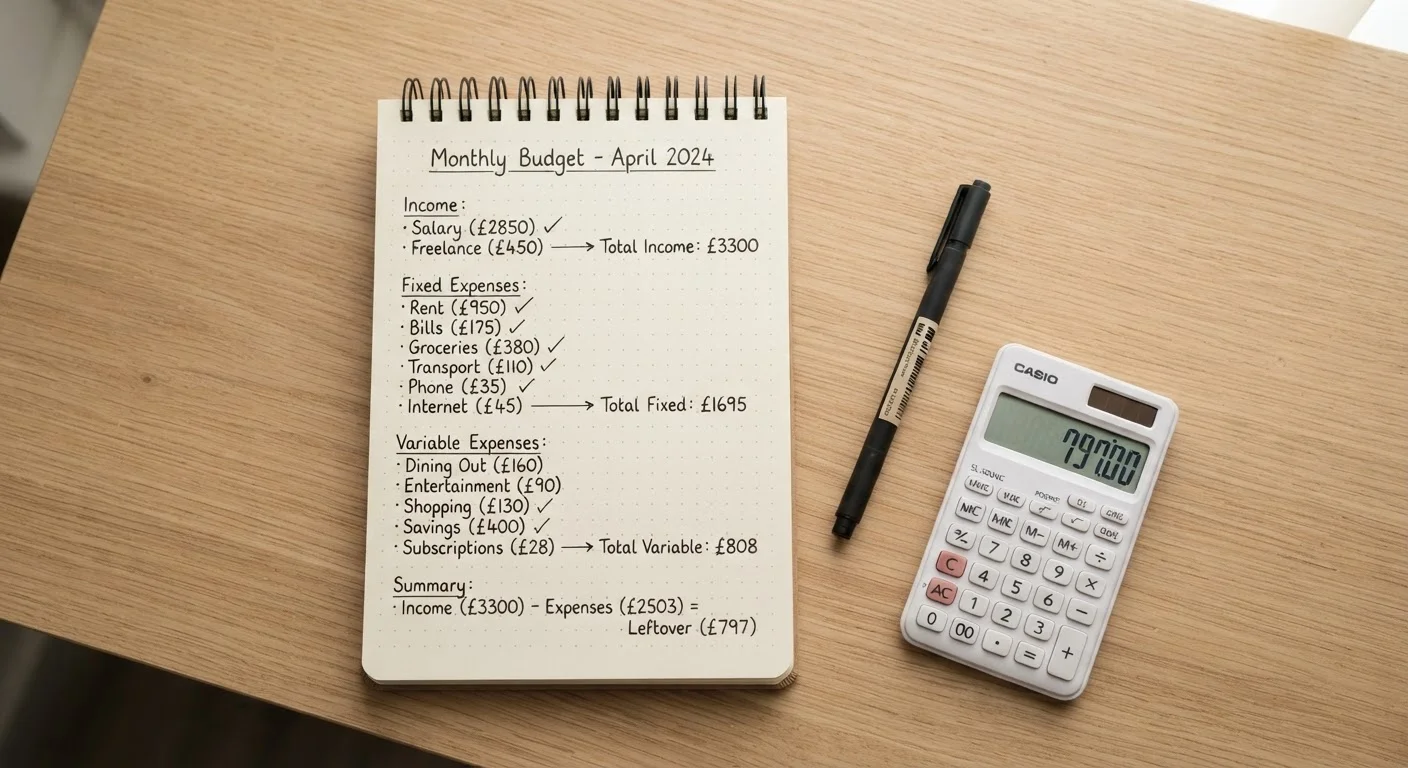
Add up every source of after-tax income you receive in a typical month — your paycheck, any freelance earnings, and any reliable supplemental income. Use net income (take-home pay), not your gross salary. If your income varies month to month, use a conservative average based on the past three to six months.
Step 2: List All Your Expenses
Gather your bank statements and credit card records from the past one to three months. Categorize every transaction into fixed expenses (rent, loan payments, insurance) and variable expenses (groceries, gas, dining). This step often surfaces costs people had genuinely forgotten about. Unfamiliar terms like discretionary spending or sinking fund are defined in our personal budgeting glossary.
Start With Last Month's Bank Statement
Rather than guessing what you spend, pull your most recent bank or credit card statement and categorize every transaction. This gives you a real baseline rather than an optimistic estimate. Most people discover at least one or two surprising spending patterns in the first pass.
Step 3: Calculate the Gap
Subtract total monthly expenses from net monthly income. A positive number means you have room to save or pay down debt. A negative number means spending currently exceeds income — and your budget's first job is to close that gap.
Net income
The amount of money you actually take home after taxes and any other payroll deductions. This is the figure your budget should be built around, not your gross (before-tax) salary.
Fixed expense
A recurring cost that stays the same each month, such as rent, a car payment, or an insurance premium. These are the easiest expenses to plan for because the amount is predictable.
Variable expense
A cost that changes in amount from month to month, such as groceries, fuel, or dining out. These require averaging past spending to estimate a realistic monthly budget.
Discretionary spending
Money spent on non-essential wants — entertainment, hobbies, subscriptions, clothing beyond basics. Reducing discretionary spending is typically the most flexible lever in a budget.
Sinking fund
Money set aside in small amounts each month for a planned future expense, such as a vacation or car repair. Sinking funds prevent irregular costs from disrupting your monthly budget.
Zero-based budget
A budgeting method where every dollar of income is assigned a specific purpose — spending, saving, or debt repayment — so that income minus all allocations equals zero.
Steps 4–5: Build Your Spending Plan
Now you are ready to design a plan rather than simply record history.
Step 4: Choose a Budgeting Framework
A framework gives you guardrails for dividing income across categories. A widely recognized starting point is the 50/30/20 rule: roughly 50% of take-home pay toward needs (housing, utilities, groceries), 30% toward wants (dining out, entertainment, subscriptions), and 20% toward savings and debt repayment. Your numbers may not fit this split exactly, and that is fine — it is a guide, not a law. If you want to compare this approach against a more detailed alternative, see our article on zero-based budgeting vs. the 50/30/20 method.
Step 5: Set Category Limits
Using your expense list from Step 2, assign a monthly spending limit to each category. Be realistic — setting an aspirational grocery budget you have never hit sets you up to feel like you've failed. For categories where spending was wildly inconsistent, estimate based on your average rather than your best month. Don't forget to build small sinking fund contributions into categories for irregular costs like car maintenance or annual subscriptions.
Don't Forget Irregular Expenses
Annual subscriptions, car registration fees, holiday gifts, and vet bills rarely show up in a single month's statement — but they will hit your account eventually. Failing to account for these irregular costs is one of the most common reasons first budgets fall apart. Consider our guide on hidden spending categories to build a more complete picture from the start.
Not sure whether to use paper, a spreadsheet, or an app to manage these categories? Compare budgeting tools to find the format you'll actually stick with.
Steps 6–7: Track, Review, and Adjust
A budget written once and never revisited quickly becomes fiction. The final two steps are what turn a one-time plan into a lasting financial habit.
Step 6: Track Spending Throughout the Month
Record transactions as they happen — or at minimum, do a weekly reconciliation. The goal is to know where you stand in each category before you overspend, not after. Many people find a quick five-minute daily check-in more effective than a large monthly catch-up session. Choose whatever cadence you will actually maintain.
Step 7: Do a Monthly Review and Adjust
At the end of each month, compare what you planned to spend against what you actually spent. Identify categories that were consistently over or under. Adjust limits for the next month accordingly. After two or three months, your budget will reflect how you actually live — and from that stable foundation, you can make meaningful progress on saving and debt reduction.
For a structured approach to monthly check-ins, the monthly budget review checklist walks through exactly what to examine and how to act on what you find. Once your budget is stable, you may also be ready to explore building savings and managing debt — or consider the basics of investing as a longer-term goal.
This article provides general financial education and is not a substitute for personalized financial advice. Please consult a qualified financial professional for guidance specific to your situation.