

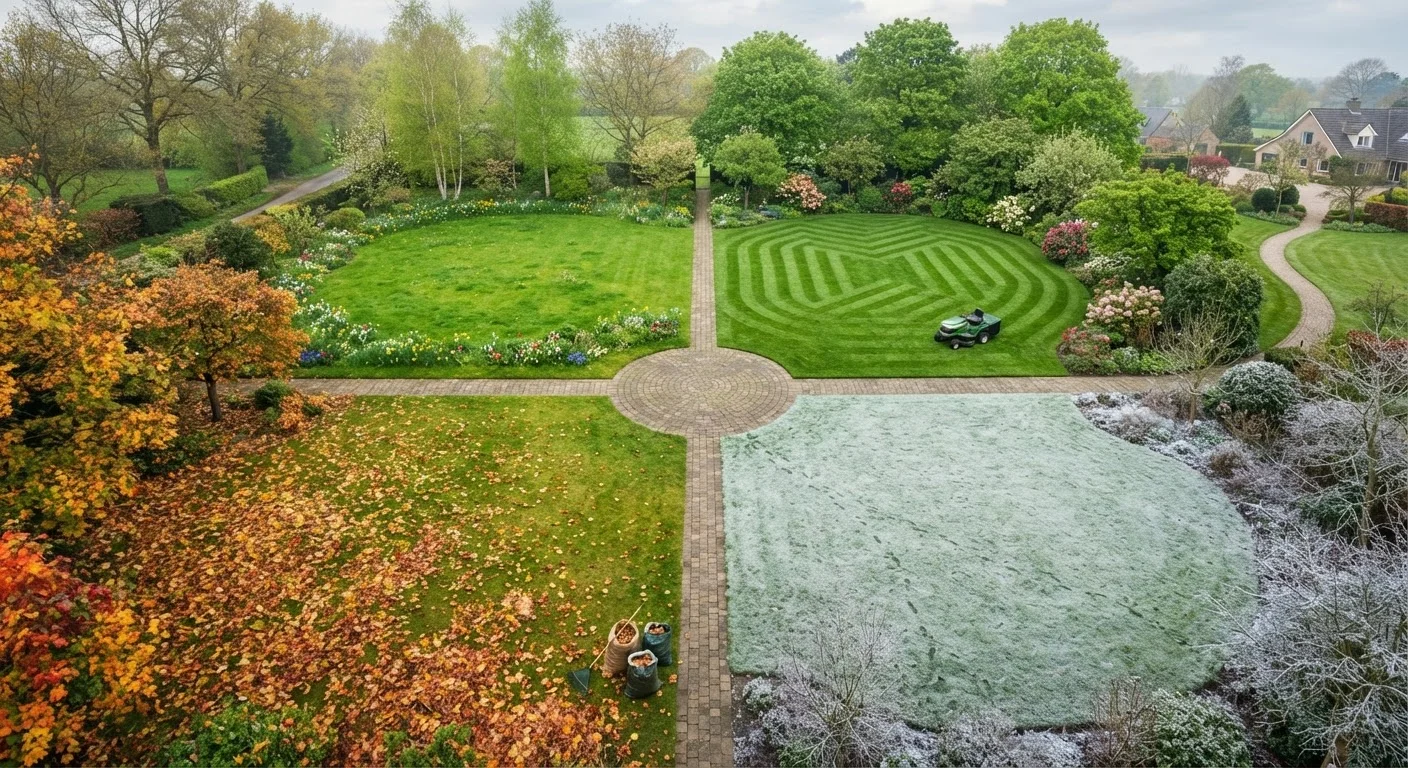
Key Takeaways
- Aerating and overseeding in fall is the single highest-impact task for most lawns.
- Mowing height — not frequency — is the most common source of avoidable lawn damage.
- Fertilize based on grass type: cool-season grasses peak in fall; warm-season grasses in late spring.
- Winter dormancy is normal — avoid traffic and heavy amendments until growth resumes.
- Matching tasks to your grass type and US region produces better results than a generic calendar.
Why Seasonal Lawn Care Matters
Grass is a living system, and like any plant, it responds to temperature, moisture, and daylight. Applying fertilizer at the wrong time, mowing too short in a drought, or skipping fall aeration can set a lawn back by an entire growing season. A seasonal approach — matching tasks to what the grass actually needs — removes guesswork and prevents the most common mistakes.
Two major grass categories shape every decision: cool-season grasses (fescues, bluegrass, ryegrass) thrive in the northern US and grow most actively in spring and fall. Warm-season grasses (Bermuda, zoysia, St. Augustine) dominate the South and Southwest, peaking in summer. Knowing your grass type is step one. If you're also planning beds, borders, or new plantings around your lawn, the seasonal garden planning checklist is a useful companion resource.
~40M
US acres of managed lawn turf
Estimates from turfgrass researchers suggest US lawns cover roughly 40 million acres, making lawn care one of the country's most widespread land-management activities.
1 inch
Recommended weekly water depth
Turfgrass extension guidelines across multiple US universities consistently cite one inch of water per week — from rain or irrigation combined — as the standard target for most grass types.
½ inch
Thatch thickness threshold for action
Turf specialists generally recommend dethatching or aerating once the thatch layer exceeds half an inch, at which point it begins impeding water and nutrient movement to roots.
Spring: Wake Up Your Lawn Right
Spring tasks are about assessment and gentle encouragement — not aggressive intervention. Begin with a cleanup pass: rake out thatch (the layer of dead grass and debris between soil and blades) and remove any remaining winter debris. Thatch thicker than half an inch restricts water and nutrient absorption.
Mowing should resume once grass is actively growing and the soil is no longer waterlogged. Set the blade high for the first few cuts — around 3 to 3.5 inches for most cool-season grasses — to encourage deep root development. Never remove more than one-third of the blade in a single mow.
Apply a pre-emergent herbicide early in spring if crabgrass has been a recurring problem. Timing matters: apply before soil temperatures reach 55°F consistently. Most garden centers carry soil thermometers for this purpose.
Fertilizing in spring should be light, particularly for cool-season lawns. A moderate application of a balanced fertilizer supports green-up without triggering the explosive top growth that crowds out root development.
Spring Soil Test: Worth the Effort
Before applying any fertilizer, consider a basic soil pH test. Most grasses prefer a pH between 6.0 and 7.0. Soil that is too acidic or alkaline limits nutrient uptake regardless of how much fertilizer you add. Cooperative extension offices in most US states offer affordable soil testing and straightforward amendment guidance.
Summer: Protect and Maintain
Summer stresses cool-season lawns and rewards warm-season ones. The core principle for this season is conservation: conserve moisture, conserve leaf surface, and conserve root energy.
Raise your mowing height by half an inch in summer. Taller blades shade the soil, reduce evaporation, and help grass outcompete weeds. Mow in the cooler parts of the day — morning after dew has dried, or early evening — and keep blades sharp to avoid tearing grass tissue.
Watering: most lawns need about one inch of water per week, including rainfall. Water deeply and infrequently (two to three times per week rather than daily shallow sessions) to encourage roots to grow downward. Early morning is the best watering window — foliage dries quickly, reducing disease risk.
Avoid heavy fertilization of cool-season grasses in midsummer. Warm-season grasses, however, are in peak growth mode and benefit from regular feeding through June and July.
Leave grass clippings on the lawn after mowing — they decompose quickly and return nitrogen to the soil, reducing the amount of supplemental fertilizer you need.
This practice, called grasscycling, is supported by university extension programs and can reduce fertilizer needs by an estimated 25% over a season.
If your lawn browns in summer heat, resist the urge to water more aggressively at night — instead, water deeply early in the morning to minimize fungal disease risk.
Prolonged overnight moisture on grass blades is a primary driver of common lawn diseases like brown patch and dollar spot, particularly in humid US climates.
Fall: The Most Important Season for Lawns
For cool-season lawns, fall is prime time — and for all lawns, fall preparation determines how well the turf survives winter and rebounds in spring. This is the season to invest the most effort.
Aeration — either core aeration (pulling plugs of soil) or spike aeration — reduces compaction, improves drainage, and lets fertilizer and seed reach the root zone. Core aeration is generally more effective and is best done when soil is moist but not saturated.
Overseeding fills in bare or thin patches. Spread seed immediately after aerating so it falls into the holes. Keep the seeded area consistently moist for two to three weeks until germination is established. For more on soil prep alongside this process, the guide to mulching techniques covers complementary soil health practices.
Fall fertilization is the most impactful feed of the year for cool-season grasses. A fertilizer higher in potassium and phosphorus supports root storage of nutrients that will fuel spring green-up. Apply four to six weeks before the ground freezes.
Continue mowing until growth genuinely stops — typically when daytime temperatures stay consistently below 50°F. Lower the blade slightly for the final cut to reduce the risk of snow mold.
Don't Skip Fall Aeration
Of all annual lawn tasks, fall core aeration delivers the clearest return on effort for cool-season lawns. Compacted soil is the root cause of poor drainage, thin turf, and fertilizer waste. Aerate before overseeding and before the fall fertilizer application — the sequence matters. Skipping this step and simply overseeding or fertilizing on compacted ground will produce noticeably weaker results.
Winter: Rest, Repair, and Plan Ahead
Dormant grass looks brown but is not dead — it has drawn energy down to the roots to wait out the cold. The primary rule in winter is minimize disturbance. Foot traffic on frozen or frost-covered grass can damage crowns (the growing point at the base of each blade), leading to bare patches in spring.
Use winter for equipment maintenance: sharpen mower blades, service the engine, clean the undercarriage, and properly store any fertilizer spreaders. A well-maintained mower makes a measurable difference in cut quality throughout the growing season.
This is also an ideal time for planning. Review what worked and what didn't in the past year. Consider whether your lawn has drainage issues, compaction zones, or shaded areas that consistently underperform — and research solutions before spring arrives. If you're planning broader outdoor changes, understanding annuals versus perennials can help you design borders and beds that complement your lawn layout.
Warm-Season Lawns Handle Winter Differently
Warm-season grasses (Bermuda, zoysia, centipede) go fully dormant and turn tan or straw-colored in winter across much of their range — this is normal and expected. Some homeowners in the South overseed dormant warm-season lawns with annual ryegrass for winter green color; this is cosmetic and requires removal in spring before the base grass resumes growth.
Quick-Reference Seasonal Task Chart
| Task | Spring | Summer | Fall | Winter |
|---|---|---|---|---|
| Mowing | Resume at high setting | Raise height; mow cool | Continue; lower for last cut | Stop when dormant |
| Fertilizing | Light balanced feed | Cool-season: skip; Warm-season: feed | Heavy feed (cool-season) | None |
| Watering | As needed; watch rainfall | 1 inch/week; deep, infrequent | Reduce as temps drop | None unless drought region |
| Aerating | Optional for warm-season | Avoid | Primary window (cool-season) | None |
| Overseeding | Spot repairs only | Avoid | Ideal timing | None |
| Weed control | Pre-emergent early spring | Spot-treat as needed | Post-emergent broadleaf | Plan strategy |
Consistent, well-timed care across all four seasons produces the kind of lawn that is resilient to drought, disease, and heavy use. Small, regular investments each season prevent the costly corrections — resodding, heavy chemical treatments, or soil amendment overhauls — that result from neglect. Pair this reference with a garden seasonal checklist to coordinate your lawn and garden efforts throughout the year.
Avoid Over-Fertilizing in Hot Weather
Applying high-nitrogen fertilizer to cool-season grasses during summer heat can burn roots and invite disease. If your lawn is stressed or dormant, hold off on feeding until temperatures reliably drop below 85°F. When in doubt, apply less than the label maximum and observe how the lawn responds before the next application.