

Key Takeaways
- Your owner's manual contains the definitive service schedule for your specific vehicle.
- Minor and major services cover different components and vary significantly in scope and cost.
- Both mileage and time matter — follow whichever threshold arrives first.
- Severe driving conditions can shorten recommended intervals for many components.
- Keeping service records protects resale value and helps diagnose future problems.
- Dashboard warning lights are not a substitute for proactive scheduled maintenance.
Vehicle Service Schedule
A vehicle service schedule is a manufacturer-recommended plan that outlines when specific maintenance tasks should be performed on your car. It's based on mileage intervals, time elapsed, or both — whichever comes first. Following it helps prevent premature wear, catch developing problems early, and keep your warranty valid.
Service schedules are engineered to match the wear rates of specific components under typical driving conditions; 'severe' driving conditions (frequent short trips, towing, extreme temperatures) often require accelerated intervals.
What a Service Schedule Actually Is
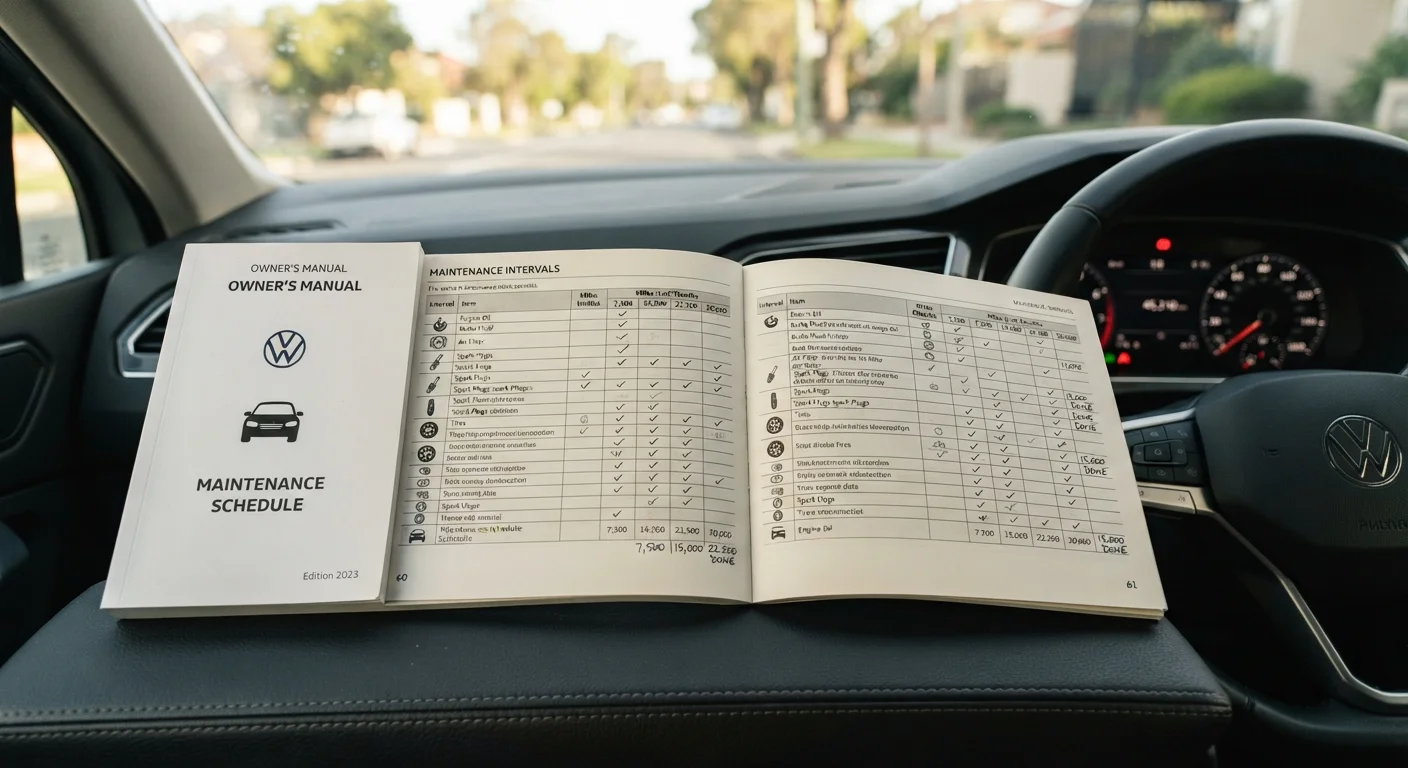
Think of a service schedule as a maintenance calendar written specifically for your car — not cars in general. Manufacturers engineer these intervals based on how components wear under real-world use. The schedule lives in your owner's manual, often toward the back, and it's the single most reliable source of guidance for your specific vehicle.
Service intervals are triggered by mileage, elapsed time, or both. The general rule: act on whichever comes first. A car driven only 3,000 miles in a year can still degrade — oil oxidizes, seals dry out, and moisture builds up in systems that aren't regularly exercised. Time-based triggers exist precisely for this reason.
For a broader look at what mechanics actually inspect at each service level, see what a full car service actually includes.
Manufacturer vs. Dealer Recommendations May Differ
Dealership service advisors sometimes recommend intervals shorter than what the manufacturer specifies. While some upselling is well-intentioned, the manufacturer's schedule — printed in your owner's manual — is the authoritative baseline. If a shop suggests more frequent service, ask them to explain the specific reason for your vehicle and driving conditions.
Minor vs. Major Services: What's Actually Different
The terms "minor" and "major" service get used loosely, but the distinction matters for your wallet and your car's health.
- Minor service typically includes an oil and filter change, a tire pressure check, and a visual inspection of key fluids and belts. It's a quick health check.
- Major service is more comprehensive — it often includes replacing the air filter, cabin filter, and spark plugs; inspecting brake pads and rotors; flushing and topping off fluids; and checking the condition of belts and hoses. This is the service that catches slow-developing problems before they become expensive failures.
Major services generally occur at wider intervals — commonly every 30,000 miles or every two to three years, depending on the vehicle. Some manufacturers use a tiered naming system (Inspection I, Inspection II) rather than minor/major labels. Your owner's manual will clarify which applies to your car.
Use Both Mileage and Time Triggers
Don't wait until you hit the mileage marker if the time interval arrives first. A car that sits mostly in the garage still needs attention on a time basis — oil degrades, rubber seals dry out, and brake fluid absorbs moisture regardless of miles driven.
Reading Your Owner's Manual the Right Way
Most drivers open the owner's manual once and never look at it again. That's a missed opportunity. The maintenance section typically includes two schedules side by side: one for normal driving conditions and one for severe conditions. Severe doesn't mean off-roading — it can mean daily short-trip commuting, towing, or driving in extreme heat.
Look for a table that lists services down the left column and mileage or time intervals across the top. Each cell tells you whether that service is due. Some newer vehicles replace this with an oil life monitoring system that calculates intervals based on actual driving data — useful, but it still doesn't cover every scheduled task, so the manual remains essential.
If you're driving a higher-mileage vehicle and want to understand how schedules evolve over time, keeping a high-mileage car running reliably covers what to prioritize as the odometer climbs.
35%
Drivers who skip recommended oil change intervals
According to industry estimates cited by the Car Care Council, a significant share of vehicles on American roads are overdue for basic scheduled maintenance at any given time.
$1,200+
Average cost of a neglect-related engine repair
The Car Care Council has consistently found that deferred routine maintenance is among the leading causes of costly mechanical failures in passenger vehicles.
Staying on Track and Keeping Records
Consistent records are almost as valuable as the services themselves. A documented history tells a mechanic what's been done, helps diagnose recurring issues, and demonstrates responsible ownership if you sell the vehicle. Keep a simple folder — physical or digital — with service receipts, mileage at time of service, and the shop or technician's name.
Scheduled maintenance is proactive; warning lights are reactive. By the time a dashboard symbol illuminates, a problem is usually already underway. See what your warning lights actually mean to understand how they fit alongside — not instead of — your service schedule.
If you're weighing which tasks you can handle yourself versus when to bring in a pro, DIY vs. professional servicing offers a grounded breakdown of where the line typically falls.
This article provides general vehicle maintenance information for educational purposes. Service intervals and requirements vary by make, model, and driving conditions. Always consult your owner's manual and a qualified mechanic for guidance specific to your vehicle.