

Key Takeaways
- Correct tyre pressure is found on your door jamb sticker, not the tyre sidewall.
- Tread depth below 2/32" is legally unsafe in most U.S. states; 4/32" is the practical safety threshold in wet weather.
- Under-inflated tyres increase stopping distance, reduce fuel economy, and wear unevenly.
- A quarter and a penny are quick field tools for estimating tread depth.
- Check both pressure and tread at least once a month and before any long road trip.
Tyre Pressure & Tread Depth
Tyre pressure is the amount of air inside your tyre, measured in pounds per square inch (PSI). Tread depth is how much rubber remains on the tyre's contact surface. Together, these two measurements determine how well your tyres grip the road, stop in an emergency, and handle wet or slippery conditions.
Tyre pressure is affected by ambient temperature — roughly 1 PSI is lost for every 10°F drop in outside temperature, which is why cold mornings can trigger your TPMS warning light.
Reading the Numbers Before You Drive
Your tyres carry a surprising amount of data — moulded right into the rubber. A typical sidewall code like 215/60R16 95H tells a mechanic (and a curious driver) the tyre's width in millimetres, the aspect ratio of the sidewall, the rim diameter in inches, the load index, and the speed rating. None of those numbers tell you what pressure to run. That figure lives on a sticker inside your driver's door jamb, and it is the one that matters for everyday driving.
The maximum PSI printed on the tyre sidewall is a structural ceiling — the most air the tyre can safely hold — not an operating target. Running a tyre at that maximum often produces a harsher ride, reduced contact patch, and uneven centre wear. Always defer to the vehicle manufacturer's recommended PSI, which accounts for the car's weight distribution and handling characteristics.
For a broader look at dashboard alerts that relate to tyre health, see what your warning lights are actually telling you.
The Safety Math Behind Tyre Pressure
Pressure keeps the tyre's shape correct so the full width of the tread contacts the road. When pressure drops even modestly, the tyre bulges at the edges, heat builds faster, and the sidewall flexes more than it was designed to. Over time, that flexing degrades the internal structure — sometimes invisibly until a blowout occurs.
1 PSI
Pressure lost per 10°F temperature drop
The U.S. Department of Energy notes this relationship between ambient temperature and tyre pressure as a key reason for seasonal checks.
4/32"
Practical wet-weather tread replacement threshold
Independent tyre safety testing has consistently shown meaningful increases in wet stopping distances as tread depth approaches the 2/32" legal minimum.
2/32"
U.S. legal minimum tread depth
Most U.S. states set this as the point at which a tyre is considered legally worn out, marked by flush tread wear indicators.
Over-inflation is less common but equally problematic. A tyre inflated beyond the recommended PSI rides on a narrowed contact patch concentrated in the centre of the tread. This reduces wet-weather grip and makes the vehicle feel skittish over road imperfections. The sweet spot — always that door-jamb figure — balances contact area, ride quality, and longevity.
Because ambient temperature shifts PSI without any driver input, checking pressure monthly and seasonally (particularly at the first cold snap of autumn) is a practical habit rather than an anxious one.
Tread Depth: Where the Legal Line Sits — and Where the Practical Line Is
Federal law and most state regulations set a minimum tread depth of 2/32 of an inch. At that depth, the tyre's built-in wear indicators — small rubber bars running across the grooves — become flush with the tread surface. Legally, a tyre at 2/32" is expired.
But safety research consistently points to a more conservative threshold. Independent tyre testing has shown that wet stopping distances increase substantially as tread depth falls from 4/32" toward 2/32". In practical terms, a tyre that meets the legal standard may still struggle to channel water away from the contact patch on a rain-slicked highway. Many tyre safety advocates recommend treating 4/32" as the personal action threshold — especially for drivers in regions with frequent rain or the possibility of snow.
Use a Quarter for an Earlier Warning
The penny test confirms a tyre is already at the legal minimum. For a safer buffer — especially in wet climates — use a quarter instead. If you can see the top of Washington's head, your tread is at approximately 4/32", and it is worth planning a replacement soon rather than waiting until the penny test triggers.
Uneven tread wear is its own diagnostic tool. Wear concentrated in the centre suggests chronic over-inflation; wear on both outer edges points to chronic under-inflation; wear on one edge often indicates an alignment or suspension issue that no amount of tyre rotation will fully fix. If you notice uneven wear, a qualified mechanic should inspect the suspension geometry before you invest in new rubber.
For related safety context on stopping systems, our piece on brake maintenance myths covers the other half of the stopping equation.
Building a Simple Monthly Routine
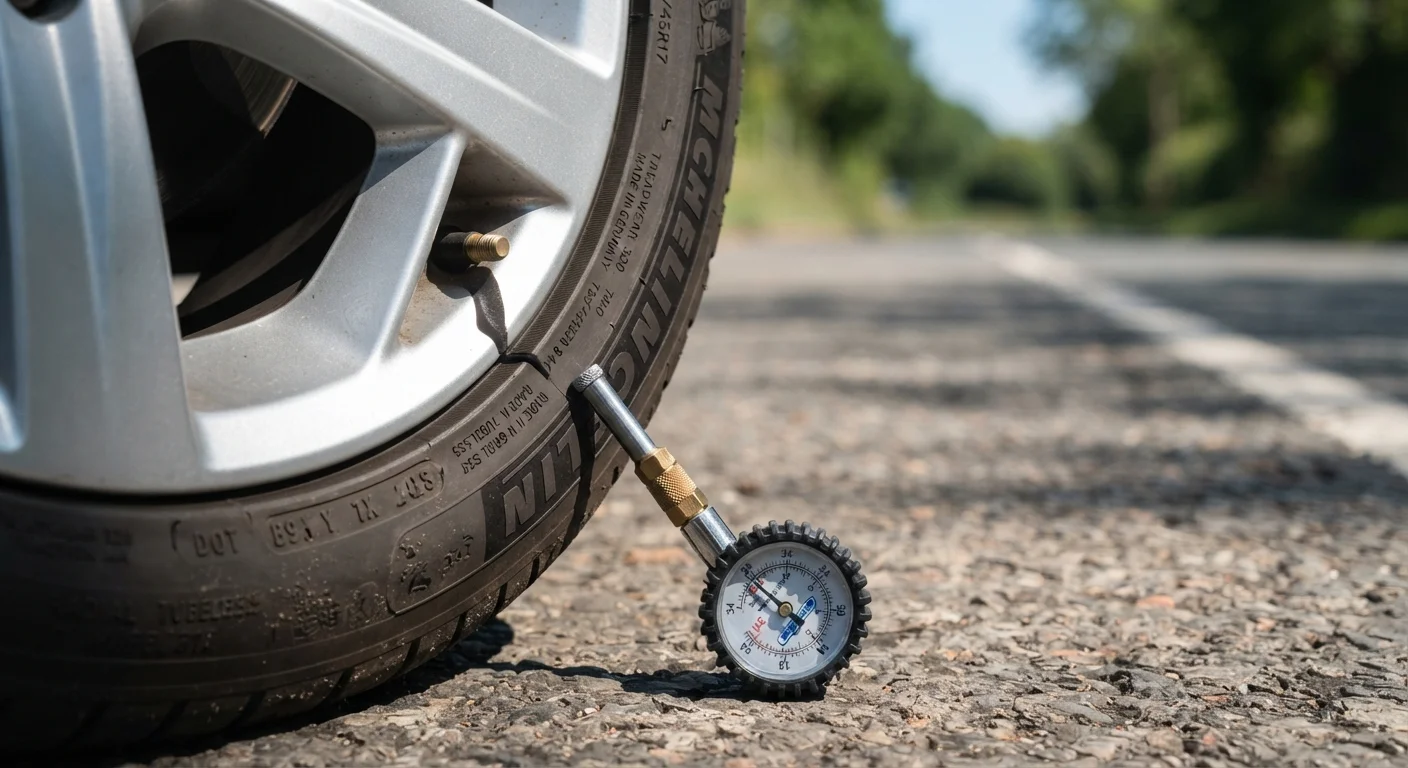
Neither check requires special equipment or mechanical skill. A quality dial or digital tyre gauge costs a few dollars and fits in a glove box. For tread, a penny or quarter works as a field tool, though an inexpensive tread-depth gauge gives a precise reading in 32nds of an inch.
Check pressure when tyres are cold — after the car has sat for at least three hours. Unscrew the valve cap, press the gauge firmly onto the valve stem until the hiss stops, and read the result. Compare it to the door-jamb sticker. Add or release air as needed, replace the cap, and repeat on all four tyres (and the spare, if accessible).
For tread, insert the coin into several grooves across the width and at multiple points around the circumference. Tread depth can vary across a tyre — checking only one spot may miss localised wear. Log your readings in a notes app or simple notebook. A pattern of rapid loss between checks is a signal worth discussing with a professional.
Explore more practical upkeep guidance in our vehicle maintenance hub — a useful reference to bookmark alongside your monthly tyre check.
This article is for general informational purposes only. Vehicle maintenance needs vary by make, model, driving conditions, and local regulations. Always consult a qualified mechanic for advice specific to your vehicle.