

Key Takeaways
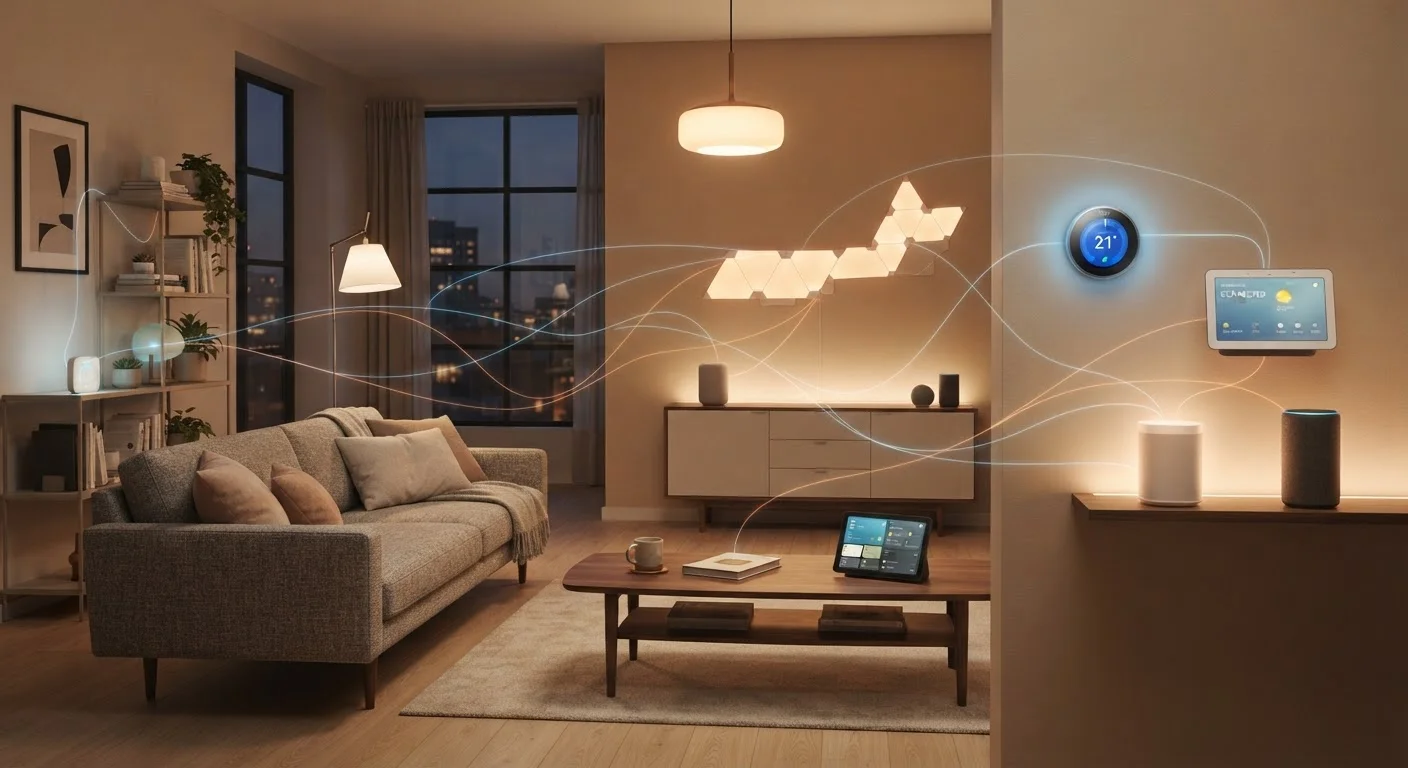
- Matter is a universal standard that lets smart home devices from different brands work together.
- It was built collaboratively by Apple, Google, Amazon, and Samsung, among others.
- Matter devices connect locally, reducing dependence on cloud servers and improving reliability.
- Not all existing devices support Matter — compatibility depends on hardware and manufacturer updates.
- Owning a Matter-compatible hub or controller is required to take full advantage of the standard.
Matter
Matter is a universal smart home connectivity standard developed by the Connectivity Standards Alliance (CSA), with backing from major tech companies. It defines a common language that smart home devices use to talk to each other, regardless of which brand made them. If a device is certified as Matter-compatible, it should work with any Matter-supported app or voice assistant — no workarounds needed.
Matter runs locally over Wi-Fi and Thread (a low-power mesh networking protocol), meaning many commands execute on your home network rather than routing through a cloud server, which can improve speed and reliability.
Why Smart Homes Needed a Common Standard
For most of the smart home's short history, buying a new device meant a frustrating question: Will this actually work with what I already have? A smart bulb from one brand might only work with that brand's hub. A thermostat from another company might need its own dedicated app. If you used Apple's ecosystem, Amazon's Alexa-compatible devices might not integrate cleanly — and vice versa.
This fragmentation wasn't just inconvenient. It created real barriers for anyone who wanted to build a connected home without committing to a single manufacturer's entire product line. For a broader understanding of how devices communicate in a smart home environment, see our plain-language smart home explainer.
Matter was designed specifically to solve this. Announced in 2019 and launched in late 2022, it establishes a single agreed-upon protocol that devices and platforms are expected to follow. Think of it like USB: before USB, every peripheral needed a different port. After USB, you plug in almost anything and it just works.
600+
Matter-certified products available at launch
The Connectivity Standards Alliance reported over 600 certified Matter products within the first year of the standard's release.
4
Major platforms backing Matter from the start
Apple, Google, Amazon, and Samsung were founding contributors to the Matter specification through the CSA working group.
How Matter Actually Works
At its core, Matter defines the rules for how a smart device announces itself on a network, how a controller (like your phone or a smart speaker) discovers it, and how commands are sent and confirmed. This happens over your local home network — either Wi-Fi or Thread.
Thread is worth a brief explanation. It's a low-power mesh networking protocol designed for small devices like sensors and smart plugs that can't always maintain a constant Wi-Fi connection. Thread devices form a mesh, meaning signals can hop between devices to reach the router. Matter supports both Wi-Fi and Thread as its underlying transport, choosing whichever suits the device type.
Because Matter devices communicate locally, many actions — turning on a light, locking a door — don't need to travel to a company's server and back. This makes responses faster and means your devices keep working even during cloud outages.
Check for Thread Border Router Support
To use Thread-based Matter devices, your setup needs a Thread Border Router — a device that bridges the Thread mesh network to your home Wi-Fi. Many newer smart speakers and Apple TV models include this functionality. Check your hub's specs before purchasing Thread-based sensors or accessories.
What Changes for You as a Consumer
The most immediate change is freedom of choice. With Matter-certified devices, you're no longer locked into a single brand's ecosystem. You can buy a smart lock from one company and a sensor from another, and manage both through whichever platform you prefer — Apple Home, Google Home, Amazon Alexa, or Samsung SmartThings.
A feature called multi-admin takes this further. It allows one device to be simultaneously linked to multiple platforms. If your household has a mix of iPhone and Android users, each person can control the same device from their preferred app.
Setup is also simplified. Matter uses a QR code or numeric code on the device to handle initial pairing. You scan it with your phone, and your chosen platform securely adopts the device. For those exploring which connected devices genuinely earn their place, this guide to smart home devices worth adding offers useful context on what to prioritize.
What Matter Doesn't Fix (Yet)
Matter is a significant step forward, but it doesn't solve every smart home challenge. The standard currently covers a defined set of device types — lights, locks, thermostats, plugs, window coverings, sensors — and the list is expanding with each new version, but some categories still lack full support.
Older devices won't automatically become Matter-compatible. Some manufacturers have issued firmware updates to add Matter support, but many older products will remain on proprietary protocols indefinitely. You can check common smart home misconceptions to understand where compatibility expectations often go wrong.
It's also worth noting that Matter doesn't address data privacy directly. Devices still collect usage data, and what happens to that data depends on each manufacturer's policies. For a deeper look at what your connected devices may be gathering, our smart home privacy guide covers the key considerations.
Matter Versions Keep Expanding Device Support
The Matter specification is updated periodically by the CSA. Version 1.2 and beyond added support for additional device categories such as robot vacuums, refrigerators, and energy management devices. If a device type you care about isn't supported yet, it may be included in a future release. Check the CSA's official site for the current list of supported device categories.
Getting Started With Matter
If you're setting up a smart home now or adding to an existing one, Matter-certified devices are a sensible default choice. Look for the Matter logo on packaging before purchasing. Ensure your hub or controller platform — whichever smart speaker or app you plan to use — has been updated to support Matter, as most major platforms have added this through software updates.
If you're starting from scratch with entry-level devices, understanding the differences between smart plugs, bulbs, and switches is a useful first step, since these are the most common Matter-certified categories available today. You can also explore more device guidance through our Everyday Devices hub.
Matter doesn't require you to throw out your existing setup. A mixed environment — some Matter devices, some older proprietary ones — is perfectly workable. Over time, as more certified products reach the market, the balance will naturally shift in Matter's favor.