

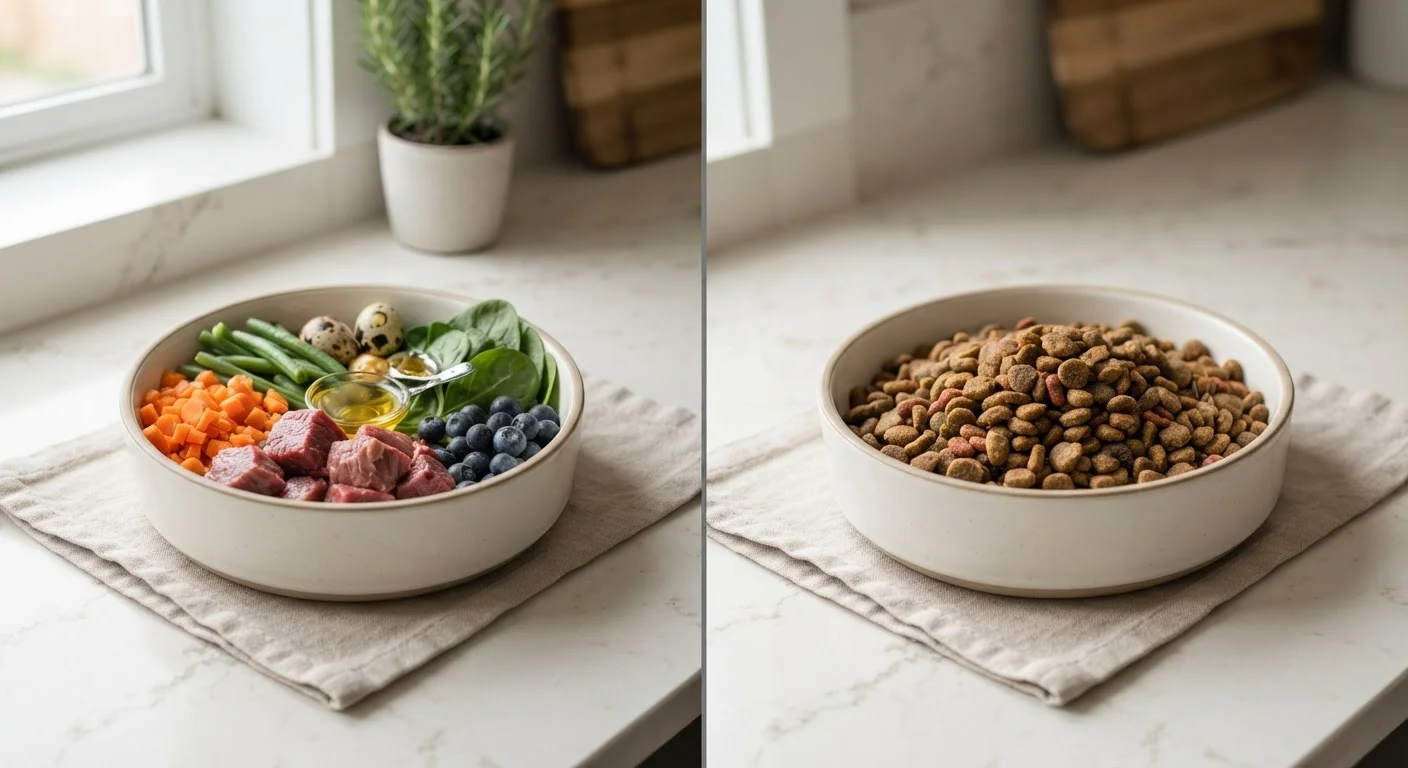
Key Takeaways
- Neither raw nor kibble is universally superior — each involves real trade-offs in nutrition, safety, and practicality.
- Properly formulated kibble meeting AAFCO standards is nutritionally complete for most healthy dogs and cats.
- Raw diets carry documented bacterial and parasitic contamination risks that require strict food-handling protocols.
- Raw diets that are not carefully balanced can develop serious nutritional deficiencies or excesses over time.
- Household vulnerability — including immunocompromised humans or pets — is a key safety factor in the raw feeding decision.
- Any significant dietary change should be discussed with a licensed veterinarian or board-certified veterinary nutritionist.
Option A
Raw Feeding (BARF / Prey Model)
The ancestral-inspired, whole-food approach.
Best for: Owners committed to hands-on meal preparation who want full control over ingredients and sourcing.
Option B
Commercial Kibble
The convenient, rigorously formulated staple.
Best for: Pet owners seeking a nutritionally complete, easy-to-store, veterinarian-familiar feeding option.
If convenience and nutritional certainty matter most to you
Commercial Kibble
AAFCO-compliant kibble is formulated to meet established nutrient profiles for specific life stages, removing the guesswork from daily feeding with minimal preparation time.
If you want maximum ingredient transparency and can commit to careful meal planning
Raw Feeding (BARF / Prey Model)
A raw diet with recipes developed by a board-certified veterinary nutritionist can offer whole-food ingredients and avoidance of certain additives, provided you follow rigorous food-safety protocols.
If there are immunocompromised people or animals in your household
Commercial Kibble
Raw meat carries a measurable risk of Salmonella, Listeria, and other pathogens. Kibble's processing steps substantially reduce this contamination risk for vulnerable households.
If your pet has a specific diagnosed health condition
Commercial Kibble
Therapeutic and prescription kibble diets are clinically validated for conditions like kidney disease, diabetes, and allergies; raw diets lack this evidence base and are harder to standardize.
What Each Approach Actually Involves
Raw feeding encompasses two main frameworks: the Biologically Appropriate Raw Food (BARF) model, which includes raw muscle meat, meaty bones, organ meat, and some fruits and vegetables; and the prey model, which more strictly mimics whole-prey proportions without plant matter. Both require sourcing, portioning, and storing raw animal products at home.
Commercial kibble is an extruded, dry-processed food in which ingredients are cooked under pressure, shaped, and dried to remove moisture. Reputable manufacturers formulate to meet nutritional standards set by the AAFCO, which publishes nutrient profiles for dogs and cats at different life stages. Some products also undergo feeding trials, considered the stronger evidence standard.
It is worth noting that "raw feeding" is not a single standardized diet — recipes vary enormously between households and online sources. This variability matters significantly when evaluating the evidence. For a broader look at how ingredient choices affect pet health, see our analysis of grain-free diet claims.
Nutritional Completeness: Where the Evidence Stands
The most consistent concern raised by veterinary nutritionists about home-prepared raw diets is nutritional imbalance. Multiple peer-reviewed analyses of raw diet recipes — including those widely circulated online — have found that the majority fail to meet AAFCO minimum nutrient requirements. Common shortfalls include calcium-to-phosphorus imbalances (particularly when bones are excluded), insufficient iodine, and inadequate vitamin D and E.
Commercial kibble formulated to AAFCO standards and verified through feeding trials has decades of population-level data supporting its adequacy for healthy pets. That said, kibble is not perfect: the high-heat extrusion process can degrade some heat-sensitive vitamins, which manufacturers compensate for by adding synthetic nutrients post-processing.
~60%
Raw diet recipes failing AAFCO minimums
A 2019 study published in the Journal of Nutritional Science found that the majority of home-prepared raw dog food recipes analyzed were nutritionally deficient in at least one key nutrient.
~25%
Commercial raw products testing positive for pathogens
An FDA sampling study of commercial raw pet food found that roughly one in four products tested positive for Salmonella or Listeria monocytogenes.
74%
Pet owners who value ingredient transparency
According to the American Pet Products Association's pet owner surveys, the majority of dog and cat owners say knowing what is in their pet's food is important to their purchasing decisions.
Proponents of raw feeding often cite improved coat condition, smaller stool volume, and better dental health as observed benefits. These reports are largely anecdotal; controlled, peer-reviewed studies supporting these outcomes are limited. The dental benefit from raw meaty bones does have some scientific plausibility — mechanical abrasion may reduce tartar — but bone chewing also carries documented risks of tooth fractures and intestinal obstruction.
Before switching diets, consult our practical checklist for evaluating a new pet food.
Food Safety: A Non-Negotiable Consideration
The CDC, the FDA, and the American Veterinary Medical Association (AVMA) have all issued position statements or guidance noting the public health risks associated with raw pet food diets. Studies have detected Salmonella, Listeria monocytogenes, E. coli, and parasites such as Toxoplasma gondii and Neospora caninum in commercially available raw pet food products.
Critically, the risk extends beyond the pet. Contaminated food, feeding surfaces, pet feces, and even the pet's coat can become vectors for human exposure. This is a particularly serious consideration in households with young children, elderly individuals, pregnant people, or anyone with a compromised immune system.
High-Risk Household Warning
The FDA and AVMA advise against feeding raw meat-based diets in households with immunocompromised individuals, young children under five, or elderly adults. The risk stems not only from the pet's bowl but from contaminated surfaces and pet fur. If your household includes any of these groups, discuss alternatives with your veterinarian before pursuing a raw diet.
Kibble is not without food-safety history — there have been documented recalls for Salmonella and mycotoxin contamination — but the thermal processing used in manufacture substantially reduces (though does not eliminate) pathogen load compared with raw products.
If you are also considering how certain ingredients intersect with human food risks, our guide on feeding pets human food addresses where genuine dangers lie.
Head-to-Head Comparison
The table below summarizes the core trade-offs across the dimensions most likely to affect your decision.
| Criterion | Raw Feeding | Commercial Kibble |
|---|---|---|
| Nutritional completeness | Variable; depends on recipe quality | Standardized via AAFCO guidelines |
| Pathogen risk | Higher — requires strict hygiene | Lower due to thermal processing |
| Ingredient transparency | Full control over sourcing | Ingredient list on label; processing varies |
| Convenience | Time-intensive; requires planning | Ready to serve; easy to store |
| Cost | Often higher, especially for quality meat | Wide price range; generally lower |
| Veterinary evidence base | Limited controlled studies | Decades of population-level data |
| Suitability for special health needs | Difficult to standardize therapeutically | Clinically validated prescription options |
For cat owners specifically, feeding format carries its own nuances. Our detailed comparison of wet food versus dry food for cats covers moisture, palatability, and dental considerations that apply within the kibble category as well. And because dogs and cats have fundamentally different metabolic requirements, any diet framework must account for species: see why swapping dog and cat food causes problems for context.
This article is for general informational and educational purposes only. It is not a substitute for personalized veterinary advice. Always consult a licensed veterinarian or board-certified veterinary nutritionist before making significant changes to your pet's diet.