

Key Takeaways
- The primary socialization window closes around 12–16 weeks of age.
- Positive early exposure shapes a dog's lifelong emotional responses to novelty.
- Quality of exposures matters more than quantity — fear responses must be avoided.
- Incomplete vaccination does not mean zero socialization; risk can be managed thoughtfully.
- Missing the window makes behavioral challenges more likely, but later work is still valuable.
What Is the Socialization Window?
Between approximately 3 and 12–16 weeks of age, a puppy's brain is in a uniquely receptive state. During this period — often called the sensitive period for socialization — neural pathways form rapidly in response to experiences, and the puppy learns what is safe, normal, and non-threatening in the world. Research in canine behavioral development, including foundational work by Scott and Fuller, established that stimuli encountered positively during this window are far more likely to be accepted as ordinary throughout the dog's life.
The window does not close like a switch. Rather, the brain's openness to forming positive associations with novelty gradually diminishes after about 12 weeks, and by 16 weeks the critical phase is largely complete. What a puppy has and has not experienced by that point creates a kind of emotional blueprint — one that influences reactivity, fear responses, and social flexibility well into adulthood.
3–16 weeks
Primary socialization window in puppies
Established through landmark canine developmental research by Scott and Fuller, replicated across subsequent behavioral studies.
~8–11 weeks
Fear imprint phase overlap
A secondary fear period within the broader socialization window where single negative events carry heightened learning weight.
Top reason
Fear-based aggression as a leading cause of relinquishment
Behavioral issues, many rooted in poor early socialization, are consistently cited among the leading reasons dogs are surrendered to shelters in the US.
What Puppies Need to Encounter
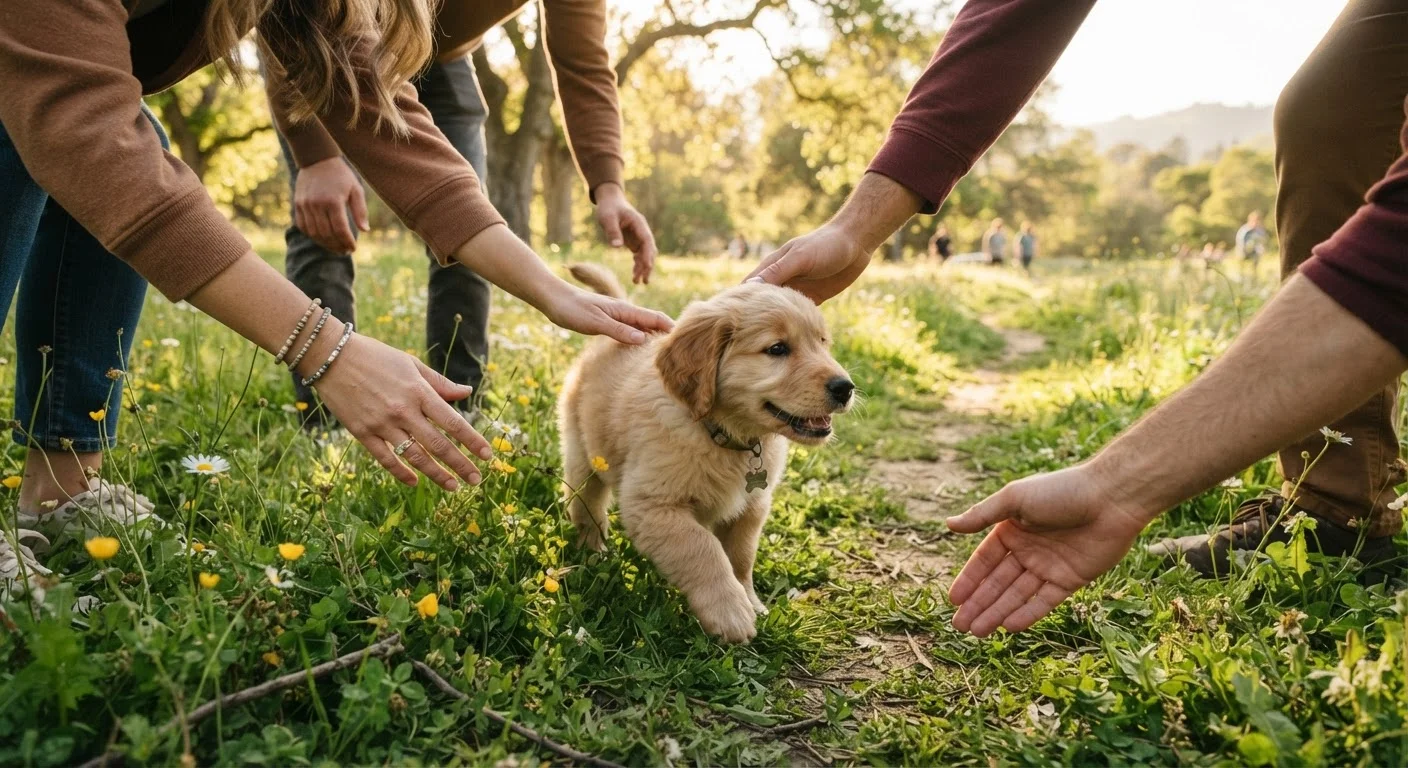
Effective socialization is not simply about exposure — it is about positive exposure. The goal is to pair novel stimuli with calm, rewarding experiences so the puppy's emotional response is curiosity rather than fear. Key categories of experience include:
- People: Adults of different ages, genders, and appearances; children; people wearing hats, uniforms, or glasses.
- Animals: Other dogs of varying sizes and energy levels, and ideally other species the dog will share a home or environment with.
- Environments: Different surfaces (grass, gravel, hardwood floors), indoor and outdoor spaces, urban and rural settings.
- Sounds: Traffic, appliances, thunder recordings, crowds, and other ambient noise at a gradual, non-startling volume.
- Handling: Being touched on paws, ears, and mouth — essential for veterinary visits and grooming throughout life.
Each session should end on a positive note. If a puppy shows clear stress signals — yawning, lip-licking, tucked tail, freezing, or attempting to flee — the exposure is too intense and should be reduced in proximity or intensity immediately.
Use a 'socialization checklist' — a structured list of stimuli to introduce — and mark each item with how the puppy responded, not just whether exposure occurred. This helps you identify gaps and track emotional reactions over time.
Tracking responses rather than just checkboxes prevents owners from inadvertently repeating exposures that triggered stress, while ensuring truly novel stimuli aren't overlooked.
Keep first exposures very brief — two to three minutes is often enough. Repeated short positive exposures build stronger, more durable associations than a single long session.
Shorter sessions prevent fatigue and stress accumulation, both of which can flip an experience from positive to negative even if it started well.
Balancing Socialization With Vaccination Safety
One of the most common points of confusion for new owners is the apparent conflict between socialization urgency and incomplete vaccination. Puppies typically finish their core vaccine series around 16 weeks — just as the socialization window is closing. Waiting until full vaccination to begin socialization means missing most of the sensitive period entirely.
Veterinary behaviorists and organizations such as the American Veterinary Society of Animal Behavior (AVSAB) have stated that the risks of inadequate socialization — including fear-based aggression and anxiety-driven behavior — frequently outweigh the infectious disease risk when appropriate precautions are taken. Practical risk-reduction strategies include:
- Attending puppy classes held in sanitized facilities where all participants are vaccinated.
- Socializing with known, healthy, vaccinated dogs in low-traffic private settings.
- Carrying the puppy in arms or using a carrier in busy public areas to allow sound and visual exposure without ground contact.
- Avoiding high-risk environments such as dog parks, pet store floors, or areas frequented by unknown dogs.
Puppy Classes Are Socialization Goldmines
Well-run puppy classes offered by certified trainers provide structured, supervised exposure to other puppies and people in a controlled environment. AVSAB recommends that puppies begin classes as early as 7–8 weeks if they have had at least one round of vaccines and are healthy. Look for instructors who use positive reinforcement and screen participating dogs for health status.
Always discuss the specific timing and approach with your veterinarian, who can factor in local disease prevalence and your puppy's individual health status.
What Happens If the Window Is Missed?
Puppies who receive little or no positive socialization before 16 weeks are statistically more likely to develop fear-based behaviors: reactivity toward strangers, aggression toward unfamiliar dogs, noise phobias, and generalized anxiety. These are not character flaws — they are predictable outcomes of a brain that learned, in the absence of contrary evidence, that novelty is dangerous.
Behavioral Problems Can Signal a Missed Window
If an adolescent or adult dog shows intense fear, aggression, or reactivity toward ordinary stimuli — people, other dogs, traffic — early socialization gaps are a strong contributing factor to investigate. These behaviors are not defiance or stubbornness. Addressing them requires patience, professional guidance, and an understanding of the dog's history. Punishment-based approaches can significantly worsen fear-driven behavior and should be avoided.
The degree of impact varies. Genetics play a meaningful role; some breeds and bloodlines carry higher baseline anxiety or reactivity regardless of socialization quality. A poorly socialized puppy from a calm, stable lineage may recover more readily than one from anxious parents who also missed early exposures. This is one reason working with anxious and fearful dogs often requires professional guidance tailored to the individual animal.
It is also worth noting that negative experiences during the sensitive period can be just as formative as absent ones. A single traumatic encounter — a rough handling incident, a frightening noise without comfort — can create lasting avoidance if it occurs during a fear imprint phase, which overlaps with the socialization window around 8–11 weeks.
Socialization Beyond the Sensitive Period
Missing the primary window does not mean accepting permanent behavioral limitation. The adult brain retains neuroplasticity, and gradual, positive counter-conditioning can shift fearful associations over time. Progress is typically slower, requires more patience and consistency, and may never reach the ease that early socialization would have provided — but meaningful improvement is achievable for most dogs.
A structured approach remains essential. Understanding core training principles — reward timing, threshold management, and building duration gradually — underpins any effective desensitization work. For dogs with significant fear or reactivity, private sessions with a qualified trainer often provide a safer starting environment than group classes.
Supporting a puppy's overall well-being through this period extends beyond behavior. Appropriate puppy nutrition supports healthy brain development, and consistent daily routines reduce ambient stress so the puppy's emotional resources are available for learning. Together, these elements form a foundation that gives every puppy — regardless of their early start — the best possible chance at a confident, well-adjusted life.
“The socialization period is arguably the most important developmental stage in a dog's life. What a puppy learns — or fails to learn — during those early weeks sets the emotional tone for everything that follows.”
— American Veterinary Society of Animal Behavior, Professional organization representing veterinary behavior specialists
This article is for general informational purposes only and does not constitute veterinary or behavioral advice. Consult a licensed veterinarian or certified animal behaviorist for guidance specific to your puppy's needs.