

Key Takeaways
- Fearful rescue dogs need a predictable environment before they can begin to trust new people.
- Counter-conditioning and desensitization are the most evidence-based tools for reducing fear responses.
- Forcing interaction — including forced petting — can set back progress significantly.
- Progress is nonlinear; regressions are normal and should not be treated as failures.
- A qualified veterinary behaviorist should be consulted for dogs showing severe fear or aggression.
What you will need
Understanding Fear in Rescue Dogs
Many rescue dogs arrive carrying the effects of prior neglect, inconsistent handling, inadequate early socialization, or outright trauma. Fear in dogs is not a personality flaw — it is a learned survival strategy. The amygdala-driven stress response that makes a dog hide under a bed or flatten to the floor during a thunderstorm is the same mechanism that kept their ancestors alive. Understanding this reframes the work ahead: you are not correcting bad behavior, you are creating the conditions for a nervous system to settle.
Fear manifests differently across individuals. Some dogs display overt signals — trembling, panting, pacing, or attempting to flee. Others show more subtle signs: yawning when approached, lip licking, avoiding eye contact, or a tucked tail during what appears to be a calm moment. Learning to read your dog's body language accurately is foundational to everything that follows. For first-week setup considerations, our new pet arrival checklist covers the practical environment and health steps that complement behavioral work.
When Fear Becomes a Safety Concern
A dog who freezes, growls, snaps, or lunges when approached is communicating fear, not defiance. These signals should never be punished, as punishment increases anxiety and can escalate to biting. If your rescue dog displays these behaviors regularly, consult a veterinary behaviorist or certified applied animal behaviorist before attempting further training on your own.
Step-by-Step: Building Trust With Your Rescue Dog
The following steps are grounded in applied animal behavior science and veterinary behavioral guidelines. They are designed to be implemented sequentially, though real-world progress will rarely be perfectly linear.
What you will need
High-value food treats
Used to create positive associations during counter-conditioning exercises.
Long leash (15–20 ft)
Allows safe, low-pressure outdoor movement without confining the dog unnecessarily.
Snuffle mat or food puzzle
Redirects anxious energy into calm, self-directed foraging behavior.
Baby gate or exercise pen
Creates a defined safe zone the dog can retreat to without full isolation.
Training clicker
Provides a precise, consistent marker signal to communicate the exact moment of correct behavior.
Establish a Decompression Zone
Before any training begins, set up a quiet area the dog can reliably retreat to — a crate with the door open, a gated room, or a corner behind furniture. Place familiar-smelling bedding and a bowl of water there. For the first several days, allow the dog to decompress without requiring interaction. This period, sometimes called the "3-3-3 rule" among rescue advocates, acknowledges that dogs need time to process a new environment before they can begin learning.
Establish Predictable Daily Routines
Anxious dogs rely heavily on predictability to feel safe. Feed, walk, and settle the dog at consistent times each day. Predictable schedules reduce the ambient uncertainty that keeps fearful dogs in a chronic low-level stress state. Review our article on structuring daily routines to support good pet behavior for a practical framework.
Use Passive Association to Build Positive Feelings
Spend time near your dog without directing attention at them — read a book, work at a laptop, or eat a meal near their space. Occasionally toss a high-value treat in their direction without making eye contact. This technique, sometimes called "treat and retreat," pairs your presence with good things while removing social pressure. Over time the dog begins to associate your proximity with comfort rather than threat.
Introduce Counter-Conditioning Below the Fear Threshold
Counter-conditioning means changing an emotional response by pairing a feared trigger with something the dog already values — typically food. Identify the distance at which the dog notices a trigger (a person, noise, or object) but does not freeze or flee. That is the threshold. At that distance, present the trigger briefly and immediately deliver a treat. Gradually, over many repetitions, the dog's emotional response shifts: the trigger predicts good things rather than danger.
Reward Calm, Offered Behavior — Not Just Compliance
Notice and reward moments when the dog voluntarily relaxes: lying with a loose body, sighing, sniffing the ground, or approaching you without being lured. Mark these moments with a calm verbal cue ("yes" or a clicker) and a treat. Teaching the dog that relaxed behavior earns rewards creates a self-reinforcing cycle of calm. Avoid overusing lures — the goal is the dog choosing to engage, not performing under pressure.
Expand the Dog's World Gradually
Once the dog shows consistent comfort at home, introduce new environments incrementally. Begin with low-stimulus outdoor spaces using a long leash, then slowly add mild distractions over weeks. Keep early outings short and positive. If your household includes other animals, consult our guide on introducing a new pet to a multi-animal household before orchestrating meetings. Dogs who have not had positive exposure during puppyhood face additional socialization challenges — the article on the puppy socialization window explains why this matters even for adult dogs.
Let the Dog Choose the Distance
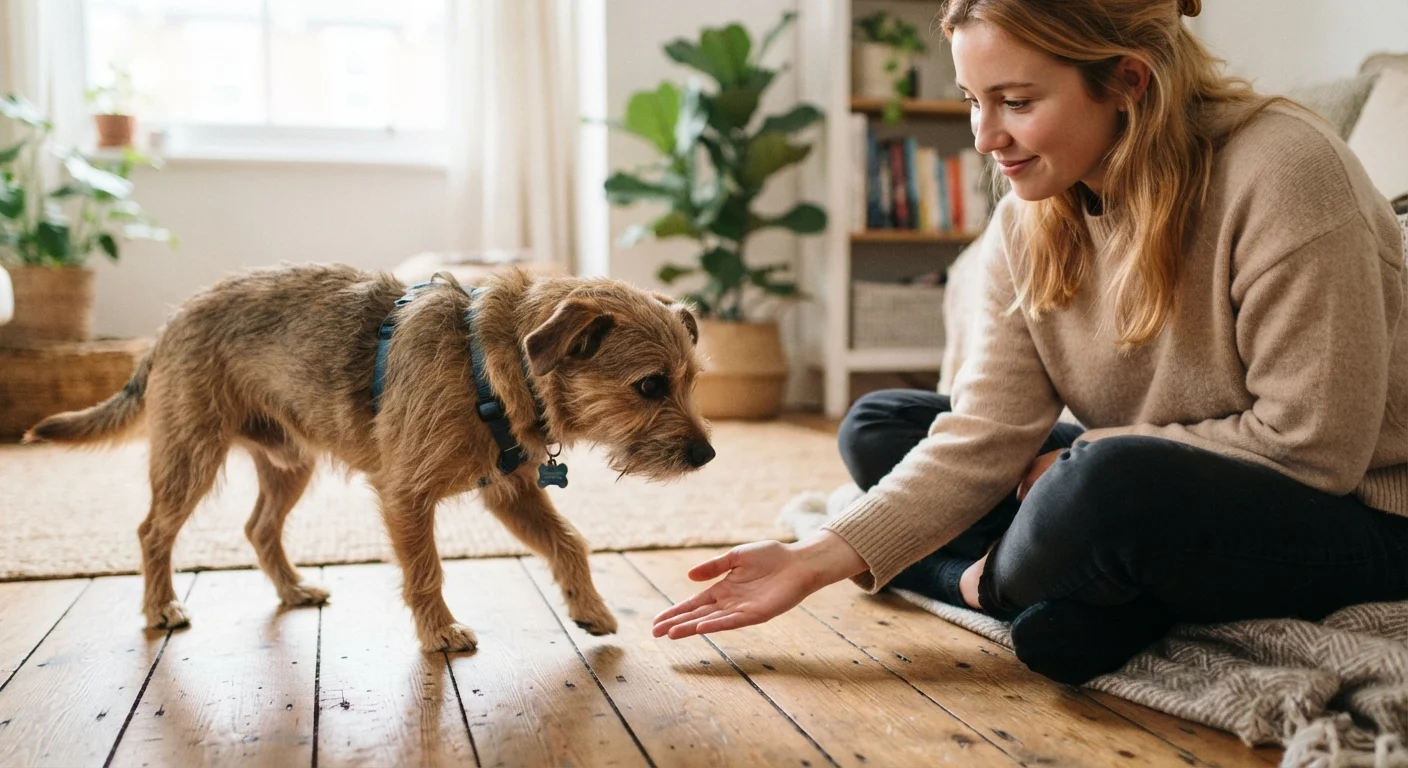
When introducing yourself or new people to a fearful dog, crouch sideways — not face-on — and let the dog approach you rather than reaching toward them. Averting your gaze and keeping your body loose removes social pressure and signals that you are not a threat. This single adjustment can accelerate trust-building considerably.
Avoid Flooding — It Causes Harm
"Flooding" means exposing a dog to a feared stimulus at full intensity until they stop reacting. While it may look like the dog has calmed down, research shows this typically causes learned helplessness, not genuine comfort. Always work below your dog's fear threshold and progress gradually.
If your dog is also showing signs of distress when left alone, that pattern may indicate separation anxiety — a related but distinct issue covered in depth in our article on separation anxiety in dogs.
This article provides general behavioral information and education. It is not a substitute for individualized guidance from a licensed veterinarian, veterinary behaviorist, or certified applied animal behaviorist. If your dog's fear is severe, consult a qualified professional before proceeding.