

Key Takeaways
- Group classes excel at socialization and real-world distraction training, especially for puppies.
- Private sessions allow a trainer to address specific behavioral issues with undivided attention.
- Your dog's temperament, reactivity level, and training goals should drive the format choice.
- Cost and scheduling differ significantly between formats; neither is universally superior.
- Many owners benefit from combining both approaches at different stages of training.
Our Verdict
Neither group classes nor private sessions are objectively better — each serves a distinct purpose. Group training is well-suited to socialization and foundational skills in stable, social dogs, while private sessions are often the more effective starting point for reactive, anxious, or behavior-challenged dogs. Many owners find that cycling between both formats produces the most well-rounded results.
| Best for | Recommended |
|---|---|
| Puppies building foundational skills and social confidence | Group Classes |
| Dogs with reactivity, fear, or specific behavioral problems | Private Training Sessions |
| Owners working on a tighter budget | Group Classes |
| Dogs that have completed group training but need advanced refinement | Private Training Sessions |
What Each Format Is Actually Designed to Do
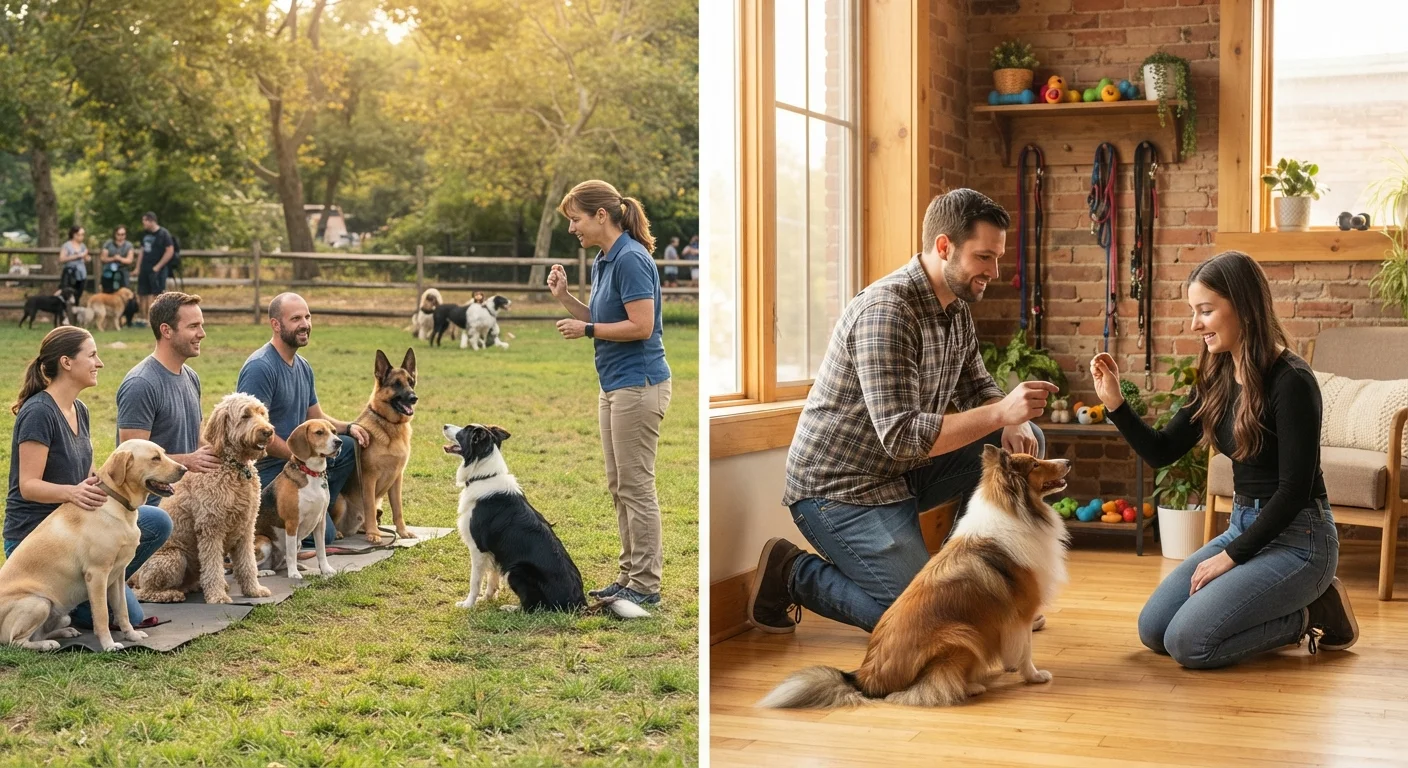
Group classes typically gather four to eight dog-and-owner pairs in a shared space — a training facility, community center, or outdoor area — with a single trainer guiding everyone through the same curriculum. Private sessions, by contrast, pair one trainer exclusively with you and your dog, either in your home, a neutral location, or a training facility.
These aren't just logistical differences. The format shapes what can realistically be taught, how quickly progress occurs, and which dogs are likely to thrive. Understanding the core learning mechanisms behind training helps clarify why environment and distraction level matter so much when choosing a setting.
The Case for Group Classes
Group classes offer something private sessions structurally cannot: controlled exposure to other dogs, people, sounds, and unpredictable movement. For a dog learning to sit, stay, or walk on a loose leash, practicing amid real-world distractions is closer to the environments where those skills actually need to hold.
Socialization is among the clearest benefits. Early socialization shapes a dog's lifelong temperament, and group puppy classes are widely regarded as a structured, safe way to support that process. Exposure to unfamiliar dogs and handlers under a trainer's guidance is qualitatively different from unmanaged dog-park visits.
Group classes also tend to cost less per session than private work, and the social element often helps owners stay motivated and accountable. Watching other dog-handler pairs work through the same challenges can normalize the difficulty of training and reduce owner frustration.
Ask About Class Size Before Enrolling
Trainer-to-dog ratios significantly affect the quality of instruction in group settings. A class with more than eight dogs per trainer leaves little time for meaningful individual feedback. Ask prospective trainers how many teams they manage per session, and whether an assistant instructor is present to help.
The main limitation is individual attention. A trainer managing six teams simultaneously cannot consistently monitor your dog's body language, catch handler errors in real time, or tailor exercises to your dog's specific pace. Dogs that are highly reactive, fearful, or easily overstimulated are often too stressed in a group setting to learn effectively — stress impairs the very cognitive processes training depends on.
The Case for Private Training Sessions
Private sessions shift the trainer's full attention to one team. That focus allows for real-time feedback on handling technique, immediate adjustment of the training plan when something isn't working, and detailed discussion of the dog's history and specific triggers. For dogs with reactivity, separation anxiety, resource guarding, or a history of trauma, this tailored approach is often not merely preferable but necessary.
A skilled trainer in a private setting can sequence desensitization and counter-conditioning at a pace the individual dog can tolerate — an approach that is difficult to replicate when eight dogs are moving through a fixed curriculum together. Research consistently supports reward-based methods as the foundation of this kind of careful behavioral work.
Private training is also valuable when the problem is primarily about handler mechanics rather than the dog. If an owner's leash handling, timing, or reinforcement delivery needs adjustment, targeted one-on-one coaching produces faster results than group instruction. The main drawback is cost — private sessions typically run significantly higher per hour than group classes — and the reduced opportunity for real-world distraction practice.
| Group Classes | Private Sessions | |
|---|---|---|
| Cost per session | Lower (shared trainer time) | Higher (exclusive trainer time) |
| Trainer attention | Divided among all teams | Fully focused on one team |
| Socialization opportunity | High — built into format | Limited — must be arranged separately |
| Distraction training | Inherent in group setting | Requires deliberate setup |
| Suitability for reactive dogs | Often too stimulating | Well-suited with proper pacing |
| Curriculum flexibility | Fixed class curriculum | Fully customized to dog's needs |
| Handler coaching depth | General guidance only | Detailed, real-time feedback |
Making the Decision for Your Dog
The most useful question is not which format is better in general, but which is better for this dog, at this stage, with these goals. A well-socialized, easygoing adult dog working on loose-leash walking may do well in a group class. A dog who lunges at other dogs, shuts down in novel environments, or has a bite history is likely to need private work before any group setting is appropriate.
Clarifying your goals before your first session — whether that's basic manners, sport preparation, behavior modification, or socialization — makes it much easier to match the format to the need. Many owners find that starting with private sessions to address specific issues, then transitioning to group classes for maintenance and distraction work, produces the most durable outcomes.
Whichever format you choose, consistency outside the training environment remains critical. Daily routines that reinforce training have a substantial effect on how quickly and durably new behaviors become habits. No training format, however well designed, substitutes for what happens the other 23 hours of the day.