

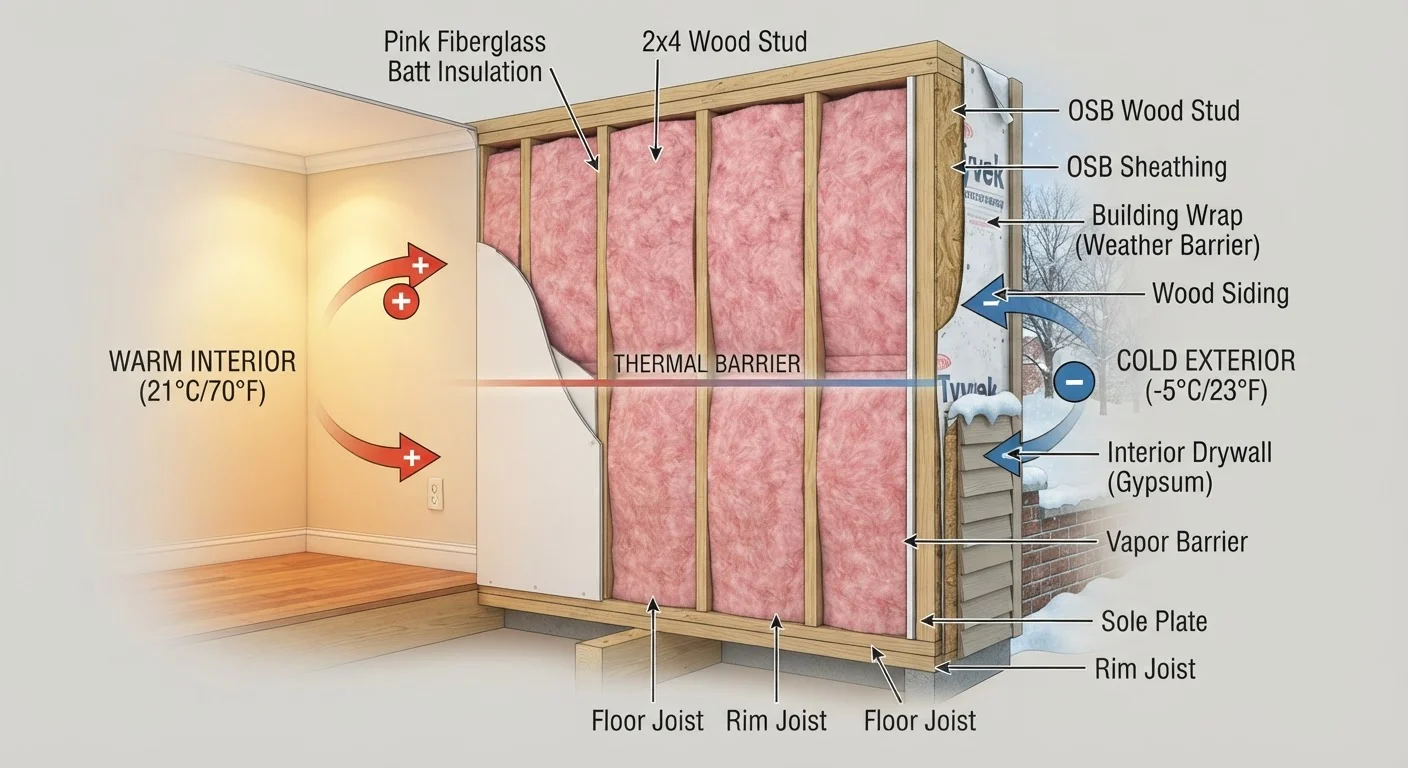
Key Takeaways
- R-value measures thermal resistance, not thickness — thicker insulation doesn't automatically mean better performance.
- Attic insulation and wall insulation serve different purposes and require different materials and installation approaches.
- Air sealing and insulation work together; insulation alone cannot stop drafts caused by gaps and penetrations.
- Vapor barriers are not always needed and can cause moisture damage if installed incorrectly.
- Old insulation doesn't always need full replacement — a professional assessment determines the right course of action.
Why Insulation Myths Cost Homeowners Money
Insulation is one of the most misunderstood systems in any home. Homeowners frequently make decisions — adding more, skipping vapor barriers, or ignoring old materials — based on assumptions that sound reasonable but are factually off. The result is often higher energy bills, moisture problems, or wasted renovation spending.
Getting insulation right requires understanding a few core principles: how thermal resistance actually works, where air infiltration fits in, and why the same approach does not apply to every part of the house. The myth-and-fact pairs below address the most common misconceptions, grounded in building science principles used by energy auditors and home performance professionals across the US.
For context on how insulation fits into a home's broader maintenance timeline, see our guide to home system lifespans.
Myth
More insulation always means better energy efficiency — the thicker, the better.
Fact
R-value gains follow a curve of diminishing returns; doubling insulation thickness does not double energy savings.
Every insulation material is rated by its R-value, which measures resistance to heat flow. While higher total R-values do improve thermal performance, the relationship is not linear. Going from R-11 to R-19 in a wall cavity yields a meaningful improvement, but going from R-38 to R-60 in an attic produces a much smaller proportional gain. The US Department of Energy publishes recommended R-values by climate zone — exceeding those recommendations significantly offers little practical benefit and adds unnecessary cost.
Myth
Insulation seals your home against drafts and air leaks.
Fact
Insulation resists heat transfer; it does not block air movement. Air sealing is a separate, essential step.
Fibrous insulation materials like fiberglass batts and cellulose are air-permeable. Cold air can still move through gaps around electrical outlets, plumbing penetrations, and attic hatches even when those cavities are fully insulated. Building scientists treat air sealing and insulation as two distinct layers of a home's thermal envelope. Skipping air sealing and simply adding more insulation is one of the most common and costly mistakes homeowners make.
Myth
Attic insulation and wall insulation are basically the same thing.
Fact
Attics and walls have different thermal dynamics, moisture conditions, and structural constraints requiring distinct insulation strategies.
Attics are typically open cavities where blown-in or loose-fill insulation can be added relatively easily. Walls are closed, narrow cavities that require either batt insulation during framing or injection/blown-in methods for retrofit. Attics also experience greater temperature swings and require attention to ventilation to prevent condensation and ice damming. Treating them interchangeably leads to poor results in both locations.
Myth
A vapor barrier should always be installed with insulation.
Fact
Whether a vapor barrier is needed — and which type — depends entirely on your climate zone and where in the building assembly it is placed.
Installing a vapor barrier in the wrong location or climate can trap moisture inside wall or ceiling assemblies, leading to mold and structural rot. In hot-humid climates, vapor barriers on interior walls can cause serious damage. In cold climates, placement matters — it generally goes on the warm side of the insulation. Some modern insulation systems rely on vapor-permeable retarders rather than full barriers. Consult a building professional familiar with your local climate before adding any vapor control layer.
Myth
Old insulation should always be completely removed and replaced.
Fact
Existing insulation in good condition can often be retained; removal is only necessary when it is damaged, contaminated, or compacted.
Complete removal is disruptive, expensive, and not always necessary. Insulation that has become wet, hosts mold, is compacted beyond recovery, or contains hazardous materials (such as vermiculite containing asbestos) does need professional removal. However, clean, dry, settled fiberglass or cellulose can often simply be topped up to achieve the target R-value. A professional inspection determines which scenario applies — don't assume replacement is required without one.
What to Do With This Information
Correcting these misconceptions doesn't require a full renovation. Start with an energy audit — many utility companies offer them at low or no cost — to identify where your home actually loses heat or cooling capacity. An auditor will use a blower door test to locate air leaks and assess existing insulation depth and condition.
Don't Add Insulation Over Moisture Problems
Adding new insulation over existing wet or moldy material will trap the problem and worsen structural damage over time. Before any insulation upgrade, inspect for signs of water intrusion — staining, musty odors, or visibly damp material. Resolve the moisture source first, then address insulation. If you suspect mold, have the area assessed by a qualified professional before proceeding.
From there, prioritize air sealing before adding insulation material. Sealing gaps around recessed lights, plumbing penetrations, and attic hatches often delivers more measurable comfort improvement than piling on additional batts. Once air sealing is complete, topping up attic insulation to the level recommended for your climate zone (available through the US Department of Energy's website) is generally the highest-return insulation upgrade.
Small, targeted improvements can add up significantly. Our overview of high-impact home upgrades covers several complementary steps that improve comfort without major expenditure.
~15%
Average heating/cooling energy saved through proper insulation
The US Department of Energy estimates that sealing air leaks and adding adequate insulation can reduce heating and cooling costs by around 15% on average.
90%
US homes estimated to be under-insulated
North American Insulation Manufacturers Association (NAIMA) has cited estimates suggesting roughly 9 in 10 US homes lack adequate insulation levels.