

Key Takeaways
- The skin barrier controls moisture retention and blocks environmental irritants simultaneously.
- Common habits like over-cleansing and skipping moisturizer can quietly degrade barrier function.
- Ceramides, humectants, and occlusives are the ingredient categories most directly linked to barrier repair.
- A compromised barrier often presents as persistent dryness, redness, or unexpected sensitivity.
- Daily UV protection supports barrier health by preventing UV-induced lipid oxidation.
Skin Barrier
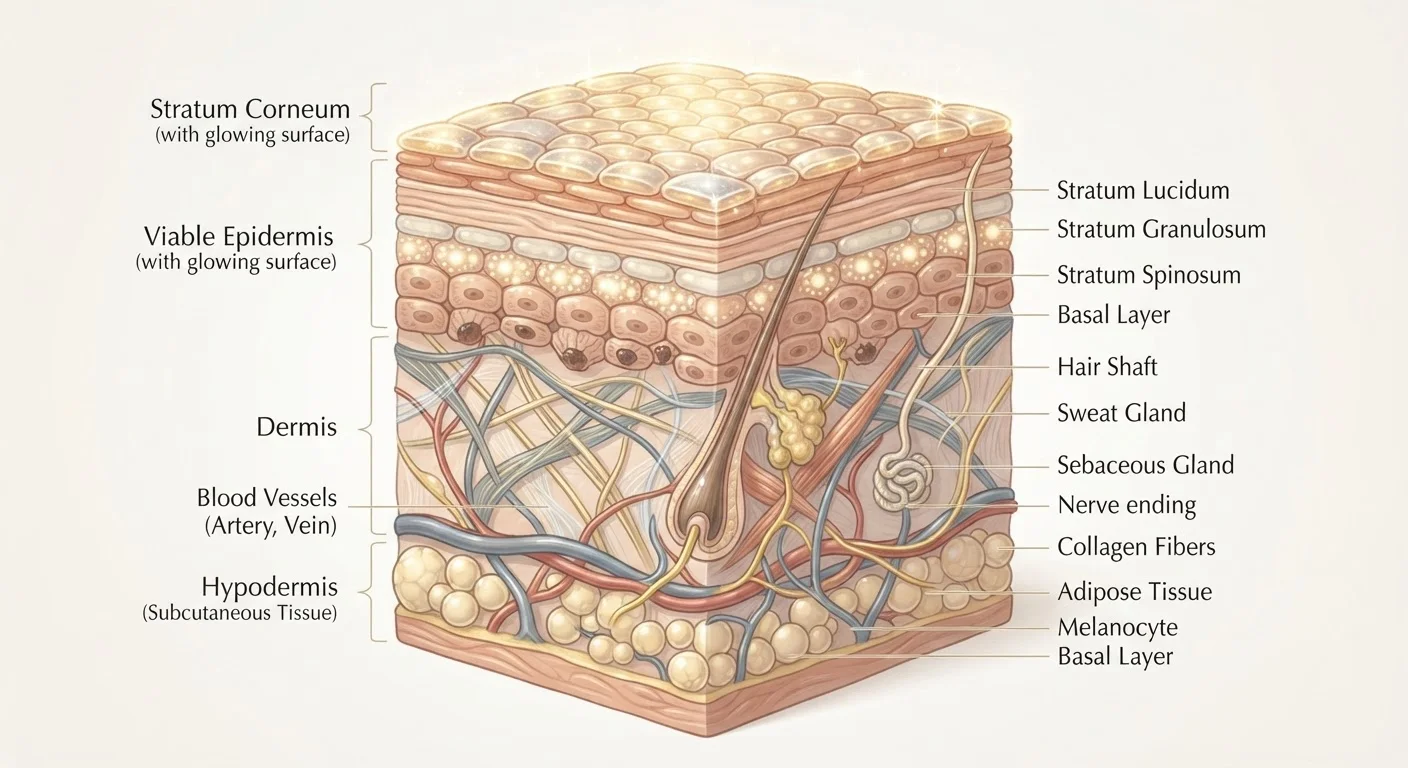
The skin barrier — formally called the stratum corneum — is the outermost layer of the epidermis. It acts as a two-way shield: keeping moisture inside the skin while blocking out environmental aggressors like pollutants, bacteria, and allergens. Think of it as a brick wall, where skin cells are the bricks and naturally produced lipids (fats) serve as the mortar holding everything together.
The lipid matrix consists primarily of ceramides, cholesterol, and free fatty acids in a near-equal ratio. Disruption of this ratio — not just the overall quantity of lipids — is strongly associated with barrier dysfunction.
The Architecture of Your Skin's Outer Layer
The skin barrier isn't a single membrane — it's a carefully organized structure built from dead but functional skin cells (corneocytes) embedded in a lipid matrix. This arrangement, often described as the "brick and mortar" model in dermatology, is remarkably effective at regulating the exchange between your body and the environment.
Three lipid types dominate this matrix: ceramides (roughly 50% of the total), cholesterol, and free fatty acids. Research has consistently shown that it's the ratio between these components — not just their presence — that determines how well the barrier performs. When any one of them is depleted or imbalanced, the mortar starts to crack.
Beneath the stratum corneum, deeper layers continuously generate new cells that migrate upward, eventually flattening and integrating into the barrier. This natural renewal cycle takes roughly 28 days in young adults, slowing with age — which is one reason older skin tends toward greater dryness and fragility.
The Barrier Is Always Active
Even when skin appears calm and healthy, the stratum corneum is continuously shedding and regenerating. This dynamic process — called desquamation — is tightly regulated by enzymes that require a specific skin pH to function properly. Cleansers and products with an inappropriate pH can slow or disrupt this process, contributing to buildup and sensitivity over time.
What Compromises the Barrier — and How
Barrier disruption rarely happens from a single dramatic event. It accumulates through repeated everyday exposures. Some of the most common culprits include:
- Over-cleansing or using harsh surfactants: Detergent-based cleansers strip away the skin's natural lipids along with dirt. Cleansing more than twice daily, or using products with high concentrations of sulfates, accelerates this process.
- Low-humidity environments: Cold, dry air — indoors or outdoors — draws water from the skin's surface faster than the barrier can compensate, leading to transepidermal water loss (TEWL).
- Overuse of active ingredients: Retinoids, exfoliating acids (AHAs and BHAs), and vitamin C derivatives are genuinely effective, but layering them without recovery time can outpace the skin's repair capacity.
- UV exposure without protection: Ultraviolet radiation oxidizes the lipids in the stratum corneum and generates free radicals that degrade barrier integrity. See why dermatologists consistently prioritize daily SPF for a closer look at that research.
Understanding your own skin type also matters here — certain types are structurally predisposed to faster TEWL or reduced ceramide production. What your skin type actually means for your routine is a useful starting point for personalizing your approach.
Simplify Before You Troubleshoot
If your skin is suddenly reactive or persistently dry, the most effective first step is usually to strip your routine back to basics: a gentle cleanser, a fragrance-free moisturizer with ceramides, and SPF. Adding more products to an irritated barrier often compounds the problem rather than solving it. Give the simplified routine at least two to three weeks before reintroducing actives.
The Ingredients That Actually Support Barrier Repair
Not every moisturizing ingredient works the same way. For barrier support specifically, the science points to three functional categories working together:
- Ceramides
- Topical ceramide formulations have shown in peer-reviewed research to help replenish what the barrier loses to environmental stress and aging. They work by integrating into the lipid matrix rather than simply sitting on top of the skin.
- Humectants (e.g., hyaluronic acid, glycerin)
- These draw water from the deeper dermis and, in humid conditions, from the air into the stratum corneum. They increase hydration but don't seal it in on their own.
- Occlusives (e.g., petrolatum, shea butter, squalane)
- Occlusives form a physical layer that slows transepidermal water loss. When layered over a humectant, they lock in the hydration drawn to the surface.
A routine that incorporates all three categories tends to address barrier health more comprehensively than any single ingredient alone. For a practical framework, building a minimal skincare routine that actually works walks through how to structure these steps without overcomplicating things.
~50%
Ceramide share of the skin's lipid matrix
Ceramides make up approximately half of the stratum corneum's lipid content, according to established dermatological research on skin barrier composition.
28 days
Approximate skin cell renewal cycle in young adults
The natural cell turnover cycle takes roughly 28 days in younger adults and slows progressively with age, affecting barrier resilience.
3–6 weeks
Typical timeframe for meaningful barrier repair
Clinical observations suggest that consistent use of barrier-supportive ingredients can produce measurable improvements in TEWL reduction within this window, though individual results vary.
Protecting the Barrier Long-Term
Barrier health is a maintenance project, not a one-time fix. A few principles consistently supported by dermatological guidance:
- Cleanse gently and selectively. A mild, pH-balanced cleanser used once or twice daily removes debris without stripping lipids. Avoid hot water, which accelerates lipid loss.
- Apply moisturizer to damp skin. Doing so within a few minutes of cleansing traps existing surface moisture before it evaporates.
- Introduce actives gradually. If you use retinoids or exfoliating acids, start at lower frequencies and give the barrier adequate time between applications to maintain its function.
- Use daily SPF. UV protection is not just a cosmetic concern — it directly reduces the oxidative damage to the lipid layer. Sunscreen belongs in every daily grooming routine, regardless of season or skin tone.
A compromised barrier often corrects itself when the aggravating factors are removed and core supportive habits are in place. Persistent redness, stinging, or unusual sensitivity that doesn't respond to simplified routines warrants evaluation by a licensed dermatologist.
This article is for general informational and educational purposes only. It is not medical advice and is not a substitute for professional dermatological evaluation or treatment. If you have concerns about your skin health, consult a qualified healthcare provider.
“The skin barrier is arguably the most important structure in dermatology. Almost every common skin condition — eczema, rosacea, acne — involves some degree of barrier dysfunction. Protecting it isn't a trend; it's foundational skin biology.”
— Dr. Lynne Margesson, Clinical Professor of Dermatology, widely published on skin barrier and dermatitis research