
Intentional Shopping Versus Impulsive Buying: How Each Shapes Your Wardrobe Over Time

Key Takeaways
- Impulsive buying tends to produce closets full of items that rarely work together or get worn.
- Intentional shopping builds a wardrobe aligned with your actual lifestyle, body, and aesthetic.
- The financial difference between the two habits compounds significantly over time.
- Shifting toward intentional shopping doesn't require a complete overhaul — small habit changes make a measurable difference.
- Both approaches leave a footprint on your budget, storage space, and daily confidence getting dressed.
Our Verdict
Impulsive buying delivers short-term excitement but tends to produce disjointed, underused wardrobes that cost more in the long run. Intentional shopping requires more upfront effort but consistently results in a closet that reflects your real life, fits better, and actually gets worn. Most people benefit from building intentional habits gradually rather than attempting an all-or-nothing transformation.
| Best for | Recommended |
|---|---|
| Those who want a functional, cohesive wardrobe they can rely on daily | Intentional Shopping |
| Those managing a tight clothing budget who need strong cost-per-wear value | Intentional Shopping |
| Those who enjoy spontaneous finds and are comfortable editing their closet regularly | A structured blend of both approaches |
What These Two Habits Actually Look Like in Practice
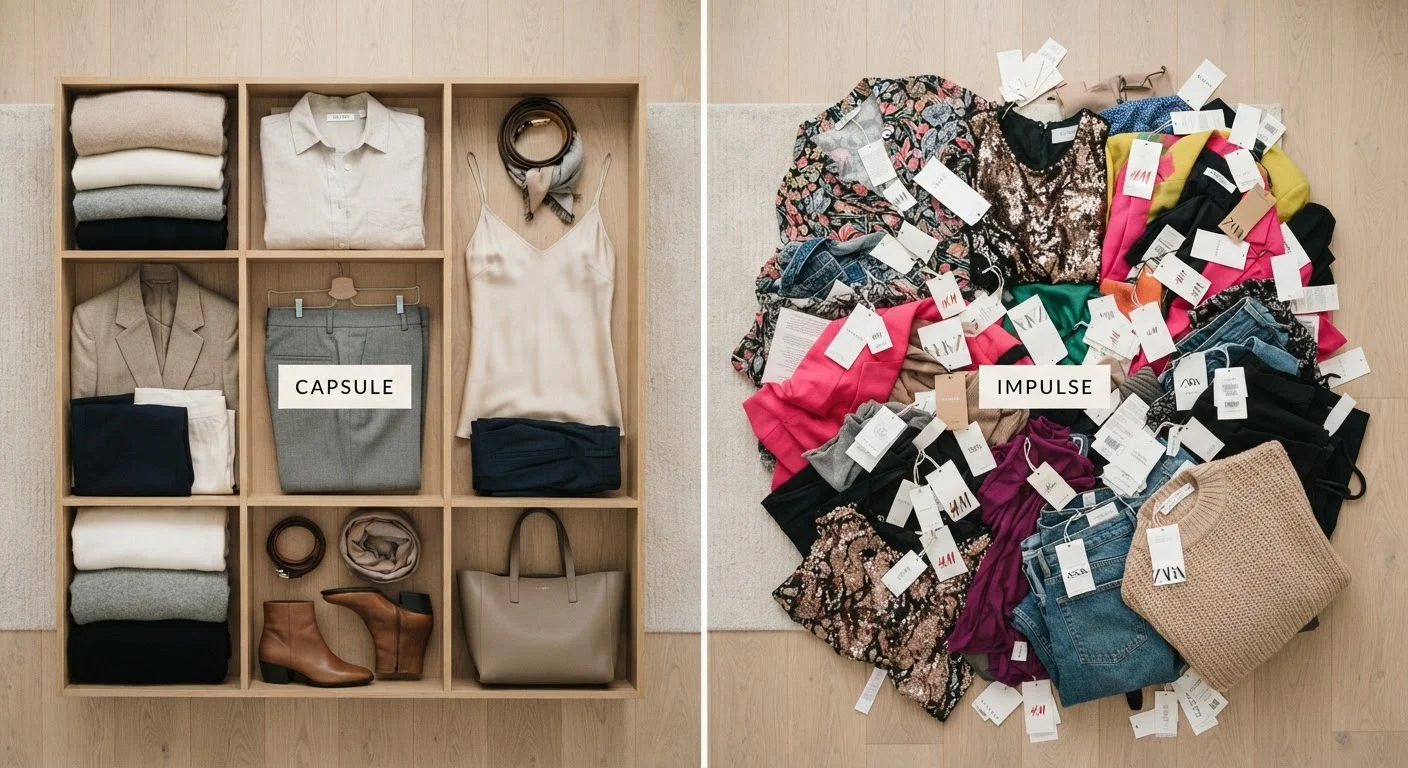
Impulsive buying happens when a purchase is driven primarily by emotion — a flash sale, a flattering dressing-room mirror, a trend that felt urgent in the moment. The item seemed right at the time, but it often arrives home to a closet where it doesn't quite fit the rest. Intentional shopping, by contrast, starts before you ever enter a store. It involves knowing what gaps exist in your wardrobe, understanding what you actually wear, and evaluating new pieces against those criteria.
Neither habit is entirely good or bad in isolation. The problem is the pattern. A single impulsive purchase is harmless; a default mode of impulsive buying over years creates a closet that's simultaneously overfull and difficult to dress from. Similarly, highly rigid intentional shopping can lead to overthinking every purchase — the goal is considered decision-making, not paralysis.
Understanding where you currently fall on this spectrum is the first step. If you frequently find items in your closet with tags still attached, or regularly feel like you have nothing to wear despite owning a lot of clothes, impulse buying is likely the dominant habit. If you can easily build five or more outfits from your existing pieces and rarely regret purchases, intentional shopping is probably already your default. For a deeper look at building from the ground up, see how to build a wardrobe from scratch.
How Each Approach Shapes Your Wardrobe Over Time
The most significant differences between these two habits aren't visible in a single purchase — they accumulate gradually and become obvious only when you step back and look at the whole closet.
| Intentional Shopping | Impulsive Buying | |
|---|---|---|
| Decision driver | Identified need or wardrobe gap | Emotion, trend, or in-store stimulus |
| Wardrobe coherence over time | High — pieces coordinate well | Low — items often clash or float |
| Cost-per-wear | Lower — items worn frequently | Higher — many items rarely worn |
| Closet volume | Moderate and curated | Large and often cluttered |
| Daily ease of getting dressed | Easier — outfit options are clear | Harder — too many poor fits |
| Post-purchase satisfaction | Generally high and sustained | Often short-lived or followed by regret |
| Trend sensitivity | Selective and considered | Frequent and reactive |
Impulsive wardrobes tend to follow trends closely, which means they cycle out quickly. Pieces bought on excitement rarely have the staying power to justify repeated wear, and they often don't coordinate with existing items. The result is a closet that feels cluttered but offers limited actual options. Research in consumer psychology consistently finds that unplanned purchases generate brief satisfaction followed by a longer-lasting sense of regret — sometimes called "buyer's remorse" — particularly when the item fails to integrate into daily use.
Intentional wardrobes grow more slowly but with greater coherence. Each addition is evaluated against what already exists, which means new pieces almost immediately have outfits to slot into. Over time, this approach also tends to favor quality over quantity — not because intentional shoppers spend more per item, but because they think through longevity, versatility, and fit before buying. For a fuller picture of what clothing actually costs over its lifetime, explore the real cost of a wardrobe beyond the price tag.
The Financial and Psychological Costs of Each Pattern
Both habits carry real costs, but they manifest differently. Impulsive buying often feels affordable in the moment — individual purchases may be modest — but the frequency and the low cost-per-wear of unworn items add up quickly. A $40 blouse worn twice costs $20 per wear; the same $40 spent on a well-chosen piece worn 80 times costs $0.50 per wear. The math is straightforward, but it's easy to overlook when purchases are made one at a time.
Use Cost-Per-Wear as a Grounding Tool
Before any purchase, estimate how many times you realistically expect to wear the item in the next year. Divide the price by that number to get a rough cost-per-wear figure. A higher-priced piece worn regularly nearly always delivers better value than a cheap item that sits unworn. This single mental habit can redirect many impulsive decisions into more considered ones.
Beyond the financial dimension, impulsive buying and intentional shopping produce measurably different daily experiences. Getting dressed from a disjointed wardrobe takes longer, generates more stress, and produces less satisfaction — a phenomenon documented in research on decision fatigue. When a wardrobe is cohesive and reflects your real lifestyle, the morning routine becomes more efficient and confidence in your appearance tends to follow. For practical guidance on aligning your spending habits with your wardrobe goals, the budgeting basics hub offers relevant frameworks.
It's also worth noting the environmental and space dimensions. Impulsive wardrobes accumulate faster than they're edited, creating storage pressure and ultimately more textile waste. Intentional wardrobes require less physical and mental maintenance. For guidance on editing what you already have, a wardrobe audit checklist is a practical starting point.
Practical Ways to Shift Toward More Intentional Shopping
The goal isn't to eliminate all spontaneous purchases — it's to make sure the majority of your buying decisions are grounded in awareness rather than reaction. A few evidence-backed strategies make that shift more accessible than it sounds.
- Establish a waiting period. Before completing any non-essential purchase, pause for 24–48 hours. This interrupts the emotional arc of impulse buying and allows clearer evaluation.
- Keep a running list of wardrobe gaps. Rather than shopping in response to in-store stimulation, shop in response to identified needs. This reorients you from reactive to purposeful purchasing.
- Apply a versatility test. Before buying, identify at least three distinct outfits the new piece could form with items you already own. If you can't reach three, that's meaningful information.
- Understand your style anchors. Intentional shopping becomes much easier once you've identified what you consistently reach for. Pay attention to what you actually wear, not what you imagine you'll wear.
These habits apply equally to secondhand shopping, where the volume and variety of options can make impulsive accumulation even easier. Shopping secondhand without accumulating clutter requires the same intentional filter as any other channel. And if you're thinking about how classic pieces versus trend-driven purchases fit into this framework, classic versus trendy dressing explores those trade-offs directly.