

Key Takeaways
- The window sticker is required by law and contains standardized data you can compare across vehicles.
- MSRP is not the final price — dealer-added packages and fees can significantly increase the total.
- Fuel economy figures are EPA estimates; real-world mileage typically varies based on driving habits.
- Safety ratings on the sticker may come from different testing agencies with different methodologies.
- Understanding each section helps you negotiate more effectively and avoid being caught off guard at signing.
Monroney Label (Window Sticker)
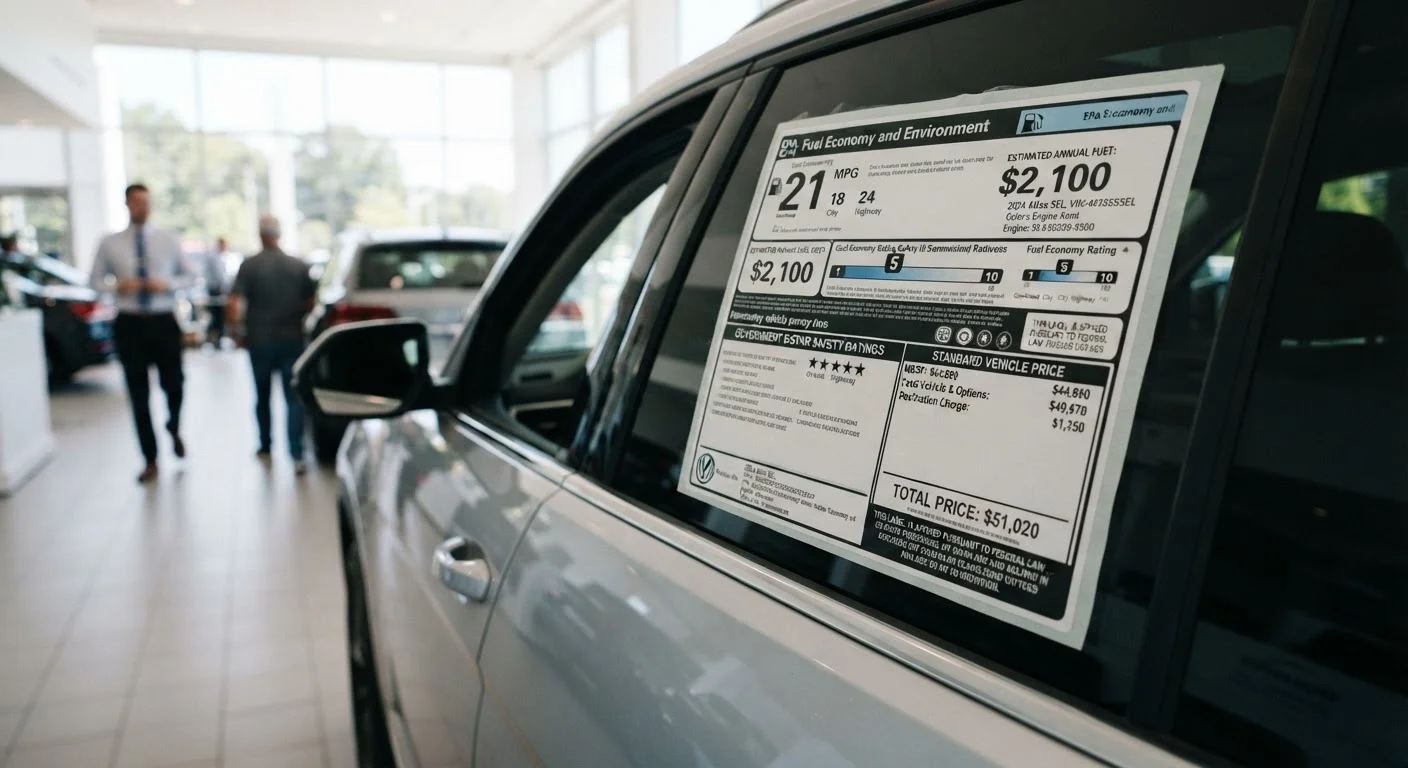
A Monroney label is the standardized information sticker required by federal law on every new passenger vehicle sold in the United States. It lists the manufacturer's suggested retail price (MSRP), fuel economy estimates, standard and optional equipment, safety ratings, and emissions data. The label must remain on the vehicle until the buyer removes it after purchase.
The label is named after Senator Mike Monroney, whose 1958 Automobile Information Disclosure Act mandated it. Dealers are prohibited from removing or altering it before sale.
Why the Window Sticker Deserves More Attention
Most buyers glance at the window sticker to find the price and move on. That's leaving a lot of useful information unread. The Monroney label is one of the few standardized documents in the car-buying process — every piece of it follows a federally mandated format, which means you can use it to make apples-to-apples comparisons between vehicles without relying on a salesperson's summary.
Think of it the way you'd approach a nutrition label on food packaging — the data is all there, but it only helps you if you know what each section actually means. (If you want to sharpen your label-reading skills in a different context, this guide to nutrition label literacy covers similar territory.)
~$600
Average destination charge on new vehicles
Destination and delivery fees vary by manufacturer and vehicle class but generally range from a few hundred to over a thousand dollars and are non-negotiable.
10–20%
Typical real-world MPG gap below EPA estimate
The EPA acknowledges that actual fuel economy varies; aggressive driving, cold weather, and city stop-and-go traffic are common contributors to lower real-world figures.
Breaking Down the Sticker Section by Section
Make, model, and trim level appear at the top. This confirms the exact configuration you're looking at — important because pricing and equipment vary considerably between trims.
Standard equipment lists every feature included in that trim at base price. Read it carefully so you know what you're actually getting before a dealer pitches upgrades.
Optional packages and add-ons appear below standard equipment. Each line shows the option name and its additional cost. Dealer-installed accessories — things like paint sealant or window tint added at the lot — sometimes appear here at inflated prices. These are almost always negotiable or removable from the deal.
MSRP breakdown shows the base price, the cost of each added option, and the destination charge. The destination charge is a fixed manufacturer fee and is not negotiable. The total at the bottom is the full MSRP — your starting point for negotiation, not a ceiling.
Pull the Sticker Data Before You Visit
Most manufacturers publish build-and-price tools on their websites that generate a virtual Monroney label. Reviewing it at home — without a salesperson present — lets you study every line item at your own pace and arrive at the dealership with a clear baseline for negotiation.
Fuel economy occupies a prominent section in the middle of the sticker. You'll see city, highway, and combined MPG (or MPGe for electric and plug-in hybrid vehicles). A five-year fuel cost estimate is also included, calculated using national average fuel prices — useful for comparing running costs between models.
Safety ratings may appear from the National Highway Traffic Safety Administration (NHTSA) and/or the Insurance Institute for Highway Safety (IIHS). These agencies use different crash-test methods, so a five-star NHTSA rating and a IIHS "Top Safety Pick" are not directly equivalent. Check each agency's website for the full test data.
Emissions information is typically found at the bottom. This covers tailpipe emissions and, for some vehicles, smog ratings — relevant if you're in a state with stricter emissions standards.
What the Sticker Doesn't Tell You
The Monroney label covers the new-vehicle side of the equation well, but there's plenty it leaves out. It won't tell you how a vehicle holds its value over time, what ownership costs look like after warranty expiration, or how reliable a particular model has proven in the field. For a broader picture, you'll want to cross-reference independent reliability data and owner reviews.
The sticker also says nothing about the dealer's out-the-door fees — documentation fees, title and registration costs, and any dealer markup above MSRP. Always ask for a complete out-the-door price before agreeing to anything.
If you're considering a used vehicle rather than a new one, the window sticker from the original sale is long gone. In that case, a vehicle history report becomes essential. Reading a vehicle history report carefully can surface accident records, title issues, and odometer discrepancies that no sticker would ever capture. And once you're on the lot, a thorough physical inspection is equally important before you start negotiating.