

Key Takeaways
- Private sales typically offer lower prices but come with fewer legal protections for buyers.
- Dealerships provide financing options, warranties, and recourse if something goes wrong.
- A pre-purchase inspection by an independent mechanic is advisable regardless of where you buy.
- Paperwork complexity and fraud risk are meaningfully higher in private transactions.
- Your priorities — price, convenience, or protection — should drive which route you choose.
Lower purchase prices than dealer equivalents
Private sellers don't carry reconditioning costs, lot fees, or sales staff salaries, which often translates into a meaningfully lower asking price for similar vehicles.
Direct access to the vehicle's ownership history
You can ask the actual owner about maintenance habits, how the car was used, and why they're selling — context a dealer often can't provide for a trade-in.
More flexible, direct negotiation dynamic
Without a sales manager structure in the background, price conversations can be more straightforward and less scripted than a dealership negotiation.
No warranty or post-sale recourse
Private sales are typically sold "as-is," meaning if a problem surfaces after the transaction, you have little legal recourse short of proving fraud — a high bar to meet.
Higher risk of undisclosed mechanical issues
Private sellers aren't required to perform the same safety and reconditioning checks dealers do, and disclosure obligations vary significantly by state.
Financing must be arranged independently
Banks and credit unions will finance private-party purchases, but you need to secure the loan before you shop, adding time and complexity to the process.
Elevated fraud and title risk
Scams involving salvage titles, odometer rollbacks, or vehicles with outstanding liens are more common in private sales; verifying a clean title is entirely the buyer's responsibility.
Our Verdict
Neither route is universally better. Private sales reward prepared, patient buyers who are comfortable doing their own due diligence and can absorb some risk in exchange for a lower price. Dealerships suit buyers who want more structure, financing flexibility, and a clearer path if problems emerge after the sale.
Buyers who prioritize price and are willing to invest time in research will find private sales worthwhile; those who value convenience, financing options, or post-sale protection are generally better served by a dealership.
The Core Difference Between the Two Routes
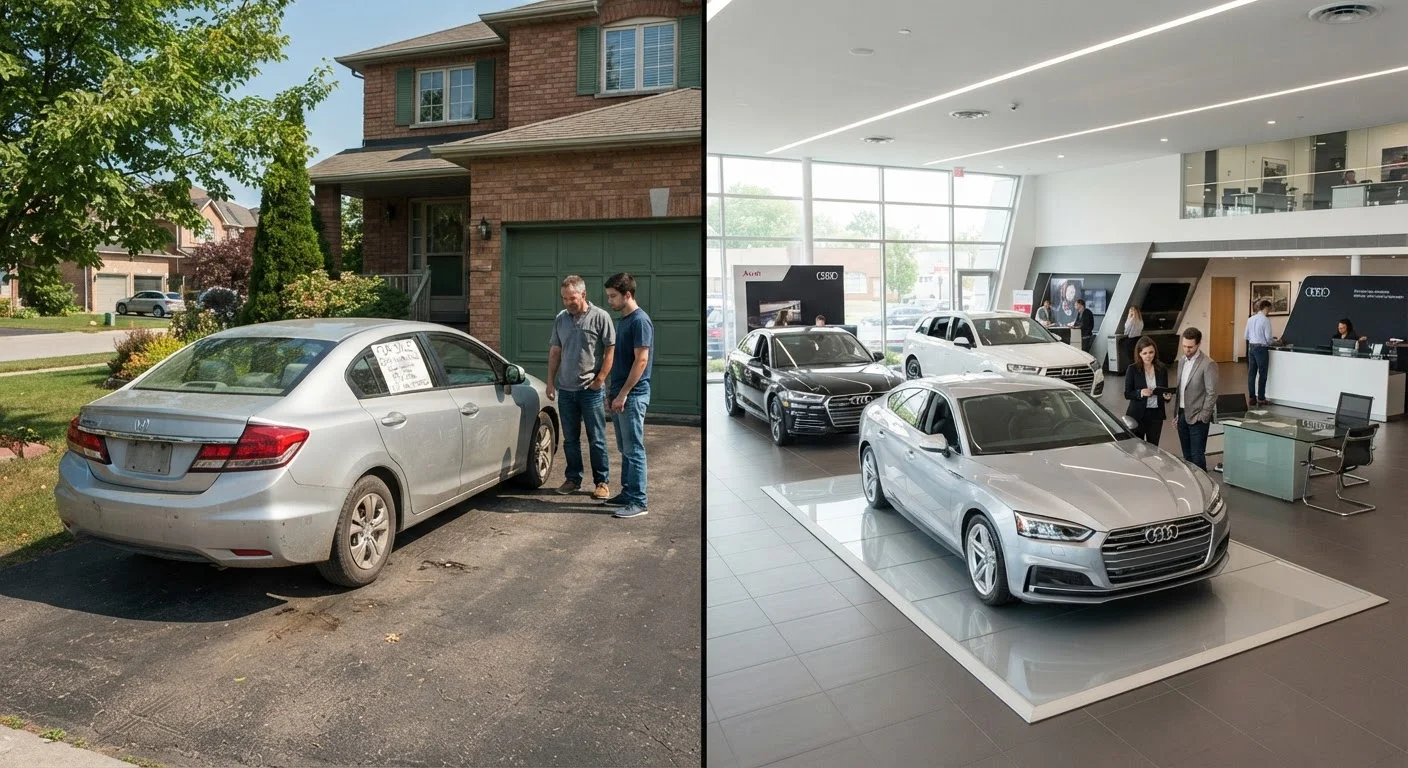
When you buy from a private seller, you're dealing directly with the current owner — no middlemen, no business overhead, and typically no warranty. When you buy through a dealership, you're transacting with a licensed business that operates under state regulations and carries legal responsibilities that private sellers do not.
That single distinction shapes almost everything else: price, paperwork, financing, and your options if the car turns out to have undisclosed problems. For a broader look at how vehicle type fits into this decision, see our guide to new vs. used trade-offs.
Advantages and Disadvantages of Buying Privately
The appeal of a private sale is straightforward: sellers don't have the overhead that dealerships carry, so prices are often lower for comparable vehicles. There's also more room for direct negotiation — you're talking to the person who actually drove the car.
Lower purchase prices than dealer equivalents
Private sellers don't carry reconditioning costs, lot fees, or sales staff salaries, which often translates into a meaningfully lower asking price for similar vehicles.
Direct access to the vehicle's ownership history
You can ask the actual owner about maintenance habits, how the car was used, and why they're selling — context a dealer often can't provide for a trade-in.
More flexible, direct negotiation dynamic
Without a sales manager structure in the background, price conversations can be more straightforward and less scripted than a dealership negotiation.
The risks, however, are significant. Private sellers in most states are not required to disclose known defects the way dealers are, and there's no governing body to complain to if you feel misled. Financing is also your responsibility to arrange in advance — most private sellers expect cash or a bank transfer. Always pull a vehicle history report before meeting a private seller, and understand how to read it for real red flags.
No warranty or post-sale recourse
Private sales are typically sold "as-is," meaning if a problem surfaces after the transaction, you have little legal recourse short of proving fraud — a high bar to meet.
Higher risk of undisclosed mechanical issues
Private sellers aren't required to perform the same safety and reconditioning checks dealers do, and disclosure obligations vary significantly by state.
Financing must be arranged independently
Banks and credit unions will finance private-party purchases, but you need to secure the loan before you shop, adding time and complexity to the process.
Elevated fraud and title risk
Scams involving salvage titles, odometer rollbacks, or vehicles with outstanding liens are more common in private sales; verifying a clean title is entirely the buyer's responsibility.
Advantages and Disadvantages of Buying Through a Dealership
Dealerships offer a layer of consumer protection that private sales simply can't match. Licensed dealers must comply with state lemon laws, federal disclosure rules (including the FTC Used Car Rule requiring a Buyers Guide on used vehicles), and are subject to regulatory oversight. Certified pre-owned programs — available only through franchised dealers — can add manufacturer-backed warranties on used vehicles.
Certified Pre-Owned Is a Dealer-Only Option
Certified pre-owned (CPO) vehicles are exclusively available through franchised dealerships and come with manufacturer-backed inspections and extended warranties. If CPO protection is important to you, a private sale cannot offer this. See our honest look at how CPO programs actually work before assuming the premium is always worth it.
On the downside, dealer pricing reflects business costs: lot fees, reconditioning, sales staff, and profit margin. The finance-and-insurance (F&I) desk is where many buyers quietly overpay — see our breakdown of F&I desk tactics to go in prepared. Financing through a dealer can be convenient, but it's worth comparing rates first — our dealer vs. bank financing comparison explains the differences clearly.
~5–15%
Typical private sale price discount vs. dealer
Industry observers generally estimate private-party used car prices run 5–15% below dealer retail for comparable vehicles, though this varies by market and model.
Federal
FTC Used Car Rule applies to dealers, not private sellers
The FTC's Used Car Rule requires licensed dealers to display a Buyers Guide disclosing warranty terms on used vehicles — a protection that does not exist in private transactions.
Making the Decision Work for You
Whichever route you choose, preparation matters more than the channel. Get a pre-purchase inspection from an independent mechanic before finalizing any private deal. At a dealership, arrive knowing the out-the-door price you're willing to pay and review every add-on in the finance office individually.
For a step-by-step walkthrough of the entire process — budgeting, inspections, paperwork — see our car buying guide from start to finish. Once you've purchased, remember that the right auto insurance coverage is just as important as getting the right price on the car itself.