

Key Takeaways
- Usage-based insurance uses telematics technology to price premiums based on how — and how much — you actually drive.
- Pay-per-mile policies charge a base rate plus a per-mile fee, making them well-suited for low-mileage drivers.
- Telematics programmes collect data including speed, braking, acceleration, time of day, and mileage.
- Safe, infrequent drivers typically see the greatest potential savings from telematics programmes.
- Privacy trade-offs are real: insurers store and may share your driving data with third parties.
Potential premium savings for safe, low-mileage drivers
Drivers who score well during the monitoring period can see meaningful discounts — some programmes advertise potential savings, though actual results vary widely by insurer and individual driving profile.
Fairer pricing tied to individual behaviour
Traditional premiums lean heavily on demographic proxies like age and ZIP code. Telematics shifts pricing toward what you actually do, which can benefit drivers who are penalised by group-based assumptions.
Pay-per-mile is genuinely linear for low drivers
If you drive infrequently, pay-per-mile pricing is straightforward — the mileage charge simply doesn't accumulate much. This is particularly valuable for drivers who keep a car for occasional use only.
Real-time driving feedback can improve habits
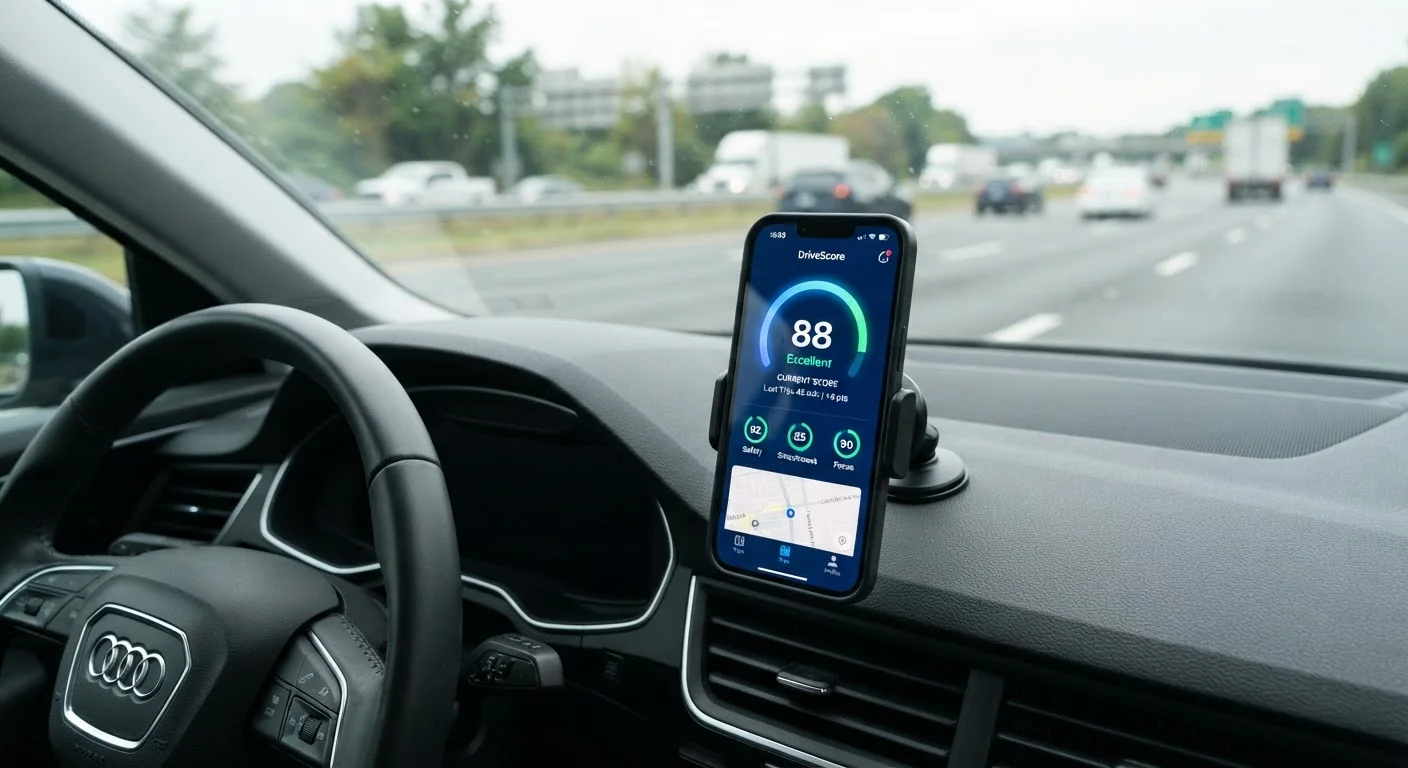
Many telematics apps provide driving scores and summaries after each trip, giving drivers concrete feedback on braking and speed that can help reinforce safer habits over time.
Privacy trade-offs are significant and ongoing
Telematics programmes continuously collect location and behavioural data. Data retention and sharing policies vary, and drivers should carefully review how their insurer handles this information before enrolling.
Premiums can increase after the monitoring period
If your driving data is less favourable than expected — hard braking events, late-night miles, or higher-than-average speed — your premium may go up rather than down once the programme evaluates your results.
High-mileage drivers rarely benefit from pay-per-mile
Pay-per-mile pricing adds up quickly for commuters or frequent long-distance drivers. A driver covering 20,000 miles a year could pay considerably more than under a traditional flat-rate policy.
Night-shift and shift workers may be penalised
Many telematics programmes flag late-night driving as higher-risk, automatically creating an unfavourable scoring signal for workers whose schedules require driving during off-peak hours.
Our Verdict
Usage-based and pay-per-mile insurance can offer meaningful savings for drivers who drive safely, drive less, or both. However, the privacy trade-offs and the risk of higher premiums for those with less-than-perfect habits mean these programmes aren't a universal win. They work best as a tool for drivers who already practice safe habits and want their premiums to reflect that reality.
Ideal for low-mileage drivers, remote workers, retirees, or anyone with consistently safe driving habits who wants a premium tied to actual behaviour rather than broad demographic assumptions.
What Is Usage-Based Insurance and How Does It Work?
Usage-based insurance (UBI) is an auto insurance pricing model that replaces — or supplements — traditional rating factors with data collected from your own driving. Instead of relying solely on your age, ZIP code, or credit score, insurers measure what you actually do behind the wheel. To understand how this differs from standard coverage types, see our auto insurance coverage guide.
There are two main models:
- Behaviour-based UBI: Your premium is adjusted based on how you drive — smoothness of braking, speed, cornering, and when you drive (late-night miles are often penalised).
- Pay-per-mile: You pay a fixed base rate each month plus a small charge for every mile driven. The less you drive, the less you pay.
Data is collected via one of three methods: a small OBD-II plug-in device (inserted into a port typically found under your dashboard), a mobile app using your phone's GPS and sensors, or built-in vehicle telematics if your car supports it. Most programmes run for an initial monitoring period — commonly 90 days — after which your premium is adjusted based on the data collected.
Enrolment Discounts vs. Ongoing Savings
Many insurers offer an upfront discount simply for signing up for a telematics programme, separate from any behavioural scoring. This enrolment discount is not the same as the ongoing savings you may — or may not — receive once your driving data is reviewed. Be clear on the difference before assuming your initial discount will persist at renewal.
What Data Does a Telematics Programme Actually Collect?
Understanding what's being tracked matters before you enrol. Typical data points include:
- Mileage: Total distance driven per day or billing cycle.
- Speed: How often and how significantly you exceed posted limits.
- Hard braking and rapid acceleration: Sudden stops or aggressive starts signal risk to insurers.
- Time of day: Driving between midnight and 4 a.m. is statistically higher-risk and may increase rates.
- Phone use: Some app-based programmes can detect distracted driving behaviours.
Importantly, data retention policies vary by insurer. Some hold your data for the length of the policy; others for longer periods. In most states, insurers can share aggregated or de-identified data with third parties, though practices differ. Reading the programme's privacy disclosure before signing up is worth the time. Factors shaping your car insurance premium explains how traditional rating factors compare.
~20%
Typical maximum discount advertised by UBI programmes
Insurers commonly advertise discounts of up to around 20% for top-scoring drivers, though actual savings depend on programme rules, insurer, and individual driving data.
7,500
Annual miles often cited as pay-per-mile breakeven threshold
Industry observers generally suggest pay-per-mile policies tend to favour drivers covering roughly 7,500 miles or fewer per year compared to standard flat-rate premiums.
Pros and Cons of Telematics Insurance
Whether a telematics programme benefits you depends heavily on your driving profile. Here's a balanced look at what you're gaining — and giving up.
Potential premium savings for safe, low-mileage drivers
Drivers who score well during the monitoring period can see meaningful discounts — some programmes advertise potential savings, though actual results vary widely by insurer and individual driving profile.
Fairer pricing tied to individual behaviour
Traditional premiums lean heavily on demographic proxies like age and ZIP code. Telematics shifts pricing toward what you actually do, which can benefit drivers who are penalised by group-based assumptions.
Pay-per-mile is genuinely linear for low drivers
If you drive infrequently, pay-per-mile pricing is straightforward — the mileage charge simply doesn't accumulate much. This is particularly valuable for drivers who keep a car for occasional use only.
Real-time driving feedback can improve habits
Many telematics apps provide driving scores and summaries after each trip, giving drivers concrete feedback on braking and speed that can help reinforce safer habits over time.
Privacy trade-offs are significant and ongoing
Telematics programmes continuously collect location and behavioural data. Data retention and sharing policies vary, and drivers should carefully review how their insurer handles this information before enrolling.
Premiums can increase after the monitoring period
If your driving data is less favourable than expected — hard braking events, late-night miles, or higher-than-average speed — your premium may go up rather than down once the programme evaluates your results.
High-mileage drivers rarely benefit from pay-per-mile
Pay-per-mile pricing adds up quickly for commuters or frequent long-distance drivers. A driver covering 20,000 miles a year could pay considerably more than under a traditional flat-rate policy.
Night-shift and shift workers may be penalised
Many telematics programmes flag late-night driving as higher-risk, automatically creating an unfavourable scoring signal for workers whose schedules require driving during off-peak hours.
Who Benefits Most — and Who Should Think Twice?
Telematics programmes tend to deliver the most value for a specific type of driver. Low-mileage drivers — those logging under 7,500 miles a year — are the natural fit for pay-per-mile policies. Remote workers, retirees, and urban residents who rely primarily on public transit but keep a car for occasional trips often see significant reductions compared to standard pricing.
Behaviour-based UBI works well for drivers who are confident their habits are consistently safe: smooth braking, moderate speeds, daytime driving, no phone use. If that describes your daily commute, the data will likely reflect it favourably.
On the other hand, high-mileage commuters, night-shift workers, or anyone whose job requires frequent driving may find pay-per-mile programmes cost more than a flat-rate policy. Similarly, drivers who drive aggressively — even occasionally — risk having their premium increase rather than decrease after the monitoring period.
Teens and young drivers are a special case. Some insurers market UBI to parents as a way to monitor new drivers and potentially access lower rates. The monitoring aspect can be a useful safety feedback tool, but whether it results in savings depends on the driving record established during the monitoring window. For a broader view of how coverage decisions interact, see our liability-only vs. full coverage comparison.
This article is for general informational purposes only and does not constitute personalised insurance, financial, or legal advice. Coverage, pricing, data practices, and programme availability vary by insurer and by state. Consult a licensed insurance professional and review actual policy documents before making coverage decisions.