

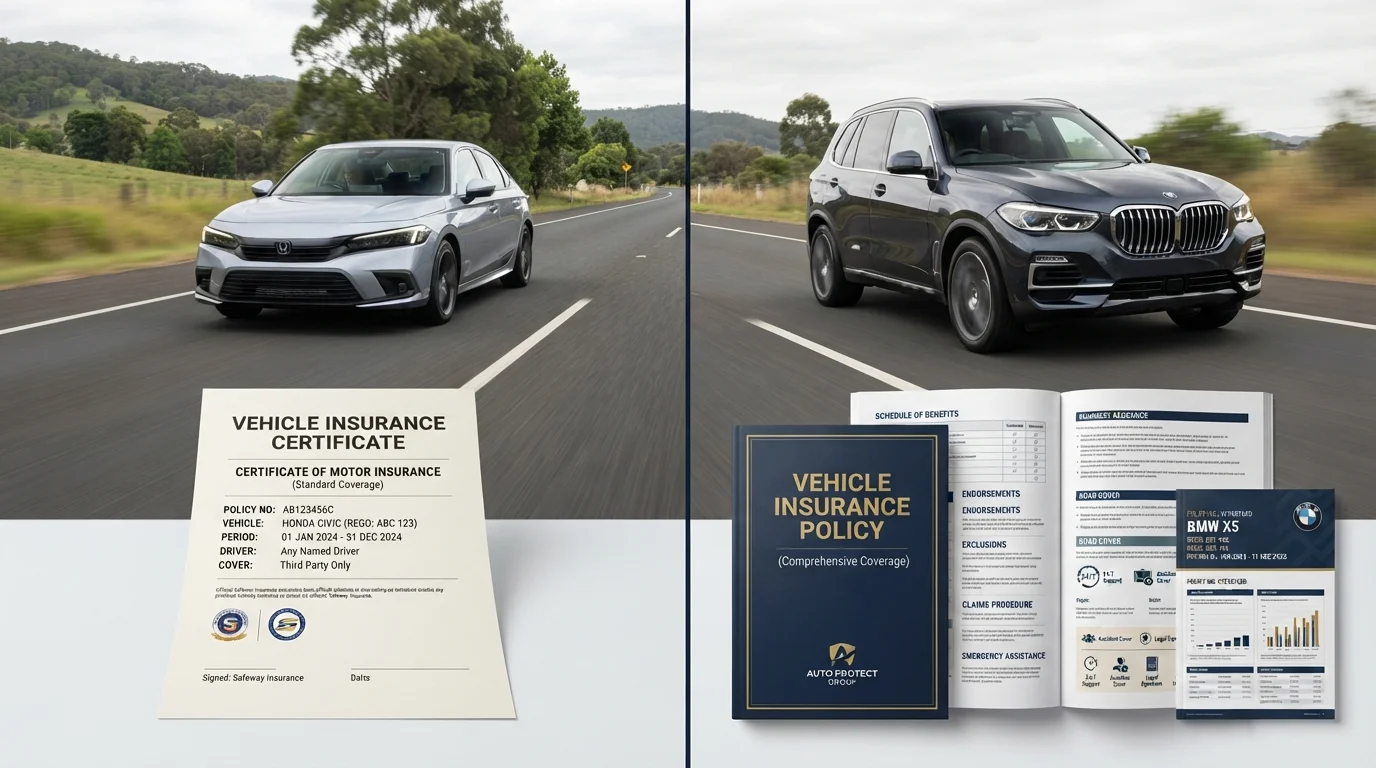
Key Takeaways
- Liability-only meets state minimums but pays nothing toward damage to your own vehicle.
- Full coverage adds collision and comprehensive protection, significantly raising your premium.
- Lenders typically require full coverage on financed or leased vehicles.
- The older and lower-value your car, the weaker the financial case for full coverage.
- Your emergency fund, driving environment, and loan status all shape the right choice.
Option A
Liability-Only Coverage
The legally required baseline that protects others, not your vehicle.
Best for: Drivers of older, lower-value vehicles who can absorb the cost of self-repair or replacement.
Option B
Full Coverage
The broader protection package that shields your vehicle alongside others.
Best for: Drivers of newer, financed, or high-value vehicles who want protection against a wide range of losses.
If your car is older and worth less than a few thousand dollars
Liability-Only Coverage
When a car's market value is low, collision and comprehensive premiums can exceed what you'd recover from a claim, making the added cost hard to justify.
If your vehicle is financed or leased
Full Coverage
Lenders require full coverage because they have a financial stake in the vehicle. Dropping to liability-only on a financed car violates your loan agreement.
If you lack a financial cushion to replace your car out of pocket
Full Coverage
Without savings to fall back on, losing a car to an accident or theft could be financially devastating; full coverage limits that exposure.
If you drive infrequently and own your vehicle outright
Liability-Only Coverage
Lower annual mileage reduces your risk exposure, and owning a paid-off, modest-value car means you have more flexibility to self-insure against vehicle damage.
If you live in an area prone to severe weather, flooding, or high theft rates
Full Coverage
Comprehensive coverage — part of full coverage — protects against non-collision events like storms, hail, and theft that liability insurance never addresses.
What Each Policy Type Actually Covers
Before weighing costs, it helps to be clear on what each option actually protects. For a full breakdown of coverage terminology, see Auto Insurance Decoded.
Liability-only coverage pays for bodily injury and property damage you cause to others in an accident where you're at fault. Every state except New Hampshire requires some minimum level of liability insurance. What it does not cover is any damage to your own vehicle — whether from a collision, a falling tree, vandalism, or a flood.
Full coverage is an informal term rather than a policy category. In practice, it refers to a policy that bundles liability with two additional coverages: collision (damage to your car from an accident, regardless of fault) and comprehensive (damage from non-collision events such as weather, fire, theft, or animal strikes). For a closer look at how those two components differ from each other, see Collision vs. Comprehensive Coverage.
Neither policy type automatically includes medical payments coverage or protection against uninsured drivers — those require separate add-ons. Learn how uninsured motorist protection works in Uninsured and Underinsured Motorist Coverage: Why It Exists.
| Criterion | Liability-Only | Full Coverage |
|---|---|---|
| Covers damage to others | Yes | Yes |
| Covers your vehicle after a collision | No | Yes (collision) |
| Covers theft or weather damage | No | Yes (comprehensive) |
| Required by lenders | No | Yes, for financed/leased cars |
| Typical premium cost | Lower | Higher |
| Best vehicle fit | Older, low-value vehicles | Newer or high-value vehicles |
| State minimum compliance | Yes (meets minimums) | Yes (exceeds minimums) |
The Cost and Value Equation
Full coverage reliably costs more — sometimes substantially. The gap depends on your location, driving record, vehicle age, and the deductible you choose. A higher deductible lowers your premium but raises what you pay out of pocket after a claim; The Real Cost of Carrying the Wrong Deductible walks through how to think through that trade-off.
~30%
Average premium increase for full vs. liability-only
Industry estimates generally place the added cost of collision and comprehensive at roughly 20–40% above liability-only premiums, though the range varies widely by driver profile and location.
1 in 8
Drivers on U.S. roads estimated to be uninsured
According to the Insurance Research Council, an estimated one in eight drivers carries no insurance, underscoring why coverage decisions affect more than just your own vehicle.
A commonly cited rule of thumb is to reconsider full coverage when your annual premium for collision and comprehensive exceeds 10% of your vehicle's current market value. For example, if your car is worth $4,000 and those two coverages cost $600 per year, you'd net very little from a total-loss claim after accounting for the deductible. That math shifts considerably for a newer car worth $25,000 or more.
It's also worth noting what full coverage still doesn't include. Coverage Gaps Drivers Discover Only After an Accident details how scenarios like rideshare driving or using a personal vehicle for deliveries can leave even full-coverage policyholders exposed.
Practical Factors That Shift the Decision
No coverage decision exists in isolation. Several factors reliably move the needle:
- Loan or lease obligation: If you're still paying off your vehicle, your lender controls the decision — full coverage is contractually required. Dropping it while carrying a loan can trigger the lender force-placing insurance on your behalf, often at a higher cost.
- Vehicle age and market value: As a car ages and depreciates, the maximum payout from collision or comprehensive shrinks. At some point the math no longer supports the premium cost.
- Your liquid savings: Someone with a healthy emergency fund can absorb a total loss more easily than someone without one. If replacing your car without insurance proceeds would seriously strain your finances, full coverage provides meaningful protection.
- Driving environment: High-traffic urban areas, regions with frequent hailstorms, or areas with elevated vehicle theft rates all increase the probability that you'll need coverage beyond liability.
- Annual mileage: More time on the road statistically means more exposure to accidents. Drivers who barely use their vehicles take on less risk — a point relevant to usage-based policies as well. See Usage-Based and Pay-Per-Mile Insurance for an alternative worth considering.
Gap Insurance: A Related Consideration
If you've recently purchased a new vehicle with a loan, standard full coverage may not be enough on its own. Gap insurance covers the difference between what your insurer pays (the car's current market value) and what you still owe on the loan — a meaningful gap in the early years of ownership when depreciation outpaces loan payoff. Ask your lender or insurer whether gap coverage applies to your situation.
There's no universally correct answer here. The right coverage level matches your financial position, the value of your vehicle, and your personal risk tolerance — not a blanket rule.
This article provides general information about auto insurance coverage types. It is not personalised insurance or financial advice. Coverage terms, costs, and requirements vary by state and by insurer. Consult a licensed insurance professional before making decisions about your policy.