

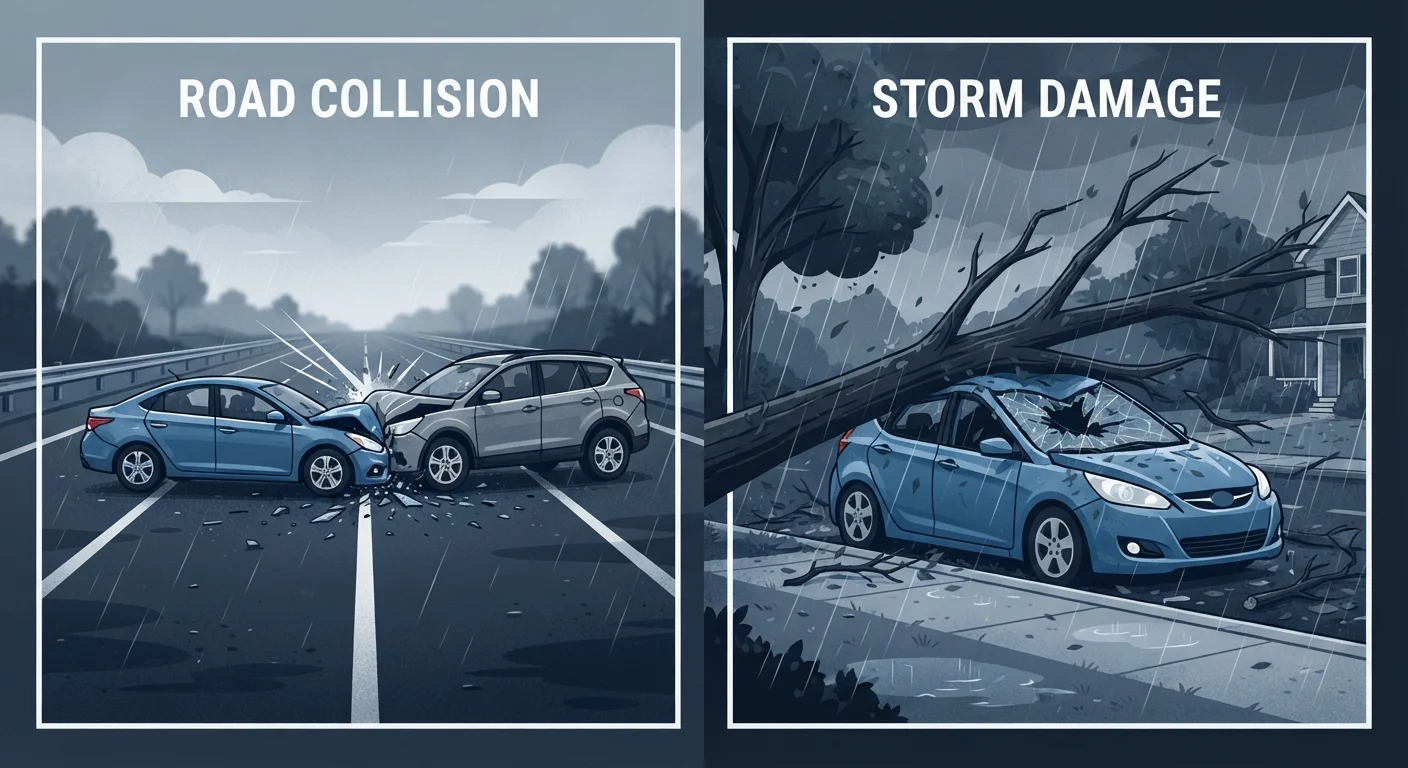
Key Takeaways
- Collision coverage pays for damage when your vehicle strikes another car or object.
- Comprehensive coverage handles non-collision losses like theft, hail, flooding, and animal strikes.
- Neither coverage is required by law, but lenders typically require both on financed or leased vehicles.
- Your deductible — the amount you pay before insurance kicks in — applies separately to each coverage type.
- Together, both coverages form what's commonly called 'full coverage' alongside liability insurance.
Option A
Collision Coverage
The coverage that steps in when your car hits something.
Best for: Drivers who want protection when their vehicle is damaged in an accident, regardless of who is at fault.
Option B
Comprehensive Coverage
The coverage that handles nearly everything else.
Best for: Drivers who want protection against theft, weather, and other non-collision events outside their control.
If you drive a financed or leased vehicle
Both Collision and Comprehensive
Most lenders and leasing companies require both. Skipping either could put you in breach of your loan or lease agreement.
If your car is older and paid off with low market value
Liability-Only (consider dropping both)
If the potential payout after a deductible is small relative to your premium costs, carrying both may not be cost-effective. Review the math carefully.
If you live in an area prone to severe weather, flooding, or high vehicle theft
Comprehensive Coverage
Comprehensive is the only coverage that protects against weather events, hail, wildfires, and theft — risks that are geography-dependent.
If you frequently drive in heavy traffic or have a long daily commute
Collision Coverage
More time on the road means more exposure to at-fault and not-at-fault accidents. Collision coverage protects your vehicle regardless of fault.
What Each Coverage Actually Protects
Collision coverage pays to repair or replace your vehicle when it's damaged by impact — hitting another car, backing into a pole, or rolling into a ditch. Fault doesn't change the outcome: if your car is damaged in a collision, this coverage applies whether or not you caused the accident.
Comprehensive coverage handles damage from events that aren't collisions. Think theft, vandalism, hail, flooding, falling trees, fire, and animal strikes (like hitting a deer). The Insurance Information Institute describes comprehensive as covering "almost everything else" that can happen to a parked or moving vehicle outside of a collision.
A useful way to remember it: if your car runs into something, that's collision. If something happens to your car, that's usually comprehensive.
| Criterion | Collision Coverage | Comprehensive Coverage |
|---|---|---|
| What triggers a claim | Impact with another vehicle or object | Theft, weather, fire, animals, vandalism |
| Fault requirement | Pays regardless of fault | Fault not applicable — non-collision events |
| Required by law | No | No |
| Required by lenders | Usually yes, on financed/leased vehicles | Usually yes, on financed/leased vehicles |
| Deductible applies | Yes | Yes |
| Payout cap | Actual cash value of vehicle | Actual cash value of vehicle |
| Covers deer strike | No | Yes |
| Covers at-fault accident | Yes | No |
Deductibles, Limits, and What You'll Actually Pay
Both coverages carry a deductible — the out-of-pocket amount you agree to pay before your insurer covers the rest. Common deductible amounts range from $250 to $1,500. Choosing a higher deductible lowers your premium, but means more out of pocket if you file a claim.
The payout for either coverage is capped at your vehicle's actual cash value (ACV) — what the car is worth on the open market at the time of the loss, not what you paid for it or what it would cost to replace it new. Depreciation is a real factor here.
~$290/yr
Average annual collision coverage cost
According to the National Association of Insurance Commissioners (NAIC), average collision premiums nationally are roughly in this range, though individual costs vary widely.
~$168/yr
Average annual comprehensive coverage cost
NAIC data suggests comprehensive tends to cost less than collision on average, partly because individual non-collision claims are statistically less frequent than collision claims.
If your car is totaled, the insurer pays the ACV minus your deductible. Gap insurance — a separate add-on — covers the difference between what you owe on a loan and what the car is worth, which is worth considering on newer vehicles. See our guide to common coverage gaps for more on how this plays out in real scenarios.
When You Need One, Both, or Neither
Neither collision nor comprehensive coverage is mandated by state law — but that doesn't mean they're optional in practice. If you're financing or leasing a vehicle, your lender almost certainly requires both. Dropping either without lender approval could put you in default.
For paid-off vehicles, the decision becomes a numbers exercise. A general guideline: if your annual premium for both coverages exceeds 10% of your car's market value, the cost-benefit case weakens. That said, this is general information — your specific situation, risk tolerance, and savings cushion all matter. A licensed insurance agent can help you run the numbers for your circumstances.
If you're weighing how collision and comprehensive fit into a broader coverage decision, our comparison of liability-only vs. full coverage walks through the broader trade-offs. And if medical costs after an accident concern you, PIP vs. MedPay explains those options in plain terms.
What 'Full Coverage' Actually Means
You'll often hear the term 'full coverage,' but it's not an official insurance term — it typically refers to a policy that combines liability, collision, and comprehensive coverage. Even with all three, gaps can exist. Rental reimbursement, roadside assistance, and gap insurance are separate add-ons. Always read your policy's declarations page to understand exactly what's included.
This article is for general informational purposes only and does not constitute personalized insurance or financial advice. Coverage terms, availability, and costs vary by insurer, policy, and state. Consult a licensed insurance professional before making decisions about your coverage.