

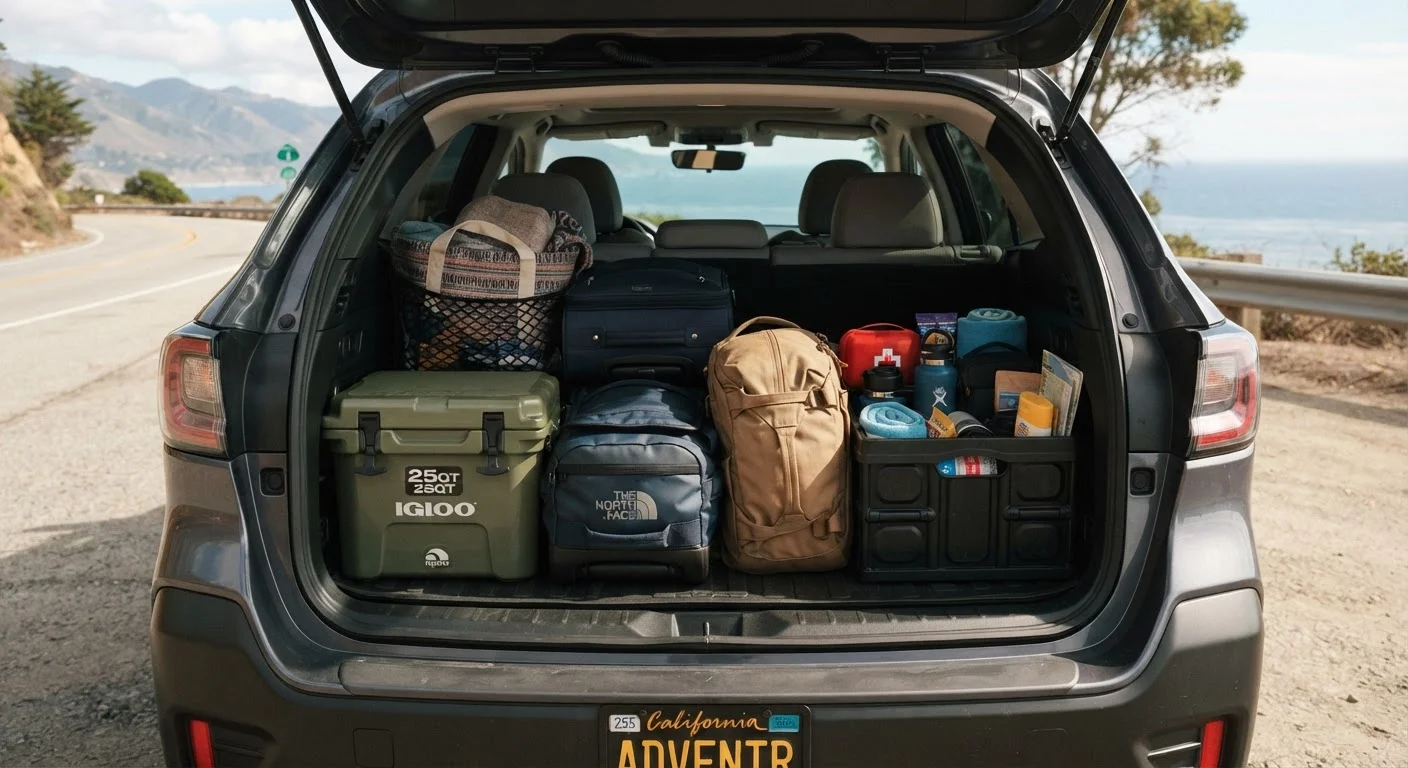
Key Takeaways
- Pack by function, not by 'just in case' — every item should serve a clear, likely purpose.
- Heavy or bulky items that rarely get used are the most common space-wasters on road trips.
- A vehicle safety kit, snacks, and navigation backup should be non-negotiables in any car.
- Packing light reduces cabin clutter, improves fuel efficiency, and makes stops less stressful.
- Layered clothing and versatile items outperform outfit-specific or single-use packing every time.
The Core Principle: Space Is a Resource, Not a Right
Most road trip packing mistakes share a common root: treating available car space as an invitation rather than a budget. A sedan, SUV, or wagon has finite room, and every bag you add affects access to gear you actually need, passenger comfort, and even how the vehicle handles on the highway.
The best framework is simple — before anything goes in the car, ask: How many times will I realistically reach for this? If the honest answer is "probably never," it stays home. This isn't about minimalism for its own sake; it's about giving the items that genuinely matter room to be useful. See our guide to what separates smooth drives from stressful ones for more on how preparation shapes the whole experience.
What Always Earns Its Space
Certain categories of items justify their real estate on every single trip, regardless of length or destination. These are the non-negotiables that experienced road trippers never skip.
~30%
Fuel efficiency drop from significant overloading
The U.S. Department of Energy notes that carrying excess weight reduces fuel economy, with each 100 lbs of unnecessary load affecting efficiency noticeably in smaller vehicles.
1 in 3
Drivers without a basic roadside kit
Various automotive safety surveys have found a significant share of US drivers do not carry jumper cables or a first-aid kit, leaving them unprepared for common roadside situations.
Beyond food and water, a vehicle safety kit — jumper cables or a jump starter, a basic first-aid kit, a reflective triangle or flares, and a tire inflator — belongs in every trunk. Many drivers carry these and never use them; that's exactly the point. For a complete pre-departure checklist including vehicle safety checks, see our road trip prep guide.
A paper map or downloaded offline navigation for your route also earns its space unconditionally. Cell coverage is unreliable in stretches of the rural US, and relying solely on a data connection in those gaps is one of the most common planning missteps covered in our look at why road trips go wrong.
The Usual Suspects: What Doesn't Pull Its Weight
Experienced road trippers tend to identify the same repeat offenders taking up room without delivering value.
- "Just in case" outfits. Packing a separate outfit for every conceivable scenario — formal dinner, hike, rain, casual evening — is the fastest way to fill a trunk with clothes you won't wear. Choose layerable, mix-and-match pieces instead.
- Full-size toiletry bottles. Unless you're camping off-grid for weeks, travel-size quantities cover most trips. Full bottles are heavy, prone to leaking, and typically available at any stop along the way.
- Bulky entertainment equipment. Tablets and noise-canceling headphones serve passengers beautifully. A portable projector, board games for six, or a Bluetooth speaker the size of a watermelon rarely justifies its footprint.
- Duplicate tools and chargers. One well-stocked charging hub beats three separate single-device chargers tangled in the console.
The Cooler Rules the Trunk
A well-stocked cooler is one of the highest-value items on any road trip — it cuts costs, reduces stop frequency, and keeps energy levels steady. Choose a mid-size hard cooler over a large one: it holds more than you'll actually consume, stays cold longer than soft-sided options, and still leaves room for everything else. Pack it last so it's accessible at rest stops without rearranging the trunk.
The same logic applies whether you're loading a car or a carry-on — see how seasoned travelers approach packing carry-on only for parallel thinking that translates directly to road trips.
Smart Packing in Practice
Knowing what to bring is only half the equation — how you pack shapes how useful everything actually is on the road.
Traveling with children adds useful complexity to the equation; their needs are real and specific. Our candid look at road trips with kids explores how to adjust packing strategy without letting it spiral into over-preparation. For broader vehicle care habits that support long drives, the Vehicle Care hub is a practical starting point.
This article provides general travel and packing guidance for informational purposes. Always verify vehicle safety equipment requirements and road conditions with appropriate official sources before traveling.