
Key Takeaways
- Phishing arrives by email; smishing by text message; vishing by voice call.
- Each method uses urgency, fear, or authority to pressure you into acting without thinking.
- Legitimate organizations almost never ask for passwords, PINs, or full account numbers through any of these channels.
- Caller ID, sender names, and even phone numbers can be faked — appearance alone is not proof of identity.
- Pausing before clicking, calling back on a verified number, and using two-factor authentication are your strongest defenses.
Social Engineering Attacks
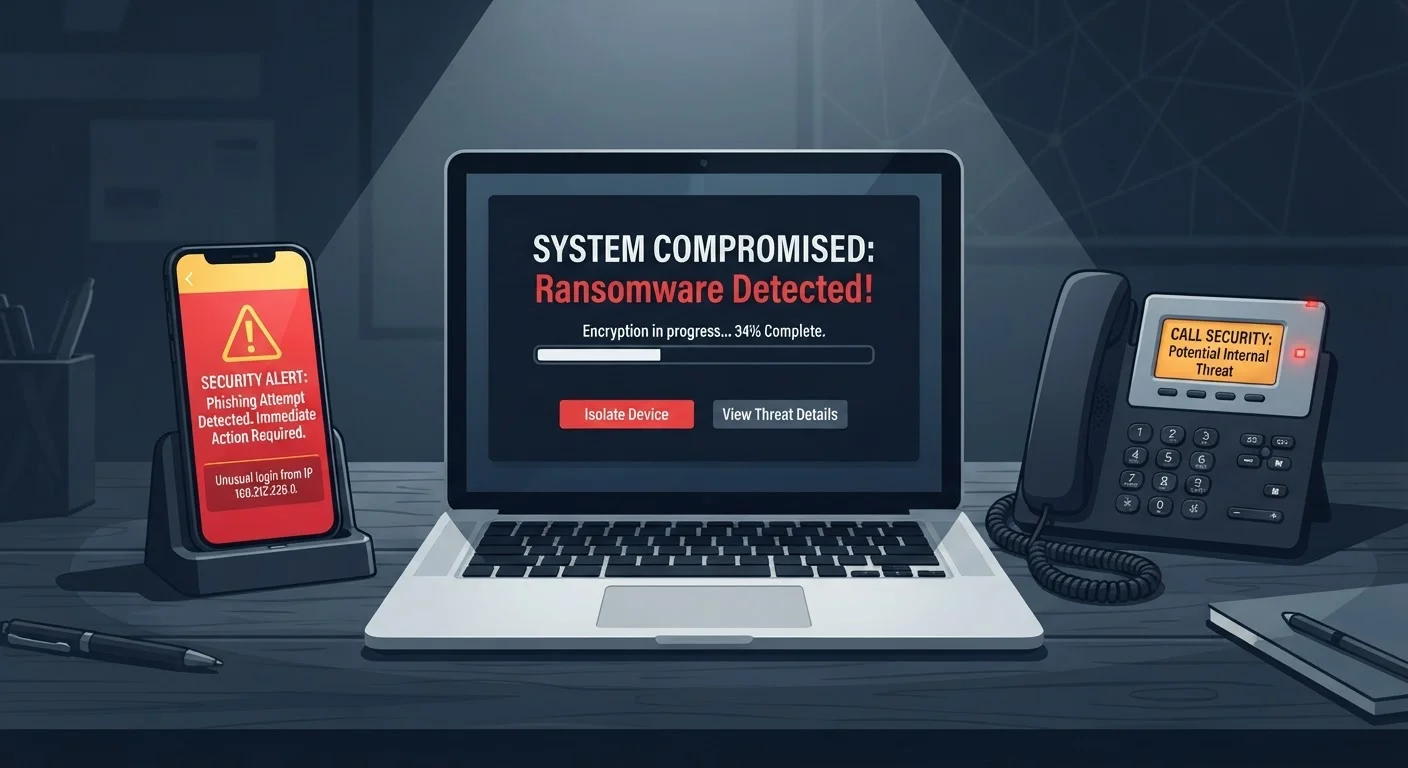
Social engineering attacks are scams that manipulate people — rather than technology — into revealing sensitive information or taking a harmful action. Phishing, smishing, and vishing are three delivery methods for the same core trick: impersonating someone trustworthy to steal your credentials, money, or personal data. The channel changes (email, SMS, or voice call), but the psychological pressure stays the same.
All three fall under the broader category of social engineering, which exploits human psychology rather than software vulnerabilities to bypass security systems.
Phishing: The Email That Looks Almost Right
Phishing is the oldest and most common form of this attack family. You receive an email that appears to be from your bank, a streaming service, a government agency, or even your employer. The message typically warns of an urgent problem — a suspended account, a failed payment, a package held for customs — and includes a link to "resolve" it.
That link leads to a convincing copycat website designed to harvest whatever you type: your username, password, or credit card number. The page may look pixel-perfect, complete with logos and legal fine print, but the URL in your browser's address bar reveals the truth. Slight misspellings, extra subdomains, or unfamiliar domains (like secure-bankname-login.com instead of bankname.com) are common tells.
Attachments are also weaponized. A PDF or Word file can carry malware that executes the moment you open it, without you ever entering a single piece of information voluntarily.
Check the URL Before You Click
Hover over any link before clicking — on desktop, the real destination appears in the status bar at the bottom of your browser. On mobile, press and hold a link to preview the URL before it opens. If the domain looks unfamiliar or misspelled, do not proceed.
Hover over any link before clicking — on desktop, the real destination appears in the status bar at the bottom of your browser. On mobile, press and hold a link to preview the URL before it opens.
Smishing: The Text That Creates Instant Panic
Smishing (SMS + phishing) exploits the more personal, immediate nature of text messaging. Most people open texts within minutes and feel a strong pull to respond — especially when the message claims to be from a delivery carrier, a bank fraud department, or a government benefits program.
A typical smishing message is brief and alarming: "Your package could not be delivered. Confirm your address to reschedule: " or "Unusual sign-in detected. Verify immediately or your account will be locked." The link leads to the same kind of credential-harvesting page used in email phishing, but the abbreviated URLs common in texts make the destination even harder to evaluate at a glance.
~3.4B
Phishing emails sent daily worldwide
Estimates from cybersecurity research firms suggest billions of phishing emails circulate every day, making it one of the most volume-driven threat categories.
98%
Of SMS messages are opened by recipients
Industry research consistently shows that text messages have exceptionally high open rates compared to email, which partly explains the growth of smishing as an attack vector.
Over 50%
Of social engineering attacks now include a phone call
Cybersecurity firm Agari has noted that hybrid attacks combining email with a follow-up voice call have become increasingly common to add perceived legitimacy.
What makes smishing especially effective is context collapse: you might receive a legitimate text from your bank one day and a smishing attempt the next, and both look structurally identical. Never tap a link in an unsolicited text. Instead, navigate directly to the company's official app or website to check your account status.
Vishing: The Voice on the Other End
Vishing (voice + phishing) removes the screen entirely and replaces it with a human — or a convincing AI-generated — voice. Callers impersonate IRS agents, Social Security Administration employees, tech support representatives, or bank fraud departments. The social pressure of a live conversation makes it harder to pause and think critically.
Common vishing scripts create extreme urgency: "Your Social Security number has been suspended due to suspicious activity" or "There's an arrest warrant in your name — you must act now." The caller may already know your name, city, or partial account number (sourced from data breaches) to appear credible. They will ask you to confirm the rest.
Caller ID spoofing means the number displayed can match a real government agency or your actual bank. That display is not proof of anything. If a call feels off, hang up and call back using the number on the back of your card or the organization's official website. Real agencies will never demand immediate payment in gift cards, wire transfers, or cryptocurrency.
If your accounts were exposed in a breach, the steps in our guide on keeping your accounts safe after a data breach are a practical starting point for damage control.
AI Is Making Vishing Harder to Detect
Generative AI tools can now clone voices with only a few seconds of audio, meaning a vishing call might sound like someone you know. If you receive an urgent call from a family member or colleague requesting money or sensitive information, hang up and call them back on a number you already have saved. This simple step defeats voice-cloning attacks entirely.
Recognizing the Pattern Across All Three
Despite different delivery channels, phishing, smishing, and vishing share a recognizable playbook. Spotting the pattern breaks the spell:
- Urgency and fear: "Act now or lose access." Real organizations allow you time to verify.
- Requests for sensitive information: Passwords, PINs, Social Security numbers, and full account numbers are never legitimately collected via an unsolicited email, text, or call.
- Pressure to bypass normal channels: Scammers discourage you from calling the main number or logging in independently — because those steps would expose them.
- Unusual payment methods: Requests for gift cards, wire transfers, or cryptocurrency are universally a scam signal.
Strengthening your accounts with a strong, unique password and a second verification layer compounds the difficulty for attackers. Our article on two-factor authentication methods explains which options offer the strongest protection and how they differ in everyday convenience.
The most reliable defense is a single habit: slow down. These attacks depend on you reacting before you think. A five-second pause — to check the URL, hang up and redial, or search for the official contact number — is often enough to break the entire attack chain.