

| Most common organizing framework | Sort, purge, assign a home, contain, maintain (Common professional organizer methodology) |
| Prime real estate definition | Eye level, within arm's reach of point of use |
| When decanting helps most | Pantries, craft rooms, laundry areas |
| Capsule wardrobe origin | Fashion concept adapted to broader home storage |
| Zoning applies to | Any room: kitchen, garage, home office, closet |
Why the Vocabulary Matters
Home organization advice is packed with terms that sound intuitive but often mean something specific. When a guide tells you to "zone" your kitchen or use "negative space" in a closet, vague interpretations lead to vague results. This reference gives you precise, plain-language definitions so you can apply what you read — whether you're reorganizing a junk drawer or a full garage.
Terminology also travels across contexts. The same concept described in a minimalism blog might appear under a different label in a professional organizer's framework. Knowing what each term actually means prevents you from duplicating effort or skipping a useful step.
Zoning
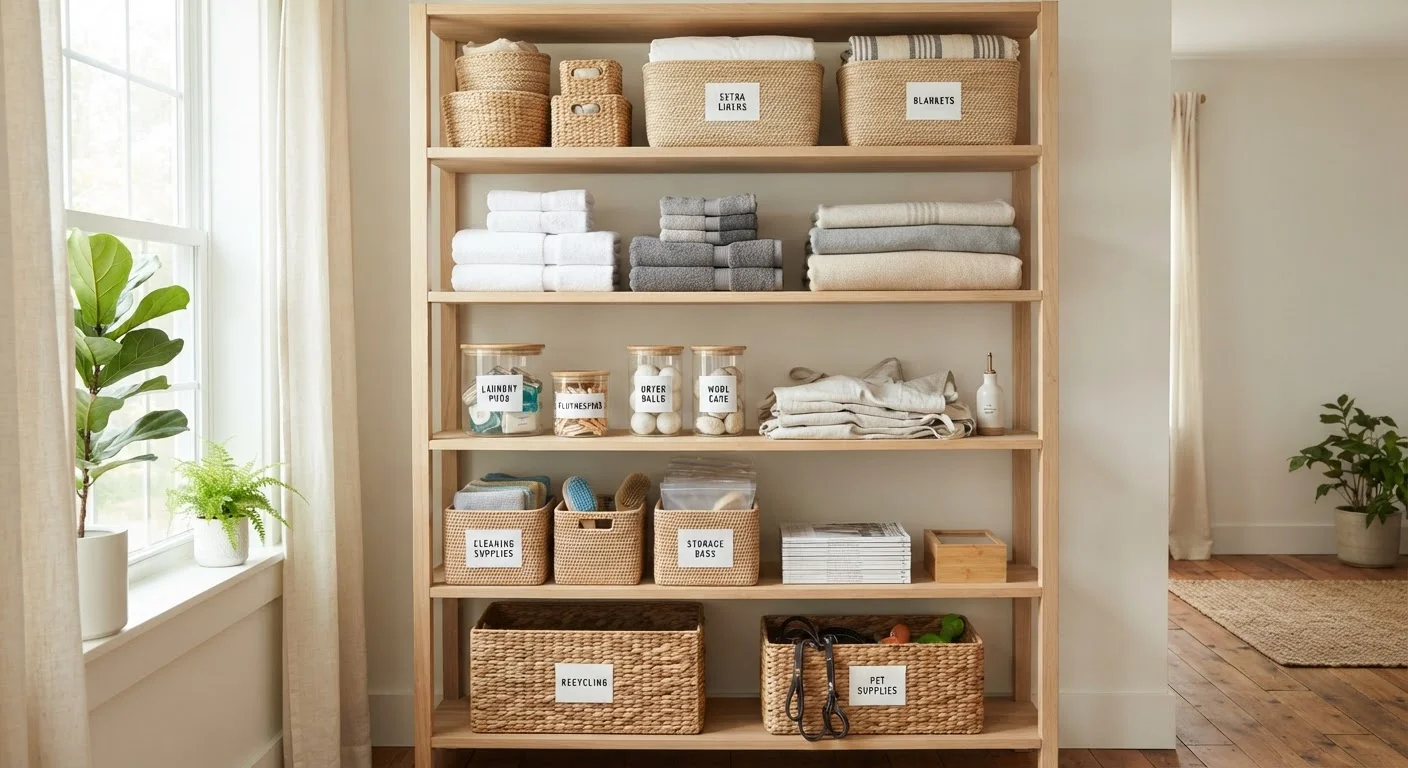
Dividing a room or storage area into sections dedicated to specific activities or item categories. Items used together are stored together within a defined zone.
Negative space
Intentional empty area within a storage system. It allows for easy retrieval, visual clarity, and room to accommodate new items without chaos.
Capsule storage
Maintaining only the minimum functional set of items within a category. Reduces clutter and decision fatigue while preserving full usefulness.
Decanting
Transferring items from original, mixed packaging into uniform containers, often labeled. Commonly applied to pantry goods, craft supplies, or cleaning products.
One-in, one-out rule
A behavioral system in which one existing item must leave when a new item is acquired. Prevents gradual accumulation from reversing an organized space.
Prime real estate
Storage locations that are easiest to access — at eye level, within arm's reach, or nearest a point of use. Reserved for the most frequently used items.
Dead zone
Hard-to-reach storage areas such as high shelves, deep lower cabinets, or the back of closets. Best used for rarely accessed or seasonal items.
Edit
The process of sorting through items to decide what stays, what goes, and what gets relocated. Often the first step before any new storage solution is introduced.
Core Organization Concepts Explained
The terms below appear most frequently in home organization guidance. Understanding them as a group helps you see how they connect — most organizing systems rely on several of these concepts working together, not just one in isolation.
| Most common organizing framework | Sort, purge, assign a home, contain, maintain (Common professional organizer methodology) |
| Prime real estate definition | Eye level, within arm's reach of point of use |
| When decanting helps most | Pantries, craft rooms, laundry areas |
| Capsule wardrobe origin | Fashion concept adapted to broader home storage |
| Zoning applies to | Any room: kitchen, garage, home office, closet |
Zoning
Zoning means dividing a room or storage area into dedicated sections based on activity or category. In a kitchen, a baking zone might contain measuring tools, mixing bowls, and baking sheets within reach of one another. In a garage, a zoning approach groups lawn tools separately from automotive supplies. The principle is that items used together live together. See how zoning applies to large storage spaces in our garage storage principles guide.
Negative Space
Negative space refers to intentionally empty areas left within a storage system. A shelf that's only three-quarters full isn't poorly used — it's leaving room for new items, for visibility, and for ease of retrieval. Removing negative space entirely is one of the most common reasons organized spaces stop working over time.
Capsule Storage
Borrowed from fashion's capsule wardrobe concept, capsule storage means keeping only the minimum functional set of items in a category. A capsule cleaning supply collection might be four to six multi-purpose products rather than fifteen single-use ones. The goal is reducing decision fatigue and clutter while maintaining full functionality.
Decanting
Decanting is the practice of transferring items from their original packaging into uniform, labeled containers. Pantry staples moved from mixed bags into matching airtight jars is a classic example. It improves visual consistency and makes quantities easier to assess at a glance.
The One-In, One-Out Rule
A behavioral guideline rather than a storage method: for every new item that enters a space, one existing item must leave. This rule is designed to prevent gradual accumulation from undoing an organized system. It works best when it's applied consistently rather than only during major resets. For more on why systems like this matter over time, see why organized homes don't stay that way.
Organization Vocabulary vs. Smart Home Jargon
Home organization terms and smart home technology terms can overlap in unexpected ways — both fields talk about "systems," "routines," and "zones." If you're navigating connected home devices alongside your organizing projects, our smart home technology explainer covers the tech vocabulary separately, so neither topic muddles the other.