

Key Takeaways
- Sleep cycles through four distinct stages roughly every 90 minutes throughout the night.
- Deep slow-wave sleep dominates early cycles and is critical for physical repair and immune function.
- REM sleep — heaviest in the final cycles — supports memory consolidation and emotional processing.
- Cutting sleep short disproportionately reduces REM, which clusters in the later part of the night.
- Consistent sleep timing helps preserve the natural sequence of stages your body depends on.
Sleep Architecture
Sleep architecture refers to the structured pattern of sleep stages your brain cycles through every night. A full cycle — lasting roughly 90 minutes — includes light sleep, deep slow-wave sleep, and REM (rapid eye movement) sleep. Most adults complete four to six of these cycles across a typical seven-to-nine-hour night. The order and proportion of each stage change across the night in predictable ways.
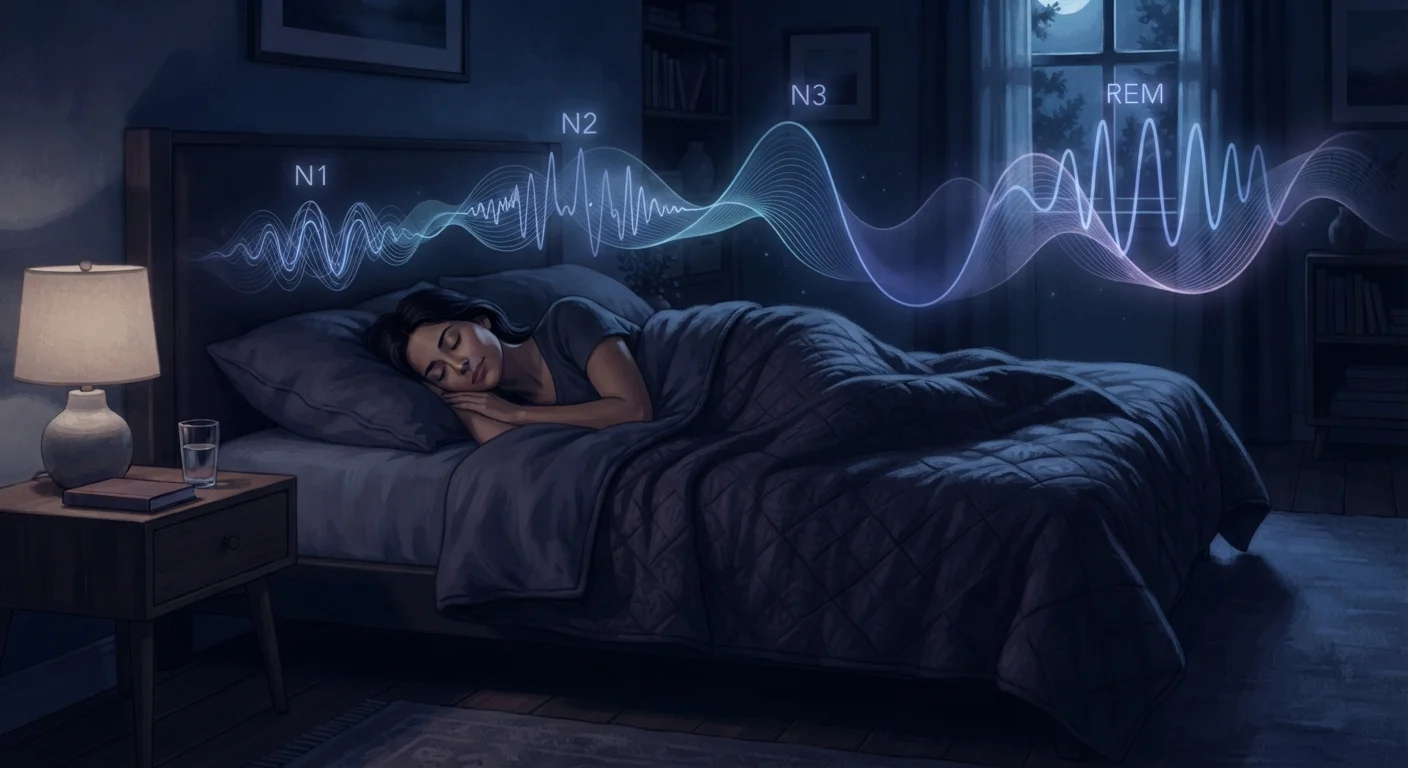
Sleep stages are classified using electroencephalography (EEG), which measures electrical brain wave patterns. Non-REM sleep is divided into N1, N2, and N3 (slow-wave) stages; REM is a distinct fourth stage characterized by low-amplitude, mixed-frequency brain activity.
The Four Stages of a Sleep Cycle
Every night, your brain cycles through a repeating sequence of four sleep stages. Understanding what each one does clarifies why both duration and continuity of sleep matter — and why interrupted sleep rarely feels as restorative as an unbroken night.
N1 — Light Sleep (Transition)
N1 is the brief gateway between wakefulness and sleep, typically lasting just one to seven minutes. Muscle activity slows, eye movements become slow and rolling, and brain waves shift from the alert beta rhythms of waking toward slower theta waves. This stage is easily disrupted; a noise or light change can pull you back to full wakefulness with no sense that you slept at all.
N2 — Consolidated Light Sleep
N2 accounts for roughly half of total sleep time in a typical night. Brain activity shows two distinctive signatures: sleep spindles (brief bursts of oscillatory activity thought to support memory consolidation) and K-complexes (large, slow waves believed to suppress arousal and protect sleep continuity). Core body temperature drops, heart rate slows, and the body begins active downregulation of metabolic activity.
N3 — Slow-Wave Deep Sleep
N3 — sometimes called slow-wave sleep (SWS) — is the most physically restorative stage. The brain produces high-amplitude delta waves, and it becomes much harder to rouse someone from this stage. During N3, the pituitary gland releases growth hormone, tissues undergo repair, and the immune system consolidates its defenses. This stage is front-loaded: the deepest, longest episodes of N3 occur in the first half of the night.
REM — Rapid Eye Movement Sleep
REM sleep is neurologically closer to wakefulness than to deep sleep. The brain is highly active, and the eyes move rapidly beneath closed lids. Voluntary muscles are temporarily paralyzed — a mechanism that prevents the body from acting out vivid dreams. REM is when the brain processes emotional experiences, consolidates declarative memories, and performs what researchers describe as overnight emotional recalibration. REM episodes grow longer with each cycle, meaning the final hours of sleep are disproportionately REM-rich.
“Sleep is not a passive state. Each stage is an active biological process, and disrupting the sequence — even without fully waking — has measurable consequences for how the brain and body function the next day.”
— Matthew Walker, Professor of Neuroscience and Psychology, University of California, Berkeley; author of research on sleep and brain health
How the Cycle Changes Across the Night
Sleep architecture is not static. The proportion of each stage shifts meaningfully between early and late cycles — a pattern with real consequences for anyone who consistently shortens their sleep window.
In the first half of the night, cycles contain longer, deeper N3 slow-wave episodes. Physical restoration — tissue repair, hormone release, immune modulation — is heavily concentrated here. In the second half, N3 shrinks and REM expands. The fourth and fifth cycles may contain REM periods of 40–60 minutes, during which emotional and cognitive processing peaks.
This time-dependence explains a practical reality: cutting a night from eight hours to six hours does not reduce all stages equally. It eliminates a disproportionate share of REM sleep. Over time, this can affect mood regulation, learning, and stress resilience in ways that feel diffuse and hard to trace back to sleep.
~50%
Of total sleep time spent in N2 stage
Research using polysomnography consistently shows N2 light sleep makes up the largest proportion of a typical adult sleep night.
4–6
Complete sleep cycles per typical adult night
Each cycle runs approximately 90 minutes; most adults require seven to nine hours to complete a full complement of cycles, according to established sleep science guidelines.
20–25%
Of total sleep time in REM for healthy adults
The American Academy of Sleep Medicine notes that REM typically accounts for around one-fifth to one-quarter of total sleep in healthy adults, with REM episodes lengthening in later cycles.
For a closer look at how this pattern evolves with age, see our article on how rest needs shift across adulthood — including when age-related changes in architecture are worth discussing with a doctor.
Habits That Support Healthy Sleep Architecture
While you cannot directly control which stage your brain enters, consistent habits create the conditions under which natural architecture is most likely to unfold without interruption.
- Keep a consistent sleep schedule. Going to bed and waking at similar times every day anchors your circadian rhythm, which governs when each stage is most likely to occur. Your circadian biology plays a central role in stage timing — not just total sleep duration.
- Protect the final hours of sleep. Because REM is concentrated late in the night, early alarms or irregular bedtimes selectively compress it. Where your schedule allows, prioritizing a full sleep window matters.
- Limit alcohol near bedtime. Alcohol suppresses REM sleep and fragments the second half of the night, even when it initially aids falling asleep.
- Moderate evening light exposure. Bright or blue-enriched light in the evening suppresses melatonin and delays sleep onset, which can compress early slow-wave episodes. Evidence-informed wind-down routines can help signal your body that sleep is approaching.
- Consider your sleep environment. Temperature, noise, and light intrusions are among the most common disruptors of sleep continuity. Auditing your bedroom conditions is one of the most practical steps toward protecting uninterrupted cycles.
Waking Timing Can Reduce Grogginess
Sleep inertia — that heavy, disoriented feeling on waking — is most intense when you're pulled out of deep N3 sleep. If you find mornings particularly difficult, some people find that small adjustments to wake time (shifting by 15–20 minutes) can coincide better with the natural end of a cycle. This is general guidance; individual sleep patterns vary, and significant sleep difficulties are worth discussing with a healthcare professional.
If you notice patterns that feel like they're quietly degrading your rest without a clear cause, subtle habits that erode sleep quality are worth reviewing — many operate below conscious awareness.
This article is for general informational and educational purposes only and does not constitute medical advice. If you have concerns about your sleep health, please consult a qualified healthcare professional.