

Key Takeaways
- Tyre pressure should be checked at least once a month, ideally when tyres are cold.
- Correct pressure is listed on the driver's door jamb sticker, not on the tyre sidewall.
- Under-inflated tyres increase fuel consumption and raise the risk of a blowout.
- Temperature swings cause pressure to fluctuate — roughly 1 PSI for every 10°F change.
- A basic tyre pressure gauge costs just a few dollars and fits in your glove box.
Tyre Pressure
Tyre pressure refers to the amount of air inside a tyre, measured in pounds per square inch (PSI) or, in some regions, bar or kilopascals (kPa). Every vehicle has a manufacturer-recommended pressure range that keeps the tyre in optimal contact with the road. Running too high or too low affects handling, tread wear, and fuel economy.
Tyre pressure is measured as gauge pressure — meaning it reflects the pressure above atmospheric level, not absolute pressure. The figure you read on a gauge already accounts for the surrounding air.
Why Tyre Pressure Gets Ignored
Of all the routine checks a driver can perform, tyre pressure is probably the easiest — and the most skipped. It requires no tools beyond a simple gauge, takes less than two minutes for all four tyres, and costs nothing. Yet surveys consistently show that a significant proportion of vehicles on American roads are running on tyres that are noticeably under-inflated.
Part of the problem is that modern tyres are designed to look reasonably full even when they're 10 or 15 PSI low. There's no obvious visual cue until the pressure loss is severe. The result: most drivers don't notice until a warning light appears — or worse, until something goes wrong on the road.
Understanding what tyre pressure actually does, and why it matters, is the first step toward making the check a habit. For a broader look at how small oversights compound into larger repair bills, see our piece on skipping routine maintenance.
~25%
Vehicles with at least one significantly under-inflated tyre
The U.S. National Highway Traffic Safety Administration (NHTSA) has reported that roughly one in four passenger vehicles is driven with at least one tyre under-inflated by 25% or more.
0.2% per PSI
Fuel economy reduction per PSI under-inflation
The U.S. Department of Energy estimates fuel economy drops by approximately 0.2% for every 1 PSI drop in pressure across all four tyres.
1 PSI
Pressure lost per 10°F temperature drop
Basic physics: air contracts when cold, causing tyre pressure to fall by roughly 1 PSI for every 10°F (about 5.5°C) decrease in ambient temperature.
What the Numbers Actually Mean
Two numbers cause confusion for many drivers: the figure on the tyre sidewall and the figure on the door jamb sticker. They are not the same, and mixing them up matters.
The sidewall number — something like Max. Press. 51 PSI — is the maximum pressure that particular tyre can structurally handle. Running at that level would make the tyre dangerously hard and reduce road grip. It is a safety limit set by the tyre manufacturer, not a target.
The door jamb sticker gives the pressure your vehicle's manufacturer recommends for your specific car's weight, suspension, and handling characteristics. This is the number to use. Front and rear tyres may have different recommended values, so check both sides of the sticker.
TPMS Is a Warning System, Not a Gauge
Many modern vehicles include a Tyre Pressure Monitoring System (TPMS) that illuminates a dashboard light when pressure drops significantly — typically 25% below the recommended level. By the time the light appears, the tyre is already meaningfully under-inflated. Regular manual checks catch problems well before the system triggers.
If you've recently had different-sized or different-brand tyres fitted, verify the correct pressure with whoever installed them — aftermarket choices can occasionally call for a slight adjustment.
How to Check and Correct Tyre Pressure
Checking pressure correctly means doing it when tyres are cold — meaning the car has been parked for at least three hours or driven fewer than a mile at low speed. Heat from driving temporarily raises pressure, which would give you a falsely high reading.
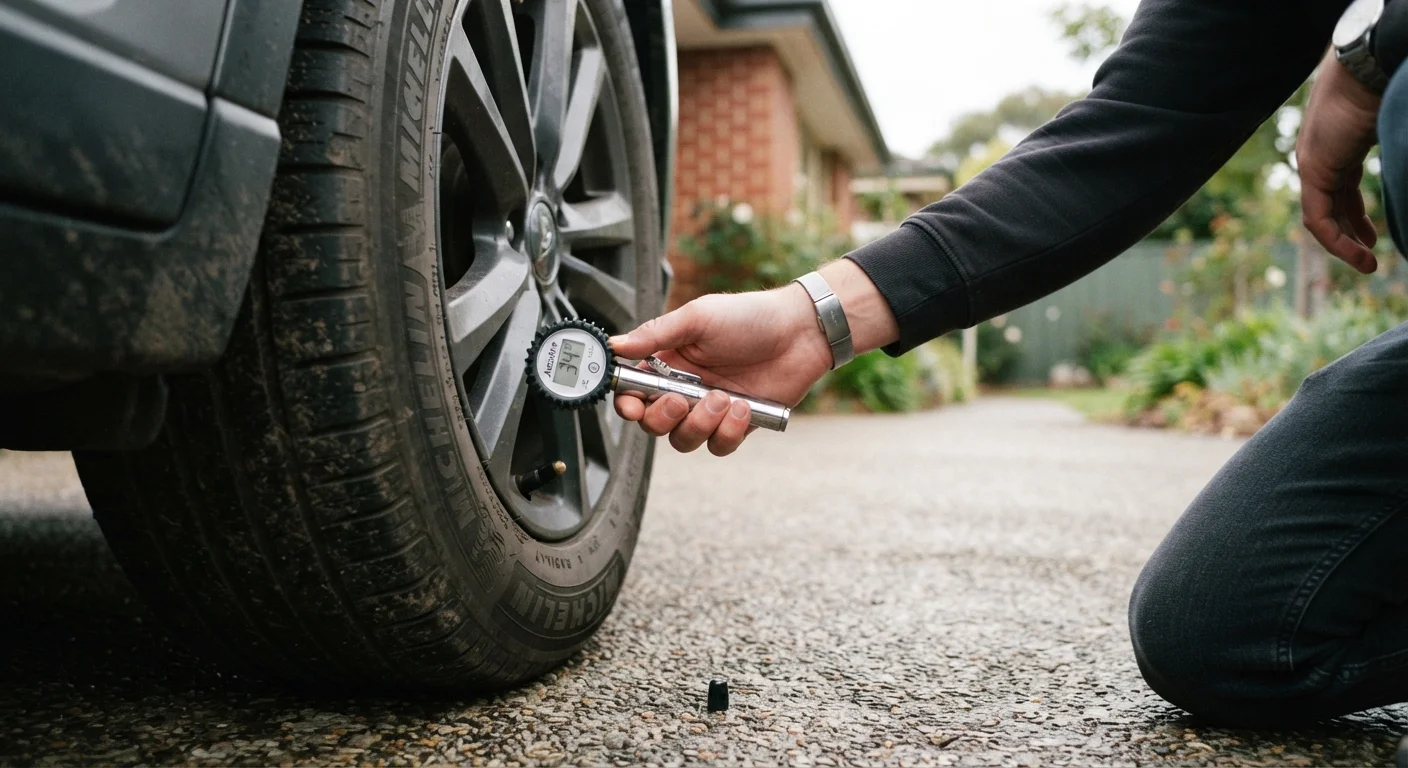
- Remove the small cap from the tyre's valve stem (usually a short rubber or metal nozzle on the inner rim edge).
- Press the gauge firmly and squarely onto the valve. A hiss means the seal isn't tight — reposition and try again.
- Read the PSI displayed and compare it to your door jamb target.
- Add air using a pump if the reading is low, or press the small pin inside the valve stem to release air if it's too high.
- Recheck after adjusting, and replace the valve cap when done.
Check Pressure in the Morning
For the most accurate reading, check your tyres first thing in the morning before the car has been driven. Even a short trip raises tyre temperature enough to inflate the pressure reading by several PSI. Cold readings give you a true picture of what's actually in the tyre.
Don't forget the spare tyre. A flat spare discovered roadside is a frustrating and avoidable situation. Check it every few months alongside the rest. New drivers will find our car maintenance starting point guide a helpful companion to these basics.
The Real Costs of Getting It Wrong
The consequences of incorrect tyre pressure go beyond a bumpy ride. Under-inflated tyres flex more with each rotation, generating excess heat — the primary cause of tyre blowouts. They also create more rolling resistance, which means your engine works harder and burns more fuel. Studies by the U.S. Department of Energy have noted that proper tyre inflation can improve fuel economy, with under-inflation reducing it measurably.
Over-inflated tyres wear unevenly down the centre of the tread, shortening tyre life and reducing wet-weather grip. Either extreme accelerates the need for tyre replacement — an expense that dwarfs the cost of a pressure gauge.
For owners of higher-mileage vehicles, where every maintenance decision carries more weight, tyre pressure is especially worth tracking consistently. Our article on keeping a high-mileage car running reliably covers this and related priorities in more depth.
Tyre pressure sits alongside fluid levels as one of the simplest checks any driver can master. See fluid levels every driver should know how to check for the companion habit worth building alongside it.