

Key Takeaways
- The declarations page summarises named drivers, vehicles, coverage types, limits, and deductibles in one place.
- Errors on the declarations page — wrong VIN, wrong driver — can affect whether a claim is paid.
- Coverage limits and deductibles directly determine your out-of-pocket costs after an accident.
- Reviewing your declarations page before each renewal helps surface gaps or overpayments.
- Always cross-reference the declarations page against the full policy for exclusions.
What you will need
What the Declarations Page Actually Is
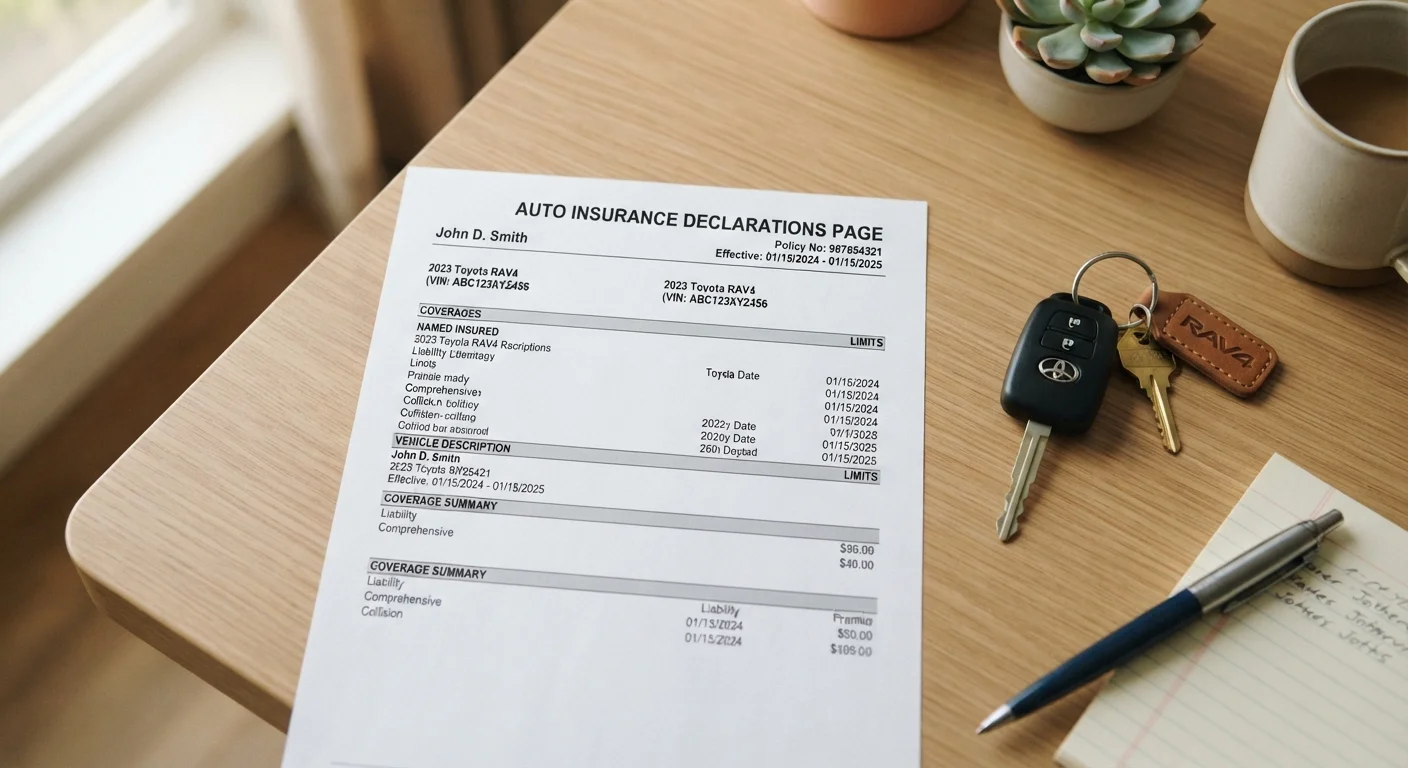
Every auto insurance policy includes a declarations page — sometimes called the "dec page" — which is a condensed, one-to-two-page summary of the entire contract. Think of it as the cover sheet: it tells you who is covered, what vehicles are insured, which coverage types apply, and how much protection you're carrying.
The full policy document behind it can run 30 or more pages of legal language. The declarations page distills that into plain figures. Insurers are required to provide it when you buy or renew a policy, and it's usually the first thing a lender or lienholder will ask for to confirm you carry the required coverage.
For a deeper grounding in what each coverage category means before you start reading, see our guide to every coverage type.
What you will need
How to Read Each Section Step by Step
Once you have your declarations page in hand — digital or paper — work through it section by section using the steps below. Don't skim; small errors in this document can have significant consequences at claim time.
Confirm the policy period and policyholder information
At the top of the page you'll find the policy period (the start and end dates of your coverage), your name and address as the named insured, and your policy number. Confirm these match your current details exactly. An old address can create complications if mail-based notices go to the wrong location.
Verify every vehicle listed
Each insured vehicle will appear with its year, make, model, and VIN (Vehicle Identification Number). Cross-check the VIN digit by digit against the number on your vehicle — it's a 17-character string found on the dashboard near the windshield or on the driver-side door jamb. Also note whether the vehicle is owned, financed, or leased, as this affects required coverage levels.
Check all listed drivers
The declarations page lists every rated driver — the people whose driving history and demographics the insurer factored into your premium. It may also list excluded drivers (people explicitly not covered). Confirm every regular driver in your household appears, and that no one is listed who shouldn't be.
Review coverage types and their limits
This is the core of the document. Each coverage type — such as bodily injury liability, property damage liability, collision, and comprehensive — will appear alongside its coverage limit. Limits are typically expressed as either a split limit (e.g., 100/300/100, meaning $100,000 per person / $300,000 per occurrence / $100,000 property damage) or a combined single limit. Make sure the limits reflect what you actually agreed to when you purchased or renewed. For a full explanation of what each coverage type does, see our coverage decoder.
Note your deductibles
For collision and comprehensive coverage, the declarations page will show your deductible — the amount you pay out of pocket before the insurer pays the rest of a covered claim. Higher deductibles generally mean lower premiums, but they also mean more exposure when you file a claim. Confirm the deductible amounts match what you chose at enrollment.
Identify any endorsements or discounts applied
Endorsements are add-ons that modify the standard policy — roadside assistance, rental reimbursement, or gap coverage are common examples. Discounts (such as multi-car or safe-driver discounts) may also appear. Verify these reflect your current situation. If you've added a vehicle or completed a defensive driving course, discounts you qualify for might not yet be applied. Contact your insurer if something looks missing.
Confirm the lienholder or loss payee, if applicable
If your vehicle is financed or leased, the lender or leasing company will appear as a lienholder or loss payee. This means claim payments for physical damage go to that party first (up to the loan balance). Make sure the correct lender is listed and that the address matches. If you've paid off your loan, request that the lienholder be removed from the policy.
Save a Copy After Every Renewal
Each time your policy renews, download or print the updated declarations page and store it somewhere accessible — your glove compartment, a cloud folder, or both. If you ever need to file a claim quickly, having the document on hand saves time. It also gives you a year-over-year record to compare coverage changes and premium shifts.
Common Mistakes and What to Do About Them
Even small discrepancies on a declarations page are worth correcting promptly. The most frequent issues drivers discover include:
- Missing drivers: A household member who regularly drives your car but isn't listed as a named insured or rated driver may be excluded from coverage, depending on your policy terms. Contact your insurer to add them.
- Wrong vehicle information: A transposed digit in the VIN (Vehicle Identification Number) can complicate or delay a claim. Verify it against the sticker inside your driver-side door jamb.
- Outdated lienholder: If you've paid off a loan or refinanced, make sure the lienholder listed matches your current lender — or has been removed entirely.
- Coverage you no longer need: Carrying comprehensive and collision on a vehicle with very low market value may not be cost-effective. Understanding what shapes your premium can help you evaluate whether adjustments make sense.
The Declarations Page Doesn't Show Exclusions
The dec page is a summary — it doesn't list what your policy excludes. Exclusions live in the full policy document and can significantly affect whether a specific claim is covered. If you're ever uncertain whether a situation is covered, read the exclusions section of the full policy or call your insurer directly before assuming you're protected.
If you spot an error, call or message your insurer in writing and request a corrected declarations page. Keep a copy of both the original and the corrected version.
This article provides general information about auto insurance documents and is not personalised insurance or legal advice. Coverage terms, exclusions, and requirements vary by insurer and state. Always read your actual policy documents and consult a licensed insurance professional for guidance specific to your situation.