

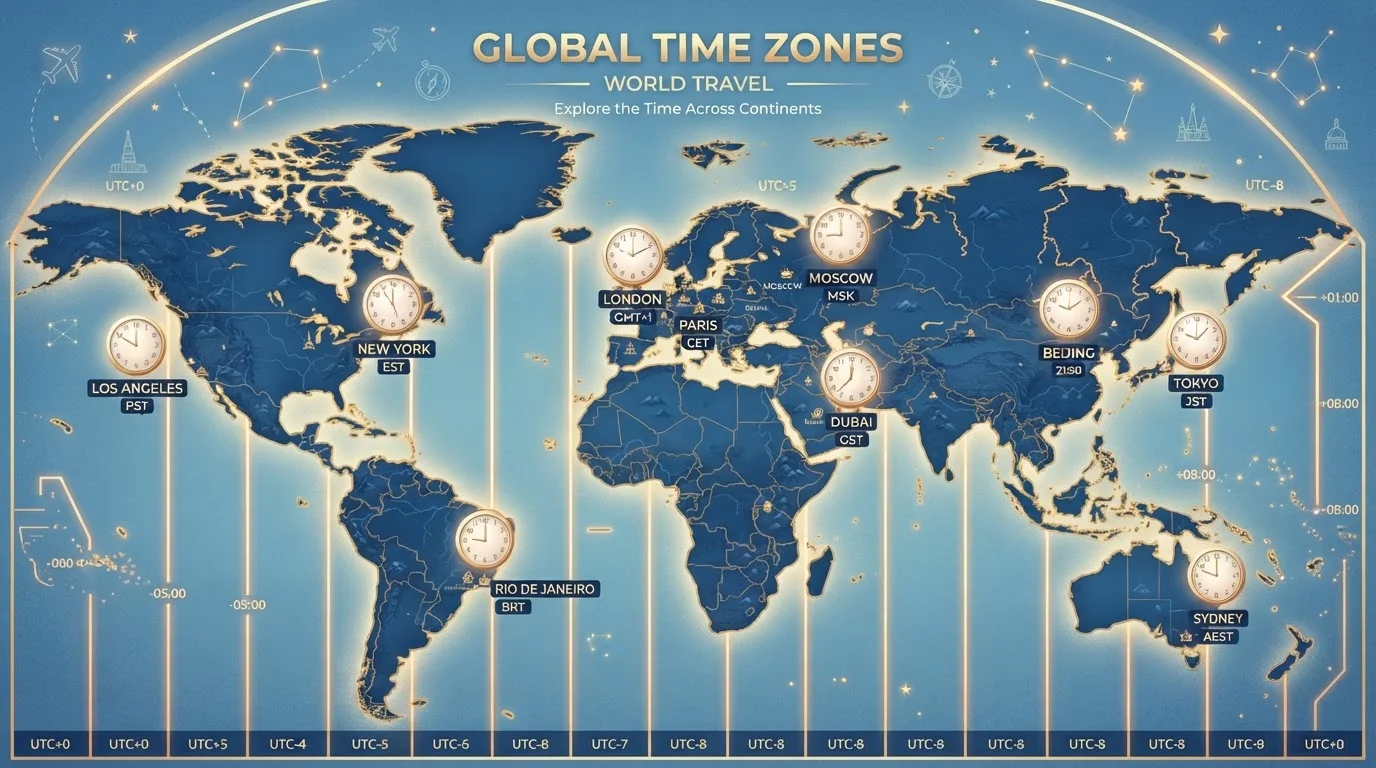
Key Takeaways
- The world uses 24 primary time zones, each offset from UTC by a set number of hours.
- Daylight Saving Time shifts clocks seasonally in many countries, changing their UTC offset temporarily.
- Flight booking systems typically list departure and arrival times in local time — knowing the UTC offset prevents costly confusion.
- Some countries span multiple time zones; others choose a single zone for unity despite geography.
- Jet lag is partly a function of how many time zones you cross, not just how far you fly.
Time Zones
Time zones are standardized regions of the globe where everyone observes the same local time. The Earth is divided into 24 primary zones, each roughly corresponding to one hour of difference, based on how far east or west a location sits from the Prime Meridian in Greenwich, England. Governments set the exact boundaries — which is why they often follow country or state borders rather than neat geographic lines.
Official time zones are expressed as UTC offsets (e.g., UTC−5 or UTC+9), where UTC stands for Coordinated Universal Time — the global standard used by aviation, computing, and financial systems worldwide.
The Basic Structure: How the World Divides Its Clocks
Imagine the Earth as a spinning orange, sliced from top to bottom into 24 vertical segments. Each slice represents approximately 15 degrees of longitude and one hour of solar time — which is why there are 24 zones for 24 hours in a day. In practice, governments redraw those slices for political convenience, producing zones with irregular shapes and a handful of unusual half- or quarter-hour offsets.
All time zones are measured against UTC (Coordinated Universal Time) — the successor to Greenwich Mean Time (GMT). A location at UTC−5, for example, is five hours behind UTC. New York operates on UTC−5 during winter; Tokyo runs on UTC+9 year-round. That's a 14-hour gap — enough to mean that Monday morning in New York is already Monday night in Tokyo.
24
Primary time zones dividing the globe
Each zone spans approximately 15 degrees of longitude, corresponding to one hour of solar time difference.
UTC+14
World's furthest-ahead time zone
The Line Islands of Kiribati observe UTC+14, making them the first inhabited places to ring in each new calendar day.
~70+
Countries or territories observing DST
The number fluctuates as governments periodically adopt, modify, or abolish Daylight Saving Time — always verify current rules before traveling.
Daylight Saving Time: The Seasonal Wrinkle
Daylight Saving Time (DST) temporarily shifts clocks forward — typically one hour — during the warmer months to extend evening daylight. In the US, most states spring forward on the second Sunday in March and fall back on the first Sunday in November. The result: the US East Coast moves from UTC−5 to UTC−4 for roughly eight months of the year.
The complication for travelers is that not every country moves on the same date, and many don't observe DST at all. During the transition windows in March and November, the time difference between, say, New York and London can shift by an hour in either direction depending on which side has already changed. Always verify the UTC offset for your travel dates specifically, not just the country's standard offset. Booking systems and calendar apps generally handle this automatically — but it's worth double-checking for any meeting or connection that falls during transition weeks.
Set Your Devices Before You Land
Enable automatic time zone updating on your smartphone and laptop before departure. This ensures alarms, calendar events, and flight reminders all adjust to local time the moment you arrive — reducing the chance of a missed wake-up call or meeting. Double-check any manually entered alarms, as those sometimes retain the original time zone setting.
Why This Matters When You Book a Trip
Flight listings show departure and arrival times in local time at each airport. A ticket reading "depart 11:55 PM Tuesday, arrive 6:00 AM Wednesday" on a transatlantic route isn't a six-hour flight — the clock gains five or six hours crossing the Atlantic, so the actual flight is closer to seven or eight hours. Misreading this is one of the most common causes of missed connections.
International travelers should also account for time zones when scheduling pre-departure tasks — visa appointments, hotel check-ins, and car rentals all operate in local time. For a thorough pre-trip checklist that keeps logistics in order, see The Documents You Need Before Every International Trip. Building smart habits around scheduling is also covered in What 'Travel Smart' Actually Means in Practice.
Jet Lag and Your Body Clock
Jet lag isn't just fatigue — it's your circadian rhythm (internal body clock) falling out of sync with the local day-night cycle. The more time zones you cross, the more pronounced the disruption. Eastward travel tends to feel harder than westward because you're shortening the day, which runs against the body's natural inclination toward a slightly longer-than-24-hour cycle.
General strategies for easing the transition include gradually adjusting your sleep schedule a few days before departure, seeking morning light at your destination, and staying well-hydrated on the flight. Workers on rotating schedules face a similar mismatch between their internal clock and external time cues — Shift Work and Sleep covers related strategies in depth. Everyone's response differs, so consult a healthcare professional if you have specific concerns about sleep disruption during travel.