

Key Takeaways
- Airport and hotel currency exchange services typically charge the highest markups on exchange rates.
- Dynamic currency conversion lets foreign merchants charge you in your home currency — usually at a worse rate.
- Withdrawing local cash from a local ATM is often more cost-effective than exchanging currency before you travel.
- Flat ATM withdrawal fees hit hardest on small transactions — fewer, larger withdrawals generally reduce total fees.
- Notifying your bank before departure helps prevent frozen cards and unexpected access issues abroad.
Why Currency Exchange Costs More Than It Looks
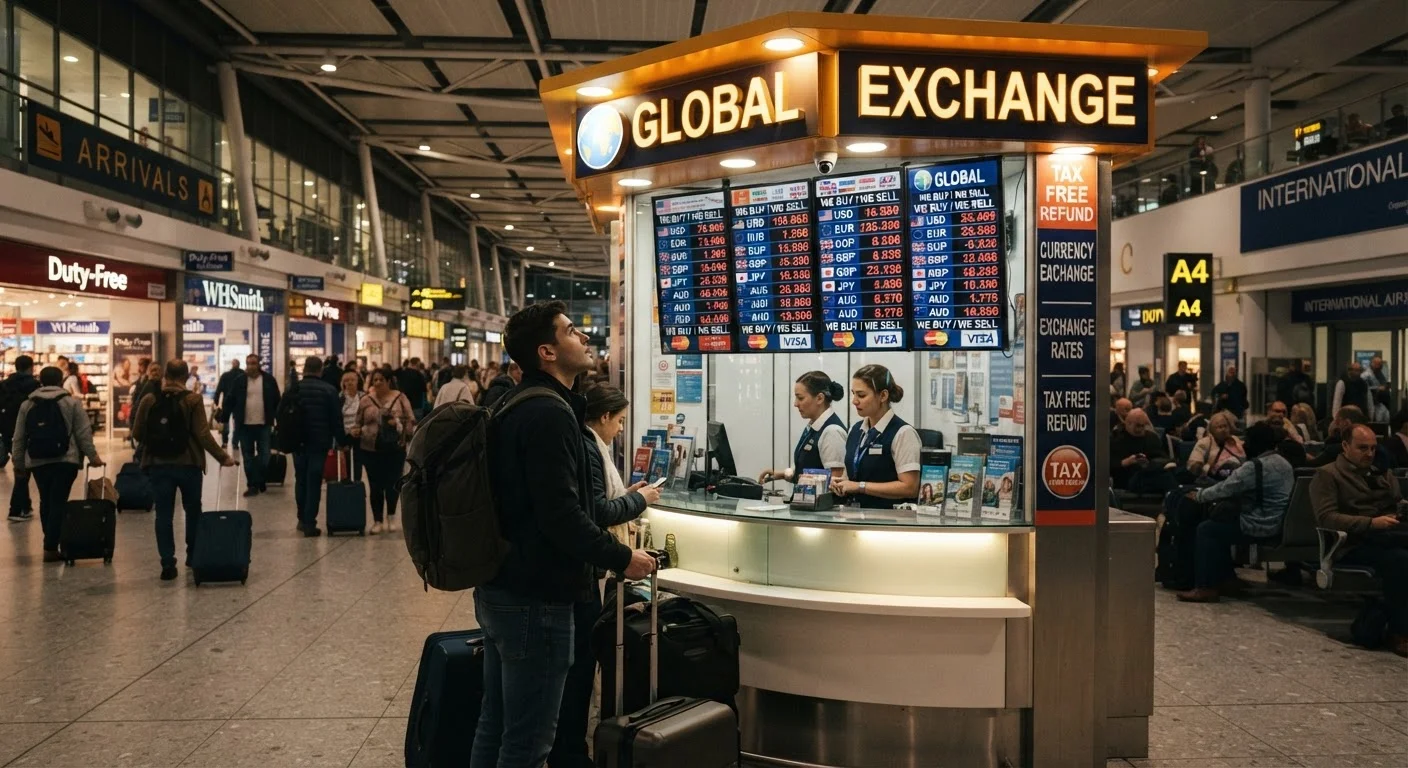
The sticker price of currency exchange is rarely the whole story. Beyond any visible commission fee, most exchange services build their profit into the exchange rate spread — the gap between the interbank rate (the rate banks use among themselves) and the rate offered to you. That spread can range from a modest 1–2% at competitive providers to 10% or more at airport kiosks and hotel desks.
Because the markup is embedded in the rate rather than charged as a line-item fee, travellers often walk away believing they paid nothing extra. They didn't. They simply can't see where the money went.
Understanding this mechanism is the first step toward making smarter decisions with your travel money. As part of a broader approach to reducing surprise costs, it's worth reading about other expenses that quietly inflate a travel budget before you depart.
Exchanging currency at the airport before or immediately after a flight.
Why it happens: Airport kiosks are visible and convenient at the moment travellers feel most anxious about having local cash. Many people assume the convenience is worth a small premium without realising how large that premium actually is.
Accepting dynamic currency conversion (DCC) at foreign point-of-sale terminals.
Why it happens: When a card terminal abroad offers to charge you in your home currency, it feels reassuring — you know exactly what you're paying. In reality, the merchant or terminal provider sets the conversion rate, and it is almost always worse than your card's own rate.
Making many small ATM withdrawals instead of fewer larger ones.
Why it happens: Travellers often withdraw cautiously — just enough for the day — to avoid carrying too much cash. This feels prudent but ignores flat per-transaction fees that make small withdrawals disproportionately expensive.
Ignoring foreign transaction fees on credit and debit cards.
Why it happens: Card fees are buried in terms and conditions most travellers never read. Many people assume a card that works abroad is a card that's cost-efficient abroad — these are different things.
Relying on hotel front desks for currency exchange.
Why it happens: Hotels offer exchange as a guest service, and it feels safer and more trustworthy than an unfamiliar street kiosk. The markup, however, is typically just as high — sometimes higher.
Practical Steps to Protect Your Travel Money
Once you understand where the losses hide, avoiding them becomes straightforward with a bit of preparation.
Up to 15%
Typical markup at airport exchange kiosks
Consumer finance analysts and travel organisations have consistently noted that airport currency exchange services can embed markups of 10–15% above the interbank rate, though rates vary by provider and location.
1–3%
Common foreign transaction fee on cards
Many standard credit and debit cards charge a foreign transaction fee in this range on every purchase made in a foreign currency, according to widely published card terms across major US financial institutions.
Use ATMs strategically. Withdrawing local currency from a bank-affiliated ATM at your destination typically gives you a rate close to the interbank rate — far better than pre-trip exchange at a kiosk. To minimise flat per-transaction fees, withdraw larger amounts less frequently rather than small amounts repeatedly. Always choose to be charged in the local currency when prompted, not your home currency.
Check your card's foreign transaction policy. Some debit and credit cards charge a foreign transaction fee (commonly 1–3%) on every purchase abroad. Others waive this entirely. Knowing which card you carry — and what it costs to use it — is foundational travel prep. This sits naturally alongside the full pre-departure checklist covered in the documents you need before every international trip.
Alert your bank before you leave. Banks may flag foreign transactions as suspicious and freeze your card without warning. A quick phone call or in-app travel notice prevents a stressful situation at a checkout counter. Combine this with the habits outlined in what travel smart actually means in practice for a genuinely low-friction trip.
Always Choose Local Currency at the Terminal
Dynamic currency conversion (DCC) is one of the most consistently costly traps in international travel. When a card terminal or ATM abroad offers to complete a transaction in your home currency, decline it and choose the local currency instead. Your card issuer's rate is almost always more favourable than the rate set by the merchant's terminal provider. This applies equally to ATM withdrawals — if the machine asks whether you accept its conversion rate, select 'no' or 'decline' to be charged in local currency.
This article provides general financial information for educational purposes only and does not constitute personalised financial or travel advice. Exchange rate policies, bank fees, and card terms vary by provider and change over time — verify current details directly with your financial institution before travelling.