

| Primary communication mode | Body posture and facial expression (Applied Animal Behaviour Science research consensus) |
| Slow blink significance | Trust and relaxation signal (Scientific Reports, 2020) |
| Tail-up greeting | Friendly, confident approach |
| Ear flattening | Fear, anxiety, or aggression |
| Belly exposure | Trust display — not an invitation to touch |
| Lashing tail | Overstimulation or agitation warning |
Why Cats Communicate the Way They Do
Cats evolved as both predator and prey, which shaped a communication system built largely on subtle, context-dependent signals rather than loud displays. Unlike dogs — domesticated primarily for social cooperation — cats developed their vocalizations, postures, and facial expressions in part to avoid unnecessary confrontations. Understanding this evolutionary backdrop helps owners decode what might otherwise seem like unpredictable or contradictory behavior.
Research in applied animal behavior confirms that cats do communicate intentionally with their human caregivers, adapting signals over time to people rather than other cats. That means your attention to these cues genuinely matters. The plain-language guide to pet body language offers broader context across species, but this field guide focuses entirely on feline-specific signals.
| Primary communication mode | Body posture and facial expression (Applied Animal Behaviour Science research consensus) |
| Slow blink significance | Trust and relaxation signal (Scientific Reports, 2020) |
| Tail-up greeting | Friendly, confident approach |
| Ear flattening | Fear, anxiety, or aggression |
| Belly exposure | Trust display — not an invitation to touch |
| Lashing tail | Overstimulation or agitation warning |
Key Body Parts and What They Signal
Ears
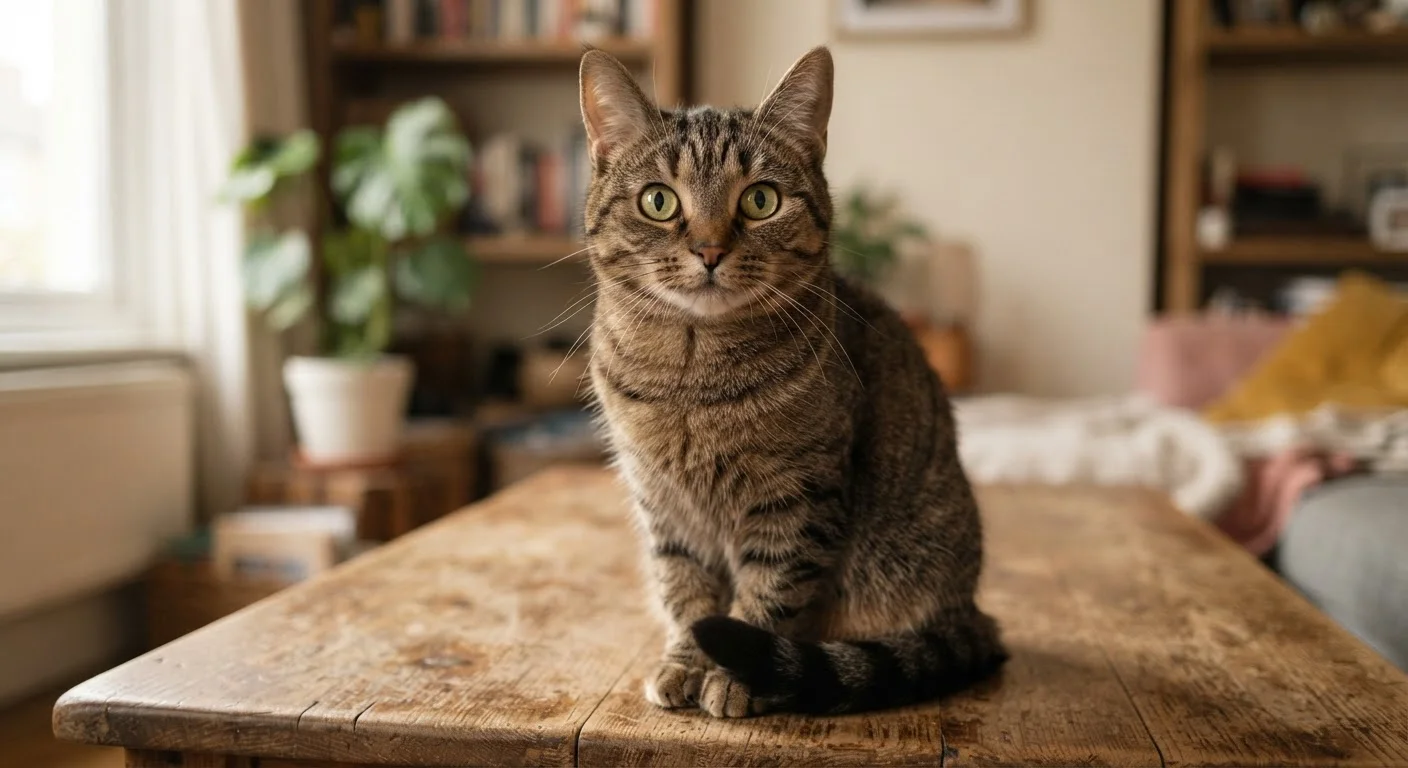
Ears are one of the most reliable indicators of a cat's emotional state. Forward-facing ears signal alertness and positive engagement. Ears rotated sideways or flattened against the skull — often called "airplane ears" — indicate fear, anxiety, or escalating aggression. A single ear flicking back briefly may mean mild irritation or distraction.
Tail
A tail held vertically upright with a slight curl at the tip is a clear greeting signal and indicates confidence and friendly intent. A puffed tail (piloerection) means the cat feels threatened and is trying to appear larger. A low-hanging or tucked tail signals submission or fear. Rapid, lashing tail movements are a reliable warning that the cat is overstimulated or agitated — not playful.
Pupils and Eyes
Dilated pupils can reflect excitement, fear, or low light — context matters enormously here. Constricted pupils in bright conditions can suggest aggression or heightened focus. A slow blink directed at you is widely interpreted by animal behaviorists as a sign of relaxation and trust; research published in Scientific Reports (2020) found that cats respond positively to slow blinks from familiar humans. Avoid prolonged unbroken eye contact, which cats typically read as a threat.
Posture and Body Position
An arched back paired with piloerection is a classic defensive threat display. A cat rolling onto its side and exposing its belly is demonstrating trust, but this is not necessarily an invitation to touch — many cats find belly touching aversive and will swipe in response. A cat that crouches low to the ground with its head down is showing submission or fear, not relaxation.
Piloerection
The involuntary raising of fur along the back and tail, making the cat appear larger. It occurs during fear or defensive arousal and is controlled by the autonomic nervous system.
Affiliative behavior
Friendly, bonding-oriented actions between individuals — such as head bunting, slow blinking, or tail-up greetings — that signal positive social intent.
Distance-increasing signal
Any signal whose function is to communicate 'back away' — hissing, growling, swatting, and flattened ears all serve this role in feline communication.
Overstimulation
A state in which petting or play has exceeded the cat's comfort threshold, often recognized by skin twitching, tail lashing, and sudden biting or swatting.
Slow blink
A deliberate, unhurried closing and reopening of both eyes directed at another individual. In cats, this is associated with relaxation and a non-threatening social relationship.
Vocalizations as Context Clues
Body language rarely operates in isolation — vocalizations add critical context. A short, rising chirp-like trill is typically a friendly greeting. Prolonged, low-pitched yowling usually signals distress, territorial conflict, or — particularly in unspayed females — reproductive behavior. Chattering (a rapid jaw movement while watching birds) is thought to reflect predatory frustration or excitement.
Hissing and growling are unambiguous distance-increasing signals: the cat wants space and feels unsafe. Responding by approaching or trying to soothe the cat with touch often escalates rather than de-escalates the situation. Give the animal space and allow it to leave if it chooses.
If a cat's vocalizations or behavior patterns change suddenly without an obvious trigger, it is worth consulting a veterinarian. Our article on when behavior changes signal a medical problem explains what to watch for. Similarly, subtle signs of pet stress are easy to overlook but important to recognize early.
Responding to Your Cat's Signals Appropriately
Knowing the signals is only half the equation — responding well matters just as much. When your cat shows relaxed, open body language (upright tail, forward ears, soft eyes), it is safe and often beneficial to engage gently. Let the cat initiate contact rather than reaching toward it. Extend a relaxed hand at nose level and allow it to sniff before petting.
When signals indicate stress or overstimulation — tail lashing, flattened ears, skin twitching along the back — the most effective response is to stop interaction immediately and give the cat control over the situation. Attempting to calm an agitated cat through restraint typically increases arousal and the risk of a scratch or bite.
For owners curious about how the environment itself affects behavior, evidence on indoor versus outdoor cat welfare provides helpful background. Cats that feel safe and have adequate environmental enrichment tend to display more relaxed, affiliative body language overall.
276+
Distinct facial action units identified in cats
A 2023 study in Behavioural Processes mapped over 276 distinct facial muscle movements in domestic cats, highlighting the complexity of feline expression.
~45%
Cat-owner pairs showing mutual slow-blink exchange
Research published in Scientific Reports (2020) found nearly half of tested cat-owner pairs showed positive slow-blink responses when owners initiated the behavior.
This article is for general informational purposes only and does not constitute veterinary advice. If you have concerns about your cat's behavior or health, consult a licensed veterinarian or certified animal behaviorist.