

Key Takeaways
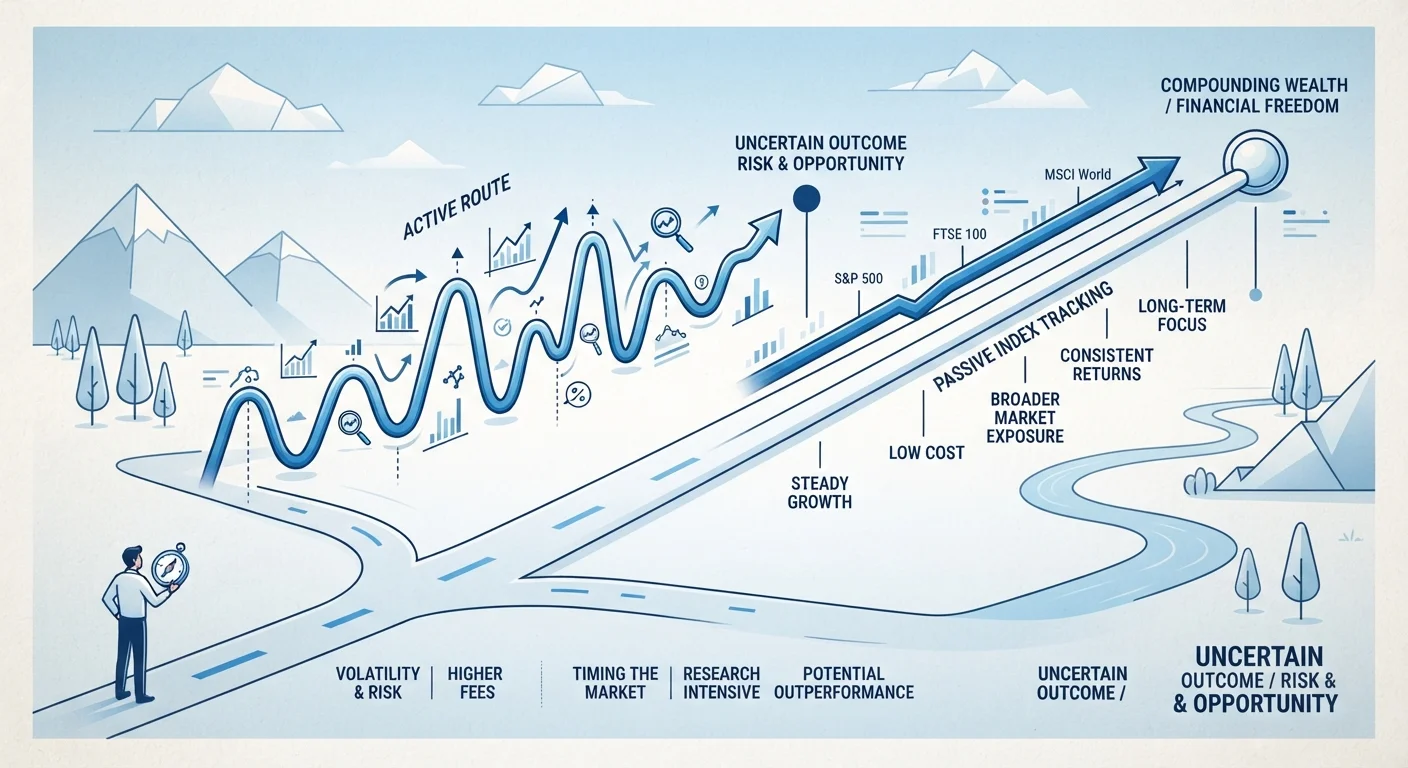
- Index funds passively track a market benchmark; actively managed funds rely on human managers to select holdings.
- Active funds typically carry significantly higher expense ratios than index funds, which compounds over time.
- Research consistently shows most active managers fail to outperform their benchmark index after fees over long periods.
- Neither approach is universally superior — the right choice depends on your goals, timeline, and tolerance for cost.
- Both fund types can be held inside tax-advantaged or standard brokerage accounts.
Option A
Index Funds
The passive, low-cost market-tracking approach.
Best for: Investors who want broad market exposure with minimal fees and no need for active decision-making.
Option B
Actively Managed Funds
The hands-on, manager-driven strategy seeking to outperform.
Best for: Investors comfortable paying higher fees in exchange for a fund manager's targeted, research-driven selections.
If you are new to investing and want a straightforward, low-cost strategy
Index Funds
Index funds require no specialist knowledge, carry low fees, and historically keep pace with broad market returns — a solid foundation for beginners.
If you believe skilled managers can exploit specific market inefficiencies
Actively Managed Funds
Some active managers do outperform in niche or less-efficient markets, though this comes with higher costs and no guaranteed results.
If minimising investment costs is your top priority
Index Funds
Index funds' expense ratios are typically a fraction of active fund fees, and even small annual cost differences compound significantly over decades.
If you want exposure to a specific sector or thematic strategy
Actively Managed Funds
Active managers can concentrate holdings around a targeted thesis in ways that broad index tracking does not replicate.
How Each Fund Type Actually Works
Understanding the mechanics of each approach helps cut through the marketing language that often surrounds fund selection.
An index fund is designed to replicate the composition and performance of a specific market index — such as the S&P 500 or the total US stock market. The fund holds the same securities in the same proportions as the index it tracks. There is no team of analysts deciding which stocks to buy or sell; the portfolio changes only when the index itself changes. This passive structure is what keeps costs low.
An actively managed fund, by contrast, employs a portfolio manager — often supported by a research team — who makes ongoing decisions about which securities to hold, when to buy, and when to sell. The stated goal is to generate returns that exceed the fund's benchmark index. This continuous decision-making process requires substantial resources, which is reflected in higher fees charged to investors.
To understand how either type fits within a broader investment plan, see our introduction to stocks, bonds, and funds for context on the underlying asset classes these funds hold.
| Criterion | Index Funds | Actively Managed Funds |
|---|---|---|
| Management style | Passive — tracks an index | Active — manager selects holdings |
| Typical expense ratio | Under 0.20% annually | 0.50%–1.50%+ annually |
| Goal | Match benchmark returns | Outperform the benchmark |
| Trading frequency | Low — mirrors index changes only | High — ongoing portfolio decisions |
| Tax efficiency | Generally higher | Generally lower |
| Transparency | Holdings mirror public index | Holdings disclosed periodically |
| Long-run benchmark beat rate | N/A — designed to match | Minority outperform after fees |
The Cost Gap and Why It Matters
Fees are arguably the most concrete, predictable difference between these two fund types — and their long-run impact is substantial.
Index funds commonly carry expense ratios (the annual percentage of assets charged as a management fee) well below 0.20%, with many broad-market options sitting below 0.10%. Actively managed funds typically charge between 0.50% and 1.50% per year, and some specialty active funds charge more.
That gap may appear small in isolation, but over a 20- or 30-year investment horizon, even a 1% annual fee difference can meaningfully reduce the final value of a portfolio due to the compounding effect. Our article on how investment fees erode returns over time walks through this arithmetic in detail.
~85%
Active large-cap funds underperforming S&P 500 over 10 years
According to S&P Dow Jones Indices' SPIVA US Scorecard, roughly 85% of active large-cap US equity funds trailed the S&P 500 over the decade ending 2023.
~1%
Typical annual fee gap between active and index funds
The Investment Company Institute reports median expense ratios for actively managed equity funds are roughly 0.65–1.0 percentage points higher than comparable index funds.
$30,000+
Approximate 30-year cost difference on a $100,000 investment
Illustrative modelling shows a 1% annual fee difference on $100,000 compounding at 7% annually can erode over $30,000 in final portfolio value after 30 years.
Taxes add another layer of cost consideration. Because index funds trade infrequently, they tend to generate fewer taxable capital gains distributions. Active funds, which may trade holdings many times per year, can generate higher annual tax bills for investors in taxable accounts — a point explored further in our comparison of tax-advantaged accounts vs. standard brokerage accounts.
What the Performance Evidence Shows
The debate over whether active management justifies its extra cost has been studied extensively. The aggregate evidence, drawn from S&P Dow Jones Indices' SPIVA (S&P Indices Versus Active) research — which compares active fund performance against relevant benchmarks — consistently finds that a substantial majority of actively managed funds underperform their benchmark index over periods of ten years or more, after fees.
This does not mean every active fund underperforms every year, or that no manager ever adds value. Some managers do outperform, particularly in less liquid or less researched corners of the market where information advantages are more plausible. However, identifying in advance which managers will outperform is difficult, and past outperformance has historically been a weak predictor of future results.
Active vs. Passive Is Not All-or-Nothing
Many investors hold a mix of index funds as their core holdings and a smaller allocation to active funds for specific market segments. This blended approach allows cost discipline for broad market exposure while leaving room for targeted active strategies. Neither philosophy demands exclusivity, and your ideal balance will depend on your personal financial goals, time horizon, and risk tolerance — factors best assessed with a qualified adviser.
For investors committed to either approach, consistent behaviour over time matters at least as much as fund selection. The habits that long-term investors tend to share — such as maintaining contributions during market downturns — apply regardless of which fund type you choose.
This article is for general informational and educational purposes only and does not constitute personalised investment, financial, tax, or legal advice. Past performance does not guarantee future results. Consult a qualified, licensed financial adviser before making decisions about your own investments.