
Engineered Hardwood vs Solid Hardwood Flooring: What the Difference Means for Installation

Key Takeaways
- Engineered hardwood resists moisture-related expansion better than solid hardwood, making it safer for below-grade or slab installations.
- Solid hardwood can typically be sanded and refinished more times than engineered, extending its lifespan by decades.
- Both products require proper acclimation to your home's environment before installation begins.
- Subfloor type — wood vs. concrete — is the single most important factor in choosing between the two.
- Engineered hardwood supports floating and glue-down methods, while solid hardwood is almost always nail-down only.
Option A
Engineered Hardwood
The versatile, dimensionally stable modern option.
Best for: Homeowners installing over concrete slabs, in basements, or in rooms with fluctuating humidity levels.
Option B
Solid Hardwood
The traditional, long-lasting classic that can be refinished repeatedly.
Best for: Above-grade installations over wood subfloors in stable, climate-controlled interior spaces.
If you're installing over a concrete slab
Engineered Hardwood
Concrete holds residual moisture that can cause solid hardwood to cup and warp. Engineered hardwood's cross-ply core tolerates this moisture movement far better.
If you want maximum refinishing potential over decades
Solid Hardwood
A typical solid plank can be sanded and refinished four to six times, making it a strong long-term investment in rooms with above-grade wood subfloors.
If you're a DIY installer without a flooring nailer
Engineered Hardwood
Floating click-lock engineered products can be installed with basic hand tools and no specialized equipment, reducing upfront costs significantly.
If you're finishing a basement recreation room
Engineered Hardwood
Below-grade spaces are prone to humidity swings and occasional moisture, environments where solid hardwood is not recommended by most manufacturers.
If you have an existing wood subfloor and want a timeless upgrade
Solid Hardwood
Nailed directly to a plywood subfloor, solid hardwood delivers unmatched rigidity, authenticity, and the option for future refinishing in any colour.
How Their Construction Shapes Everything
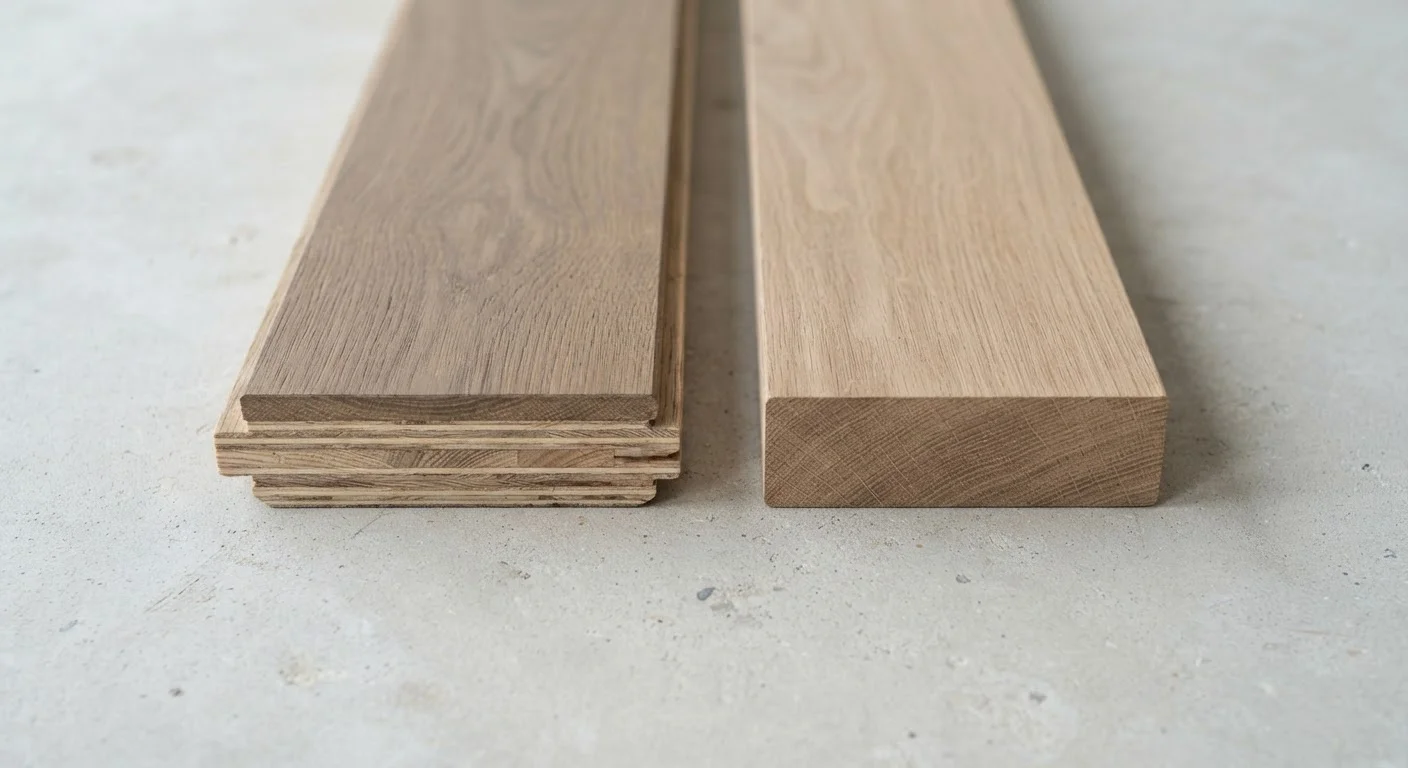
Solid hardwood is exactly what it sounds like — a single, uniform piece of milled timber, typically ¾ inch thick. Engineered hardwood, by contrast, is a sandwich of materials: a genuine hardwood veneer on top bonded to multiple layers of plywood or high-density fiberboard (HDF) running in alternating grain directions beneath it.
Those alternating layers are the key. When wood absorbs or releases moisture, it naturally expands and contracts. In a solid plank, that movement is unrestricted and happens in one direction. In an engineered plank, each layer counteracts the movement of the one above and below it, which dramatically reduces the risk of cupping, warping, or gapping.
This structural difference — not aesthetics, not price — is why the two products suit very different installation scenarios. The surface of both can be genuine oak, maple, or hickory, and from a standing position they are often indistinguishable.
| Criterion | Engineered Hardwood | Solid Hardwood |
|---|---|---|
| Core construction | Hardwood veneer over cross-ply layers | Single solid timber plank |
| Typical thickness | 3/8" – 9/16" | 3/4" |
| Over concrete slab | Yes (with moisture barrier) | Not recommended |
| Below-grade installation | Yes, if product-rated | Not suitable |
| Installation methods | Float, glue-down, nail-down | Nail-down or staple-down only |
| DIY friendliness | High (floating option) | Moderate (requires nailer) |
| Refinishing potential | 1–2 times (varies by wear layer) | 4–6 times typically |
| Moisture resistance | Better | Lower |
Subfloor and Location Requirements
Before purchasing either product, identify two things: what your subfloor is made of, and whether the room is above, on, or below ground level.
- Wood subfloor, above grade: Both products work. Solid hardwood is nailed or stapled down; engineered can be nailed, glued, or floated.
- Concrete slab, on grade: Engineered hardwood only. A moisture barrier is still required. Solid hardwood is not recommended and may void manufacturer warranties.
- Basement, below grade: Engineered hardwood only, and only products specifically rated for below-grade use. Confirm moisture readings with a concrete moisture meter before installation.
For wood subfloors, check that the surface is flat to within 3/16 inch over a 10-foot span — a common specification for both product types. High spots should be sanded and low spots filled with a floor-leveling compound before any flooring goes down.
Always Test Concrete for Moisture First
Before installing any hardwood over concrete, conduct a calcium chloride test or relative humidity probe test as specified in ASTM F1869 or F2170. Moisture readings above the manufacturer's threshold — commonly 3 lbs per 1,000 sq ft per 24 hours for calcium chloride — require mitigation before installation. Skipping this step is a leading cause of flooring failures and typically voids warranties.
Installation Methods Compared
Solid hardwood installation is largely standardized: planks are blind-nailed or stapled to the subfloor using a pneumatic flooring nailer, working row by row across the room. This requires renting or purchasing specialized equipment and carries a steeper learning curve for first-time DIYers.
Engineered hardwood offers three methods:
- Floating (click-lock): Planks lock together edge-to-edge and rest on an underlayment pad without being fastened to the subfloor. Easiest for DIY; allows for natural movement across large areas.
- Glue-down: Full-spread adhesive bonds planks directly to the subfloor, common over concrete. Requires proper adhesive selection and careful workmanship to avoid telegraphing subfloor imperfections.
- Nail-down: Used when engineered planks are thick enough — typically ½ inch or more — over wood subfloors. Provides a feel closer to solid hardwood underfoot.
Acclimation applies to both types. Store planks flat in the installation room at normal living temperature and humidity for 48–72 hours (or per manufacturer guidelines) before beginning work.
48–72 hrs
Minimum acclimation time for hardwood flooring
Most flooring manufacturers specify at least 48 to 72 hours of in-room acclimation; some products in extreme climates require longer — always follow the product's printed guidelines.
3/16"
Maximum subfloor variation allowed over 10 feet
This flatness tolerance is the most widely cited industry standard for both engineered and solid hardwood installations, per general flooring industry guidance.
Longevity, Refinishing, and What to Expect Over Time
Solid hardwood's greatest long-term advantage is refinishing depth. At ¾ inch thick, a solid plank can typically be sanded down to bare wood four to six times over its life, letting homeowners change stain colors or remove deep scratches as decades pass.
Engineered hardwood's wear layer — the top veneer — ranges from about 1mm to 6mm depending on the product. Thinner wear layers (2mm or less) may tolerate only one light sand; thicker layers (4mm+) can handle two refinishes. Review the specification sheet before purchasing if refinishing potential matters to you.
In stable, climate-controlled environments, high-quality engineered hardwood can last 25–30 years or more. Solid hardwood installations maintained in appropriate conditions can last 100 years or more. Neither product is inherently superior — the right choice depends entirely on where and how it is installed.