
Recovery Metrics Worth Understanding: HRV, Resting Heart Rate, and Sleep Score

| HRV measurement unit | Milliseconds (ms) between heartbeats |
| Gold-standard HRV method | Chest-strap electrocardiography (ECG) |
| Consumer wearable HRV method | Optical photoplethysmography (PPG) at the wrist |
| Baseline establishment period | 4–6 weeks of consistent daily tracking |
| Common HRV suppressors | Alcohol, illness, intense prior exercise, poor sleep |
| HRV trend direction for recovery | Higher variability = generally better recovery signal |
What Recovery Metrics Actually Measure
Wearable devices and fitness apps now routinely surface three recovery indicators: heart rate variability (HRV), resting heart rate (RHR), and a composite sleep score. Each measures something genuinely different, and treating them as interchangeable is one of the most common mistakes people make when trying to read their own readiness. For broader context on how sleep and recovery interrelate, see A Complete Overview of Sleep Health.
Heart Rate Variability (HRV)
The variation in time intervals between consecutive heartbeats, measured in milliseconds. Higher variability generally reflects a well-recovered autonomic nervous system; lower variability can signal stress, fatigue, or illness.
Resting Heart Rate (RHR)
The number of heartbeats per minute while the body is fully at rest. It serves as a baseline cardiovascular health marker; an elevation above your personal norm can indicate inadequate recovery.
Sleep Score
A composite number generated by a wearable or app from movement, heart rate, and sometimes blood oxygen data. It summarises sleep quality in a single figure but uses proprietary algorithms that vary by device.
Autonomic Nervous System (ANS)
The part of the nervous system that regulates involuntary functions such as heart rate, breathing, and digestion. Its two main branches — sympathetic (stress response) and parasympathetic (rest-and-digest) — directly influence HRV readings.
Polysomnography
A clinical sleep study conducted in a laboratory that directly measures brain waves, eye movements, muscle activity, and heart rate to precisely identify sleep stages. It is the gold standard against which consumer tracker estimates are compared.
Baseline
Your individual average for a given metric, established over several weeks of consistent tracking. Personal baselines are the most reliable reference point for interpreting day-to-day fluctuations in HRV, RHR, or sleep scores.
These metrics don't tell you how recovered you are in any absolute sense — they offer signals that become meaningful when tracked as trends over time, against your own baseline. A single data point is almost never actionable on its own.
Heart Rate Variability (HRV): The Autonomic Nervous System Proxy
HRV measures the variation in time between successive heartbeats, typically expressed in milliseconds. Counterintuitively, more variability is generally associated with better recovery and physiological resilience. A well-rested, low-stress nervous system produces beats that are irregular in a healthy, adaptive way; a fatigued or stressed system tends toward rigid, clock-like regularity.
| HRV measurement unit | Milliseconds (ms) between heartbeats |
| Gold-standard HRV method | Chest-strap electrocardiography (ECG) |
| Consumer wearable HRV method | Optical photoplethysmography (PPG) at the wrist |
| Baseline establishment period | 4–6 weeks of consistent daily tracking |
| Common HRV suppressors | Alcohol, illness, intense prior exercise, poor sleep |
| HRV trend direction for recovery | Higher variability = generally better recovery signal |
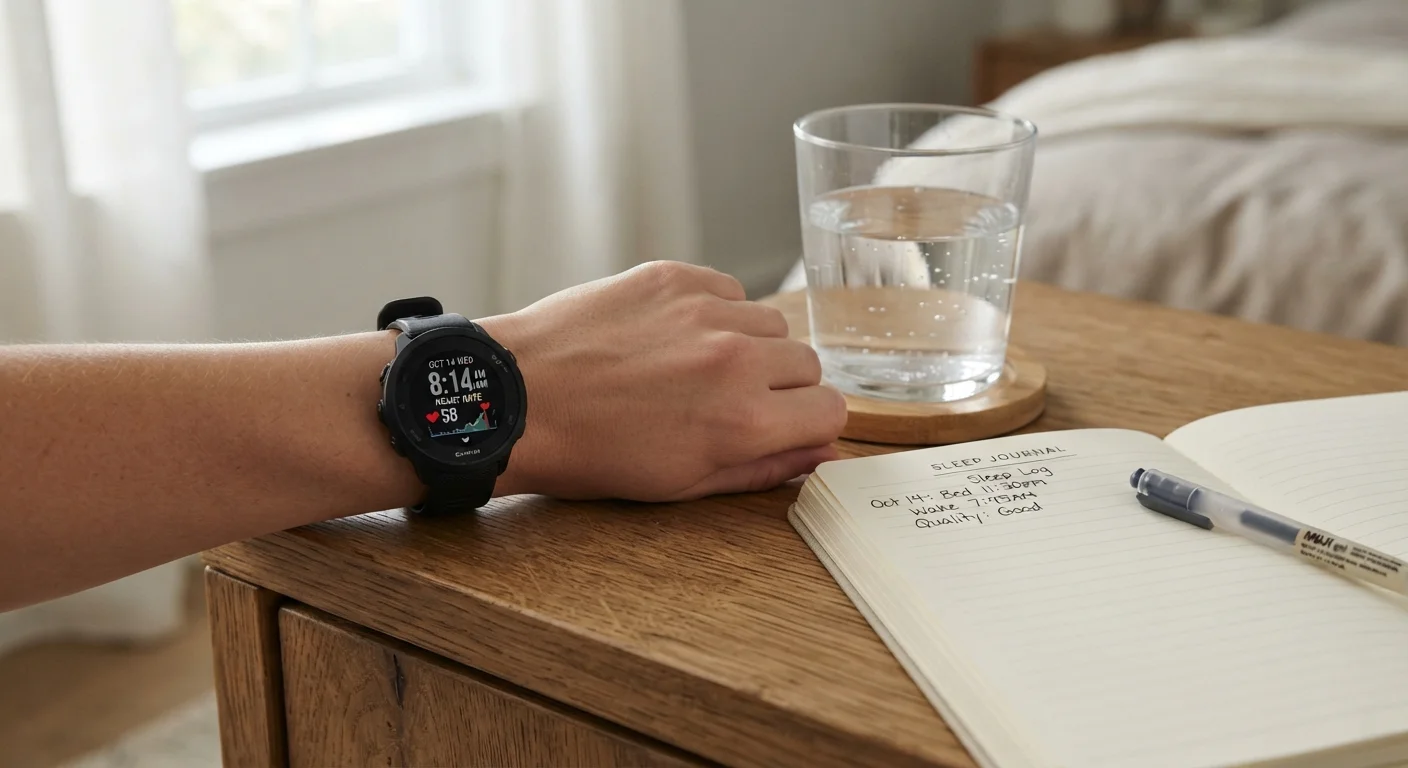
Most consumer wearables estimate HRV using optical sensors on the wrist during sleep, then report a nightly or morning value. Research-grade HRV measurement uses chest-strap electrocardiography (ECG), which is more accurate. Wrist-based optical readings are useful for trend-tracking but carry measurement error — a factor worth keeping in mind before making training decisions based on a single reading.
HRV is highly individual. Population averages matter far less than your own personal baseline established over several weeks. Alcohol consumption, illness, poor sleep, and intense exercise the day before are all known to suppress HRV the following morning, even when you feel subjectively fine.
Resting Heart Rate: A Simpler but Sturdy Signal
Resting heart rate (RHR) is the number of times your heart beats per minute when you are fully at rest — ideally measured first thing in the morning before rising. It is one of the oldest and most validated cardiovascular health markers available without clinical equipment.
For most adults, RHR falls somewhere in the range of 60–100 beats per minute, though aerobically fit individuals often measure considerably lower. What matters more than any absolute number is whether your RHR is elevated above your personal norm. A consistently elevated RHR — even by five to ten beats above your typical baseline — can indicate accumulated fatigue, early illness, dehydration, or overtraining.
60–100 bpm
Normal adult resting heart rate range
According to the American Heart Association, this is the generally accepted range for adults at rest, though fit individuals often fall below 60 bpm.
5–10 bpm
RHR elevation that may signal fatigue or overtraining
Sports medicine literature commonly references this threshold as a meaningful deviation above an individual's established personal baseline.
Wearables measure RHR during the lowest-activity period of your sleep window, which is generally a reliable method. Its main limitation is that it responds more slowly than HRV to day-to-day stressors, making it a lagging indicator best suited to spotting multi-day trends rather than single-session readiness.
Sleep Scores: Useful Summaries with Real Caveats
A sleep score is a composite number — typically on a scale of 0 to 100 — that a wearable or app calculates from movement data, heart rate patterns, and (in some devices) blood oxygen estimates. Different platforms weight these inputs differently and use proprietary algorithms, so scores are not comparable across devices or brands.
Consumer sleep trackers cannot directly measure sleep stages the way a clinical polysomnography study can; they infer stage estimates from indirect signals. This means sleep stage breakdowns shown in an app (light, deep, REM) carry meaningful uncertainty. For a detailed look at what tracker data can and cannot tell you, see Sleep Tracking Devices and What Their Data Can — and Cannot — Tell You.
That said, sleep scores are not without value. They can highlight patterns — consistently low scores correlating with high-stress periods, or improvements following changes to your wind-down routine — that are harder to notice through subjective recall alone. See how morning and evening routines shape sleep quality for complementary habit strategies.
Putting the Numbers Into Practice
Recovery metrics are most useful when they inform — not override — your own perceived readiness. A low HRV reading on a day when you feel energised and strong is not necessarily a reason to skip a planned session. Conversely, if your RHR is elevated, your sleep score is low, and you feel fatigued, that convergence is a meaningful signal worth acting on.
Building a personal baseline takes time — most practitioners suggest tracking for at least four to six weeks before drawing conclusions from trends. During that period, noting contextual factors (travel, alcohol, stress, illness) alongside your metrics significantly improves your ability to interpret the data. See how planned rest fits into a training programme and explore the evidence for active recovery versus full rest days to put these signals into a broader routine.
This article is for general informational and educational purposes only. It is not a substitute for professional medical advice, diagnosis, or treatment. Always consult a qualified healthcare professional before making changes to your exercise, recovery, or health routines based on wearable data.