

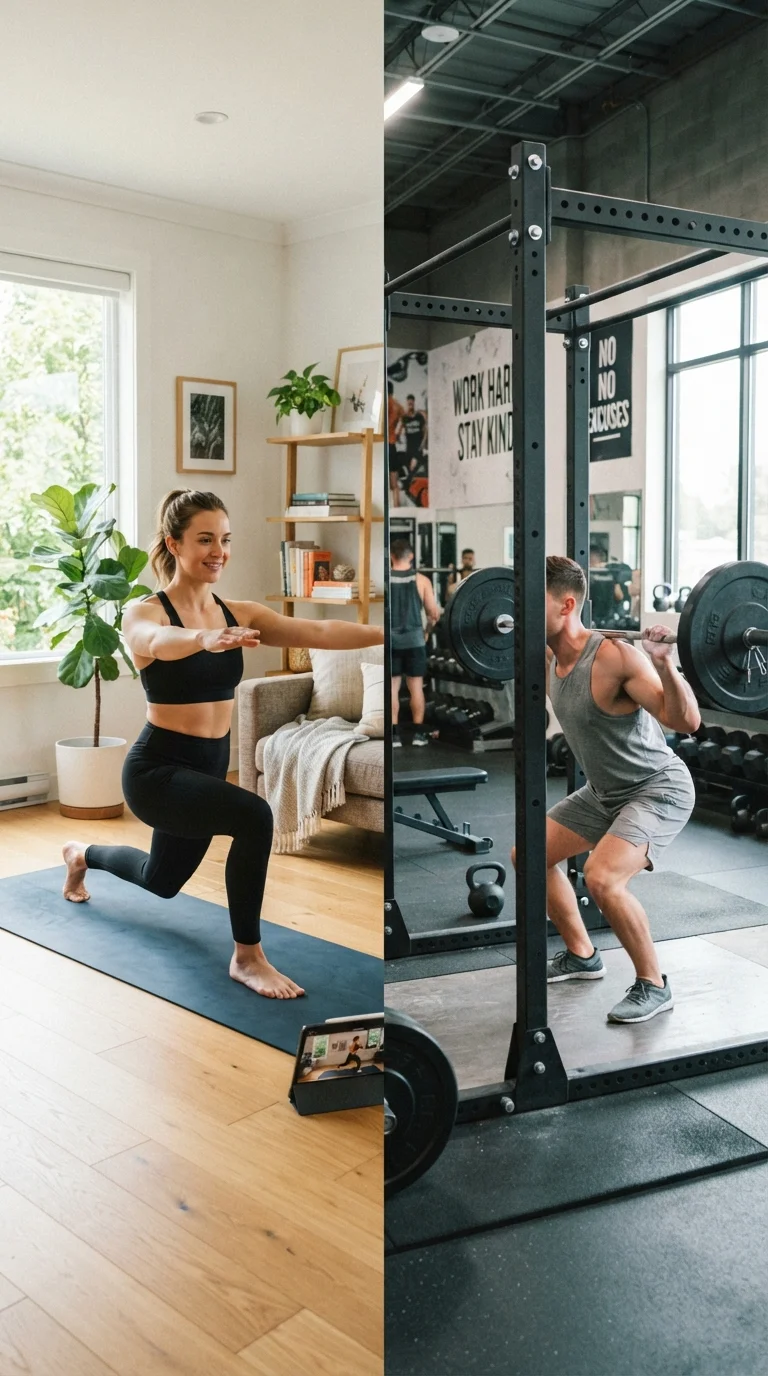
Key Takeaways
- Home workouts excel for convenience, consistency, and lower cost, especially for beginners or busy adults.
- Gym environments provide equipment variety, progressive overload potential, and structured social accountability.
- Neither setting is universally superior — the best environment is the one you'll use consistently.
- Many adults benefit from combining both approaches rather than committing exclusively to one.
- Consult a qualified fitness professional when building a new program, especially if managing a health condition.
Our Verdict
Home workouts and gym training each deliver genuine, evidence-supported benefits. Home exercise wins on accessibility, time efficiency, and long-term adherence for many adults, while the gym environment offers progressive overload tools, equipment variety, and social motivation that are harder to replicate at home. For most adults, a flexible approach — using both settings strategically — tends to produce the most sustainable results.
| Best for | Recommended |
|---|---|
| Adults with limited time, tight budgets, or early-stage fitness habits | Home Workouts |
| Those pursuing structured strength gains or sport-specific conditioning | Gym Training |
| Adults over 40 managing joint health and seeking guided progression | Gym Training |
| People who struggle with gym anxiety or irregular schedules | Home Workouts |
What Each Environment Actually Offers
The debate between training at home and heading to a gym is often framed as a matter of preference. In practice, it's a question of trade-offs that depend on your goals, schedule, living situation, and where you are in your fitness journey.
Home workouts have expanded dramatically in scope. Research consistently shows that bodyweight training, resistance bands, and minimal-equipment routines can drive meaningful improvements in cardiovascular fitness, muscular endurance, and flexibility — particularly for beginners and intermediate exercisers. The defining advantage is friction reduction: no commute, no wait for equipment, and the ability to train in a ten-minute window.
Gym training, meanwhile, offers tools that are genuinely difficult to replicate at home: cable machines, barbells, squat racks, and a range of resistance that scales with your progress. For individuals aiming for significant strength gains or body composition changes, access to progressive overload — gradually increasing resistance over time — matters considerably. It's also worth noting that research on exercise adherence identifies social environment as a meaningful predictor of consistency for many people.
For a deeper look at how cardio and strength work complement each other regardless of where you train, see our guide to balancing cardio and strength training.
| Home Workouts | Gym Training | |
|---|---|---|
| Cost (ongoing) | Low — no membership fees | Moderate to high — monthly fees |
| Convenience | Very high — no travel required | Lower — commute and schedule needed |
| Equipment variety | Limited without investment | Extensive — barbells, cables, machines |
| Progressive overload potential | Moderate — bodyweight and bands | High — scalable resistance across goals |
| Social accountability | Low — self-directed only | Higher — peers and staff present |
| Barrier to starting | Very low — start immediately | Higher — gym anxiety, membership sign-up |
| Distraction risk | Higher — home environment | Lower — dedicated exercise space |
The Real Costs and Barriers
Cost is frequently cited as the primary reason adults choose home training. A gym membership in the United States typically runs between $30 and $80 per month, and premium facilities cost considerably more. Home equipment has upfront costs but no recurring fees. However, building a reasonably equipped home gym — quality dumbbells, a pull-up bar, resistance bands — can run several hundred dollars, though it tends to pay for itself within a year compared to most memberships.
The less-discussed barrier is psychological. Gym anxiety — discomfort in a shared exercise space — affects a meaningful proportion of adults, particularly those new to structured training. For these individuals, starting at home isn't a compromise; it's a strategically sound on-ramp to consistent exercise. Once base fitness and confidence are established, transitioning to a gym becomes far less daunting.
Starting Small Beats Starting Perfect
If cost or convenience is a barrier, beginning with a consistent home routine — even 20 minutes three times a week — builds the habit infrastructure that more advanced training depends on. Research on exercise adherence suggests that frequency and regularity matter more than session duration in the early stages. Once exercise becomes routine, scaling up or moving to a gym is far easier.
On the flip side, home environments carry their own friction: distractions, limited space, and the absence of external accountability. Some people find that leaving the house to exercise creates a mental separation that helps them focus — a benefit that's real even if it's difficult to quantify.
Strength, Progression, and Special Populations
For adults whose primary goal is building and maintaining muscle mass, the gym holds a practical edge. Progressive overload — the systematic increase of training stimulus — is best supported by access to a full range of resistance. Bodyweight training can be progressed (through leverage, tempo, and movement complexity), but it imposes a ceiling that most dedicated strength trainers eventually encounter.
Adults over 40 face an additional consideration. Muscle mass naturally declines with age, and resistance training is one of the most evidence-supported strategies for slowing that process. For this group, the equipment variety and ability to load movements precisely at a gym may offer meaningful advantages. Our guide to strength training after 40 covers how training priorities shift with age.
It's also worth separating fitness myths from evidence. Some common assumptions — such as needing to train at high intensity every session, or that home workouts can't build real strength — are not well-supported by the literature. For a grounded perspective, our exercise myth-busting guide is a useful companion read.
~30%
Adults who report gym anxiety
Survey data consistently finds that a significant minority of adults feel self-conscious in gym settings, which affects adherence and initial uptake.
2–3x/week
Recommended resistance training frequency
Major health bodies, including the CDC, recommend muscle-strengthening activity on at least two days per week for adults — achievable in either setting.
This article provides general health information for educational purposes only and is not a substitute for personalised advice from a qualified fitness or healthcare professional. If you have a medical condition or injury, consult a licensed professional before beginning any new exercise program.