

Key Takeaways
- Heat styling tools alter keratin proteins inside the hair shaft, not just the surface cuticle.
- Temperatures above roughly 150°C can begin to denature the proteins that give hair its structure.
- Porosity increases as the cuticle lifts and cracks, making damaged hair harder to moisturize.
- Heat protectants lower the rate of heat transfer into the shaft but do not eliminate the risk entirely.
- True heat damage is permanent — protective habits prevent it; no product can fully reverse it.
- Lower tool temperatures with slower, deliberate passes reduce cumulative damage over time.
Heat Damage to Hair
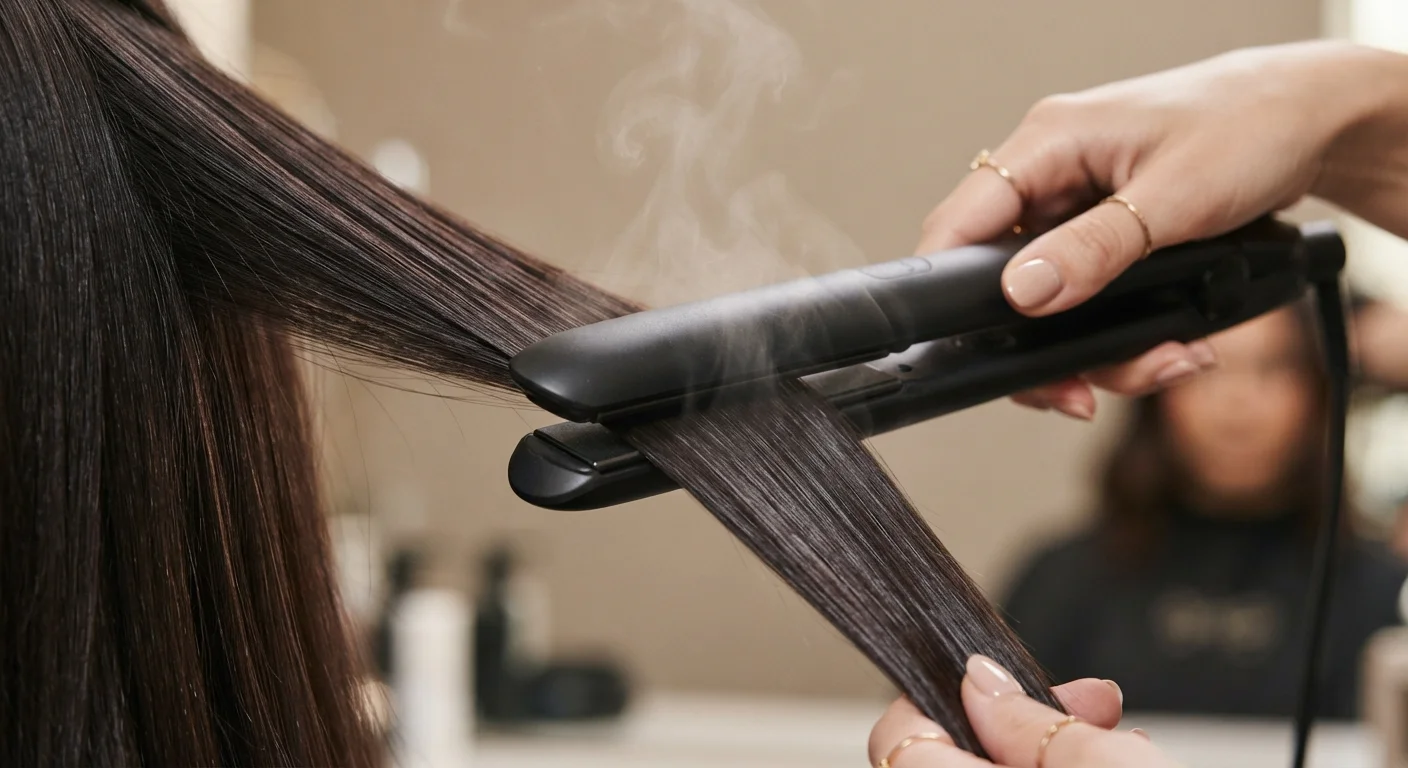
Heat damage occurs when high temperatures from styling tools such as flat irons, curling wands, and blow dryers permanently alter the internal structure of hair strands. The hair shaft is composed primarily of a fibrous protein called keratin, which can be deformed or degraded when exposed to excessive heat. Unlike surface-level frizz, true heat damage changes the bond architecture inside the hair and cannot be reversed with conditioning treatments.
Keratin proteins in hair begin to denature — meaning they unravel from their organized helical structure — at sustained temperatures above approximately 150°C (302°F). Repeated exposure accelerates cumulative structural breakdown even at lower temperatures.
The Architecture of a Healthy Hair Strand
To understand heat damage, it helps to picture the hair shaft in cross-section. Each strand has three layers: the medulla (the innermost core, present mainly in coarser hair), the cortex (the thick middle layer that provides strength, elasticity, and color), and the cuticle (a shingle-like outer layer of overlapping cells that protects the interior).
The cortex is composed largely of keratin, a structural protein whose chains coil into alpha-helices and bundle together, linked by disulfide bonds and hydrogen bonds. This organized architecture is what gives healthy hair its tensile strength and flexibility. When that architecture is disrupted, the strand loses integrity — and heat is one of the most common disruptors.
~150°C
Temperature at which keratin denaturation accelerates
Studies in cosmetic chemistry consistently identify this range as a threshold above which sustained heat exposure degrades alpha-helix protein structures in the hair cortex.
Up to 450°F
Maximum temperature many consumer flat irons reach
Many standard flat irons sold to consumers can exceed 230°C, well above the threshold at which repeated exposure causes measurable structural protein damage.
90%
Proportion of the hair shaft that is keratin protein
Because hair is almost entirely composed of keratin, any process that degrades this protein — heat, chemical processing, or UV exposure — directly compromises overall strand integrity.
What Heat Actually Does Inside the Shaft
When a flat iron or blow dryer applies high temperature, two categories of damage occur almost simultaneously.
Cuticle Disruption
The cuticle's overlapping scales lift and crack under thermal stress. A healthy cuticle lies flat, sealing in moisture and reflecting light — which is why undamaged hair looks glossy. As scales erode, the strand becomes porous and dull. This is why heat-damaged hair often feels rough and tangles easily.
Cortex Protein Denaturation
More consequential is what happens deeper inside. Heat causes keratin's alpha-helix protein structures to denature — they unfold and lose their organized shape. Research published in the Journal of Cosmetic Science has documented that sustained exposure to temperatures above approximately 150°C accelerates this unraveling. Disulfide bonds, which are the chemical crosslinks that hold keratin chains in place, can also be disrupted by repeated high-heat exposure, permanently weakening strand integrity.
Hydrogen bonds, which are responsible for the temporary shape changes that curling or straightening creates, are more easily affected — they break with heat and reset as hair cools. This is actually the mechanism that makes styling possible. But the disulfide and peptide bonds that underpin the cortex's permanent structure are not designed to cycle through thermal stress repeatedly without consequence.
Apply Protectant Before Every Heat Session
Heat protectants work by slowing the transfer of heat into the hair shaft — but only if applied consistently before styling, not after. Look for formulas that coat the strand evenly and allow the product to absorb for a moment before applying heat. Using it occasionally or skipping sessions leaves hair unprotected during those exposures.
Why Some Hair Sustains Damage Faster
Not all hair responds to heat identically. Several factors influence vulnerability:
- Porosity: Already-porous hair — whether from chemical processing, sun exposure, or prior heat use — allows heat to penetrate more rapidly and unevenly.
- Diameter: Fine hair has a smaller cortex, so the ratio of heat to structural material is higher, making it more susceptible at lower temperatures.
- Moisture content: Completely dry hair is more prone to fracture from heat than hair with normal moisture levels. This is one reason blow drying to bone-dry before flat ironing compounds risk.
- Chemical treatments: Color, bleach, perms, and relaxers alter the disulfide bond structure, making the cortex less resilient to additional thermal stress.
For a deeper look at how the scalp environment affects overall hair health and resilience, see our guide on scalp health and hair growth.
Protective Strategies Backed by Science
Since heat damage is irreversible, prevention is the only effective management strategy. Evidence-based approaches include:
Use Heat Protectants Consistently
Formulas containing ingredients such as silicones, hydrolyzed proteins, or polymers coat the hair shaft and reduce the rate of heat transfer. They lower the peak temperature the cortex experiences — meaningfully, but not completely. Applying them to damp or dry hair before every heat session is standard guidance from cosmetic chemists.
Calibrate Tool Temperature to Hair Type
Many stylists recommend starting at the lowest effective temperature rather than defaulting to maximum heat. For fine or chemically treated hair, temperatures below 180°C are generally considered safer for occasional use. Coarser hair may tolerate moderately higher settings, but no hair benefits from maximum heat as a default.
Reduce Repetition and Contact Time
Each pass of a flat iron over the same section adds cumulative thermal load. Slow, deliberate single passes cause less total damage than rapid multiple passes over the same area. Spacing out heat styling sessions — and embracing air-dry or heatless styling on intervening days — allows the cuticle to recover somewhat from surface-level stress.
Bond-Building Treatments: What They Can and Cannot Do
A category of salon and at-home treatments marketed as 'bond builders' has grown significantly in recent years. These formulas are designed to reconnect broken disulfide bonds within the cortex and can improve strength, elasticity, and feel in damaged hair. However, cosmetic chemists note that full restoration of denatured keratin is not possible — these treatments improve the condition of what remains rather than reversing molecular-level destruction. They are a useful tool for managing damage, not a license to continue high-heat habits unchecked.